
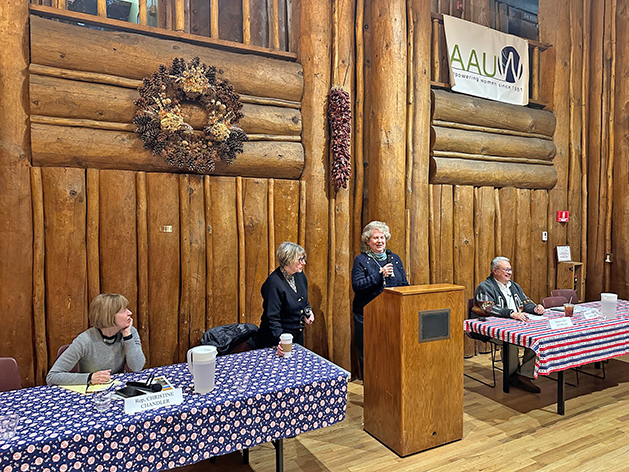
 From left, Rep. Christine Chandler, moderator Margo Batha, League of Women Voters of Los Alamos First Vice President Leslie Wallstrom and Sen. Leo Jaramillo participate in the 2026 Legislative Preview Thursday evening at Fuller Lodge. Photo by Kirsten Laskey/ladailypost.com
 Los Alamos resident Morrie Pongratz asks legislators how best to address the state’s shortage of healthcare professionals during Thursday’s Legislative Preview in Fuller Lodge. Photo by Kirsten Laskey/ladailypost.com
By KIRSTEN LASKEY
Los Alamos Daily Post
kirsten@ladailypost.com
As the next 30-day New Mexico legislative session approaches, the state’s healthcare issues appear to be at the forefront of both constituents’ and legislators’ minds.
Residents voiced concerns about problems plaguing healthcare in New Mexico and Sen. Leo Jaramillo and Rep. Christine Chandler discussed ways they think these problems could be resolved during the 2026 Legislative Preview hosted Thursday evening by the League of Women Voters of Los Alamos (LWVLA) and American Association of University Women (AAUW) in Fuller Lodge. Sen. Roberto Gonzales was unable to attend due to the weather.
One of the major concerns for healthcare providers is medical malpractice lawsuits, Rep. Chandler said, adding that she spent the summer trying to understand that issue. She spoke directly to medical practitioners as well as looked at what other states did, particularly Colorado, due to its proximity to New Mexico, as well as the similarities the two states share politically and culturally.
“What I found out was we are out of alignment,” she said. “We are out of alignment with how Colorado addresses medical malpractice … they have guardrails … and they do have caps on punitive damages, and they also have a higher burden of proof.”
A major concern among New Mexico healthcare professionals is excessive punitive damage awards, Chandler said. As a result, she is working on a bill that will “cap punitive damages … it will also raise the standard of proof … and it will also not permit the pleading of punitive damages until the discovery is nearly completed.”
Punitive damages are just one issue; “we have a lot of challenges here in the state to bring in professionals,” she said.
Salaries tend to be lower, the state has a lot of Medicaid payers and there are concerns about schools in certain parts of the state; all these factors need to be considered, Chandler said.
Chandler said she will carry a very significant healthcare provider loan repayment program. She explained that the program could potentially be structured to offer almost double what she hears is being offered across the country. So, the state’s program would be in the $330,000 range for physicians if they commit to staying in New Mexico for four years. There would be a lesser package for other healthcare providers who do not carry the debt load that physicians do.
Another focus for Chandler is regulating artificial intelligence (AI). She has filed two bills to address AI consumer protection. One is a transparency bill. It would require any screening that utilizes AI, which is ripe for mistakes or bias, to provide notice to the person being screened that AI was used. Furthermore, if the screening led to an adverse effect, such as the individual denied a job interview or a loan, they would be allowed to know the reason for the decline, and the person could correct any incorrect information or appeal the decision.
There is also a chatbot component to her transparency bill. Chandler said the chatbot would regularly announce itself as being a chatbot.
Another big focus is the interstate licensing compact, Sen. Jaramillo said.
“What we are thinking with a bipartisan bill is that this will allow physicians to move from state line to state line with other states that have this compact and we’re hoping this can attract physicians to New Mexico …,” he said.
Jaramillo touched on some other bills he plans for this legislative session. One bill would ensure that funding would come to rural New Mexico’s acequias and land grants of $5-$8 million annually “to help them work on infrastructure projects, which primarily focus … on rural New Mexico.”
He added that he plans to carry a bill that would be a tax credit for companies to provide equipment to schools and help train teachers to build a curriculum around that equipment. The tax credit would be 5 percent of the equipment’s worth. It is envisioned that this would be a summer program.
Furthermore, Jaramillo said he plans to help allocate capital outlay funds to Los Alamos County for its housing efforts and emergency operations center. He added that he plans to assist the University of New Mexico-Los Alamos with any of its capital outlay requests.
Jaramillo finished his presentation by reading Gonzales’ statement regarding his priorities for the upcoming legislative session.
They included a comprehensive transportation bonding bill in partnership with the New Mexico Department of Transportation. This would authorize $1.5 billion in bonding structured as roughly $290 million a year and financed over 10 years. A key component is accountability – “projects would need to be fully identified and completed with no partial or unfinished projects funded through the bond,” Jaramillo said.
Additionally, Gonzales supports investments in local roads through the general fund. He is advocating approximately $155 million statewide for road improvements, including $5 million designated for rural areas. Gonzales also said he supports stable and ongoing funding for forest fire response and mitigation. This includes expanding the number of full-time state hotshot crews. He would like to see six crews statewide. He also supports teachers and would like to see the state cover 80 percent of educators’ health premiums.
Citizens asked about issues with the state’s healthcare during the question-and-answer period of Thursday’s Legislative Preview. One attendee remarked on the shortage of physicians in the state.
Chandler reiterated the loan repayment bill she is planning to introduce during the 30-day session.
“I think it addresses many of the issues that have been raised …,” she said, emphasizing that “This is a long-term issue. Even if this bill gets through this year, it is going to be five years before we see the impact of the reforms associated with it. It’s not going to be next year. I also point out to you that there are shortages in 48 states … so we are competing for doctors. It is a seller’s market at this point. Physicians have choices, and we need to make the state a welcoming place for physicians … but that is not going to happen tomorrow.”
Jaramillo said he is excited about the medical licensing compact and further noted that there is discussion in the Senate for Gross Receipts Tax (GRT) credits for physicians “to be a way to keep physicians, to attract them to New Mexico …”
He added that there is also discussion underway for a significant rebuild of the University of New Mexico Hospital, as well as how to bring physicians to rural New Mexico.
Another attendee asked what could be done to provide transportation for senior citizens to receive medical care.
Jaramillo said he will keep this on his radar as the session begins. Chandler agreed, adding that she is interested in learning more about this issue.
In connection with senior citizens, another attendee asked about staffing in assisted living facilities and healthcare insurance access.
“…because of the activities at the federal level, subsidies … have been lost and because we have been very prudent and have been able to manage our wealth, we have invested, ensuring that we maintain subsidies for access to healthcare insurance …,” Chandler said. “It’s not a permanent fix; we need to be working on other ways to ensure that people have access to healthcare insurance and coverage … we are very fortunate in this state because we have set up with the governor to support people in that regard …”
Jaramillo also said the interstate licensing compact will hopefully help with staffing at assisted living facilities.
One participant asked about immunizations and whether legislation was needed to ensure continued access to immunizations.
Chandler credited Gov. Michelle Lujan Grisham for being proactive on public health policies but said she would investigate the issue.
Jaramillo agreed.
“We had a governor who understood the importance of immunizations … we need to have it documented for the next governor who comes in …,” he said.
Another participant asked about not charging GRT on medical services.
“A reason why we haven’t adopted an across-the-board GRT on medical services is the estimates,” Chandler said. “One hundred million dollars on the state level would be the hit, last time I heard, and remember that impacts local government as well as because they will lose those tax revenues also, so there needs to be some way to backfill those revenues. We are going to do targeted relief in terms of GRT, so things like co-pays, there will be some relief …”
Jaramillo said there has been some talk about breaks on medical GRT, but the details are not yet known.
The 30-day legislative session is scheduled to begin Tuesday, Jan. 20 in Santa Fe.
 Scene of the 2026 Legislative Preview hosted by the LWVLA and AAUW Thursday evening in Fuller Lodge. Photo by Kirsten Laskey/ladailypost.com