
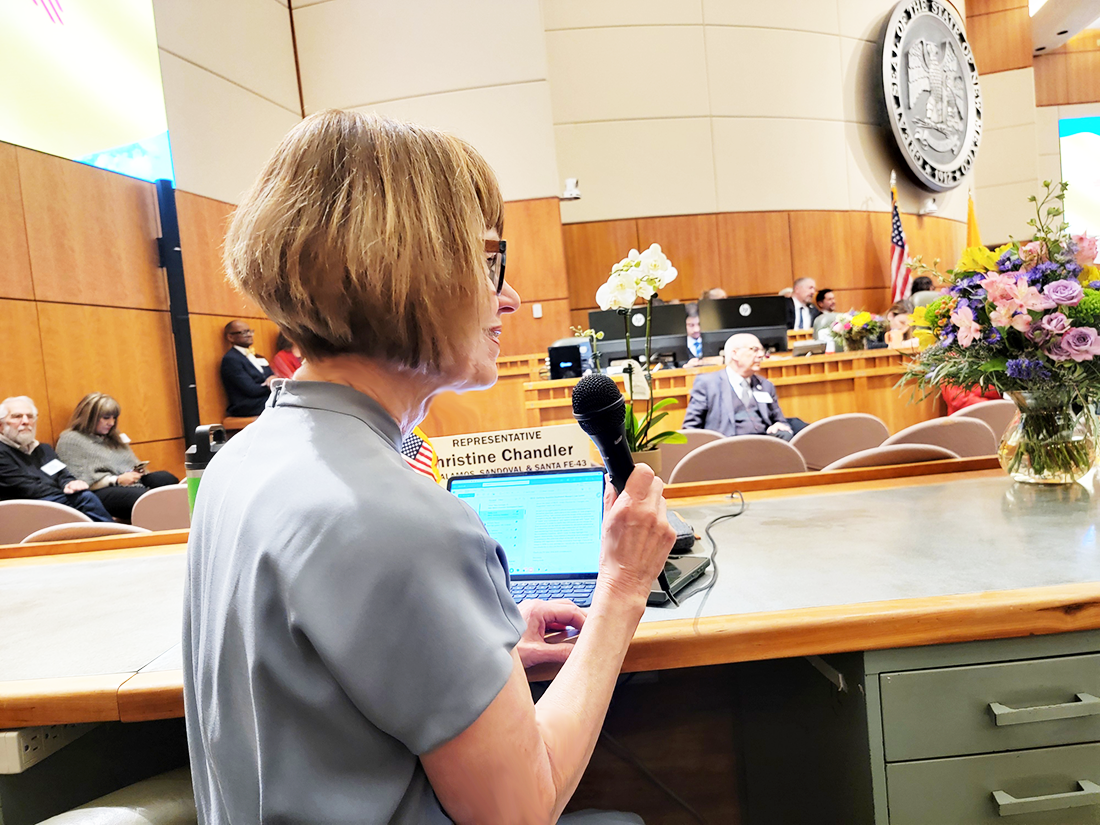
 Rep. Christine Chandler of Los Alamos chairs the House Judiciary Committee. She is shown here on the House Floor at the opening of the 60-Day Session, Jan. 21 at the Roundhouse in Santa Fe. Photo by Carol A. Clark/ladailypost.com
By DANIEL J. CHACÓN
The Santa Fe New Mexican
As the state House of Representatives prepares to take up a crime package as early as Saturday, Gov. Michelle Lujan Grisham is expressing her support but calling on lawmakers to do more to improve public safety in New Mexico.
The crime package, after all, consists of only six bills.
“I support these bills and appreciate the House’s quick work on this public safety package — but New Mexicans are demanding more,” Lujan Grisham said in a statement.
“Bills still pending in the Senate would address violent crime, gun crimes and serious issues related to juvenile offenders, but most are not yet scheduled for hearings,” she said. “I hope the Senate will hear these bills soon and help us produce the most comprehensive and effective public safety package possible.”
Ben Baker, the governor’s senior public safety adviser, said House Bill 8 represents “a portion of much-needed things within a public safety construct”.
“I am pleased that there is bipartisan support on the topics that have been identified, but I will tell you that I think in no way is this a comprehensive measure of where we want to end up,” he said in an interview Friday.
“I think it’s a great place to start,” Baker said, adding he was pleased with several bills in the package. “However, I think there is much work left to be done, and I’m very much looking forward to the same kind of traction occurring during the remaining time in this session.”
Lujan Grisham is hoping at least 10 other public safety bills reach her desk, though Capitol insiders predict some of them, such as Senate Bill 279, which would ban the sale or transfer of semiautomatic rifles, are unlikely to cross the finish line.
Other bills include increasing the penalty for being felon in possession of a firearm to a second-degree felony with a minimum prison sentence of nine years and expanding the list of offenses that constitute racketeering, such as human trafficking and sexual exploitation of a child.
“I want these crime bills to make their way through this process and be on the governor’s desk so that she can sign them into law,” Baker said.
“It is our goal that the public safety-related bills are not confined to just the things that are contained within House Bill 8 … and that there are other stand-alone bills,” he said, adding, “there’s still work to be done relative to what we’re going to do with our increasing violent juvenile gun problem” in New Mexico.
Eyes on juvenile crime
Second Judicial District Attorney Sam Bregman, who is proposing sweeping changes to the state Children’s Code, including expanding the definition of a “serious youthful offender”, told KOB-TV this week “the most significant thing we could do on crime” is amend the Children’s Code to deal with an “unbelievable spike” in juvenile crime.
“If they don’t pass anything when it comes to juvenile crime, I think it leaves a big hole in a lot of people’s guts about what’s going on here because this is a real problem,” said Bregman, a Democrat whose district includes Albuquerque, where officials have noted in particular a sharp increase in violent crime among juveniles.
The governor’s call for lawmakers to give her other top-priority public safety bills a fair hearing comes after some House Republicans continued to complain the crime package doesn’t address juvenile crime.
“We really need to address what the big problem here in the state of New Mexico is, and that’s juvenile crime,” Rep. Andrea Reeb, R-Clovis, said during a news conference Thursday.
“I was disappointed that we weren’t able to get that into this package or I think we would have had a lot more bipartisan support on these issues because, let’s face it, this is the problem we’re having not only in Albuquerque but in rural districts across the state,” added Reeb, a former prosecutor.
“We’ve got to get this juvenile crime under control,” she said. “We’re going to be back here in a year or two years dealing with this issue again because we’re not doing what New Mexicans need us to do, which is actually pass a crime package that is going to deal with crime.”
Rep. Nicole Chavez, R-Albuquerque, whose son, Jaydon Chavez-Silver, was shot and killed in a drive-by shooting in 2015, said the crime package “does not do enough”.
“I cannot help but feel overwhelming frustration,” she said. “We are failing to fully address one of the most urgent issues and painful issues of this state: juvenile crime. I think we need to do better. … I feel like here we are again, kicking the can down the road.”
House Minority Whip Alan Martinez, R-Bernalillo, noted the 60-day session is almost at the halfway point and said lawmakers are considering a crime package that “is not really going to solve a lot of problems”.
“We can’t keep saying every year we’re going to deal with crime and then leave here and say, ‘Well, we tried,’” he said. “We need to have a little bit of political courage and say, ‘This is the issue that New Mexicans are facing. Here’s some commonsense solutions on how to take care of that.’”
Martinez called the crime package “window dressing”.
‘A process for vetting bills’
Rep. Christine Chandler, D-Los Alamos, who chairs the House Judiciary Committee, said after the House Republicans’ news conference the bill dealing with juvenile offenders is still on the table.
“We have a process for vetting bills, and it’s a committee process,” she said, adding House Bill 134 is awaiting that process.
“Are we open to that bill? Yes, of course we are,” she said.
Chandler said the approach to juvenile crime is different than how the state addresses adult offenders.
“We should first look to rehabilitate them,” she said of youth offenders. “Someone that young, we don’t want to give up on them. We want to look for ways to bring them back into society and be productive citizens.
“I’m not saying that some of the changes may be necessary,” she added. “The world has gotten more violent and scary, I agree, but we still have to be very thoughtful about how we approach young people in the criminal system, and we’re not just going to pick up a bill that hasn’t been vetted, slap it into a package and say, ‘We’re good’ … it’s just not going to go that way.”
Chandler said she was disappointed Republicans voted against the crime package this week in the House Judiciary Committee, which she chairs, even though they sponsored some of the bills that were included.
“We’ll see how it plays out on the floor,” she said. “But I think the logic is a little off, you know. No legislation is perfect.”
Crime bills backed by governor
While Gov. Michelle Lujan Grisham supports a crime package the House is scheduled to consider on the floor as early as Saturday, she’s hoping lawmakers will pass 10 other public safety bills on her priority list.
They include:
- Senate Bill 253, which would increase the penalty for being a felon in possession of a firearm.
- Senate Bill 279, which would ban the sale or transfer of semiautomatic rifles and also prohibit the manufacture and sale of magazines that hold more than 10 rounds.
- Senate Bill 32, which would establish the crime of unlawful possession of a stolen firearm.
- Senate Bill 35, which would establish that shooting at a motor vehicle and shooting from a motor vehicle are distinct criminal offenses.
- Senate Bill 228, which would make it a fourth-degree felony for a person to enter a retail establishment with the intent to commit a felony or theft after that person received notice they were not authorized to enter that retail establishment.
- Senate Bill 70, which would expand the list of offenses that constitute racketeering.
- Senate Bill 196, which deals with rebuttable presumption against the release of certain types of defendants.
- Senate Bill 153, which would create the crime of home invasion as a second-degree felony.
- Senate Bill 154, which would limit a court’s ability to defer the sentence of a person who commits a traffic violation.
- Senate Bill 166, a companion piece to a criminal competency measure, would expand the definition of “harm to self” and “harm to others”.