
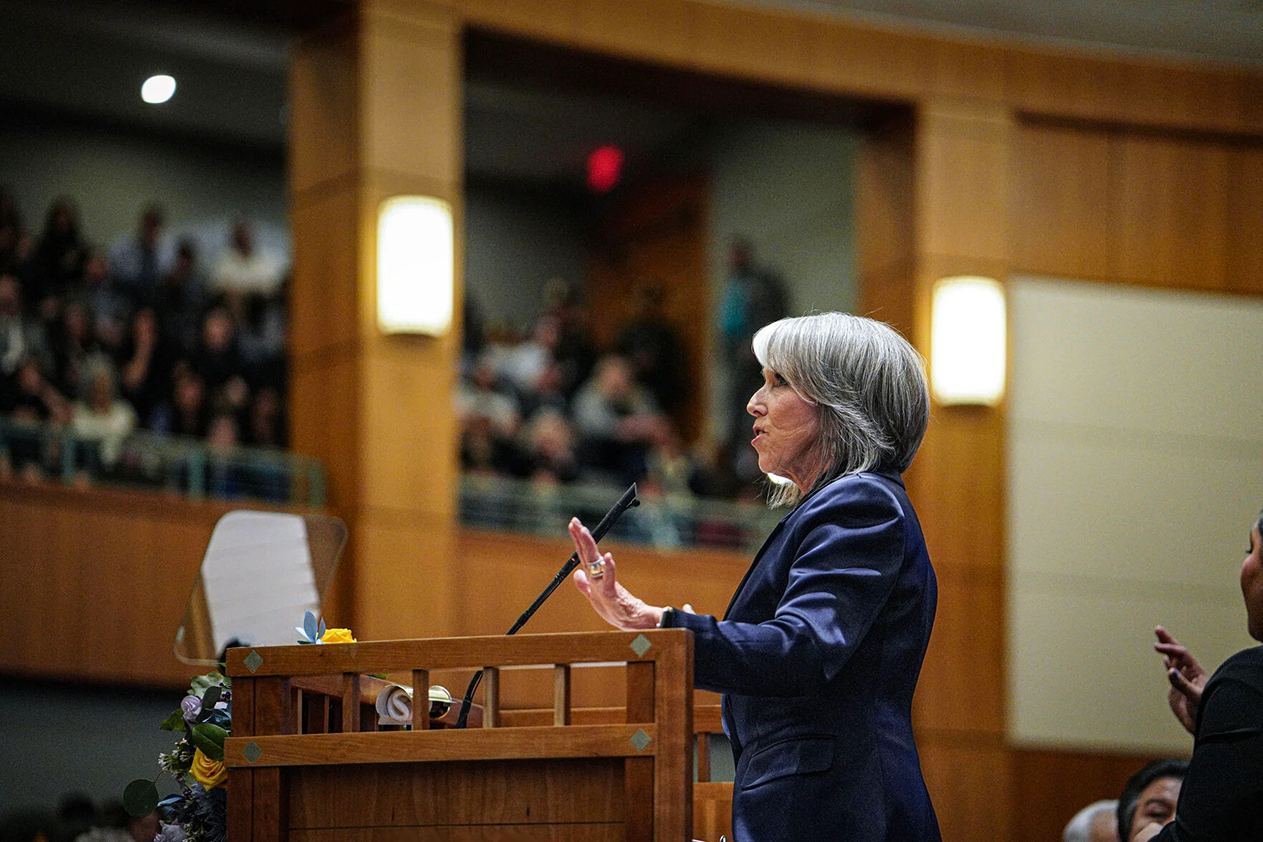
 Gov. Michelle Lujan Grisham delivers her State of the State address at the state Capitol on Tuesday, Jan. 21, 2025, the first day of the 2025 legislative session. She called for changes New Mexico’s law governing how to treat babies born with drugs in their system amid low uptake with care plans prescribed to families. Gabriela Campos/The New Mexican
By ESTEBAN CANDELARIA
The Santa Fe New Mexican
In the past, the state Children, Youth and Families Department has opposed changes to New Mexico’s law governing how to treat children born with drugs in their system, arguing it was the best agency to manage the law and that treatments prescribed under it should not be mandatory.
But during her State of the State address kicking off this year’s legislative session on Tuesday, Gov. Michelle Lujan Grisham made something of an about-face on the agency’s previous positions, calling for families to follow through on treatment plans and for the state Department of Health to take the lead on managing the law instead.
The shift came as something of a surprise to House Minority Leader Gail Armstrong.
“I gave her a standing ovation,” Armstrong, R-Magdalena, said in an interview. “I was thinking she’s ready to do something, but I wasn’t 100% sure that was the piece she was willing to do.”
Families are not required to follow through on treatment services referred to them under New Mexico’s law related to the federal Comprehensive Addiction and Recovery Act, and many don’t, prompting attempts by Republican lawmakers to require families to participate in services.
So far, they have been unsuccessful.
CYFD has previously opposed making treatment services mandatory, arguing doing so could make them feel punitive and thus discourage families from taking part. On Wednesday, an agency spokesperson deferred comment to the Governor’s Office.
During her address, Lujan Grisham said the change was needed because “too many families do not adhere to the spirit of that program.” Spokesperson Jodi McGinnis Porter said in a written statement that making care plans mandatory would ensure accountability when children are exposed to drugs.
“It’s now necessary to move towards mandatory engagement to underscore the urgency that New Mexico places on addressing substance use issues, providing a clear pathway for treatment, and protecting the most vulnerable populations,” she wrote.
Lujan Grisham also said the state would move responsibility of CARA to the state Department of Health, “where public health experts are best equipped to support families with drug-addicted babies.”
Taking the responsibility away from CYFD is also an idea the agency has opposed, arguing the child welfare department can provide direct services to children and families regarding child safety, parenting education and substance misuse treatment.
In the past, legislative analysts have recommended making the Health Care Authority the lead agency on CARA, noting it has direct oversight over Medicaid managed care organization care coordinators, who would in large part be responsible for CARA plans.
Analysts have noted the Department of Health has the advantage of direct relationships with hospitals, birthing centers and other providers, and McGinnis Porter said the Department of Health already handles components of CARA for uninsured New Mexicans. She said it makes sense to move management of the legislation to the agency as part of a broader public health approach.
A recent reform bill endorsed by lawmakers on the Legislative Finance Committee proposed to make the Health Care Authority the lead agency on CARA. There’s little indication, though, that the governor’s proposal and the committee’s proposal will clash. Armstrong, who will help carry the committee’s bill, said she was willing to make the Department of Health the lead agency.
“We’re willing, and I believe my whole caucus is willing, to do whatever it takes to make something good happen,” she said. “… I just want to make a change that’s measurable.”
The Health Care Authority threw its support behind the move.
“As the state’s primary public health and maternal-child health agency, NMDOH can offer resources and referrals to programs and providers that respect family’s needs, priorities, and values,” spokesperson Marina Piña wrote in an email.
Esteban Candelaria is a corps member with Report for America, a national service program that places journalists into local newsrooms. He covers child welfare and the state Children, Youth and Families Department. Learn more about Report for America at reportforamerica.org.