
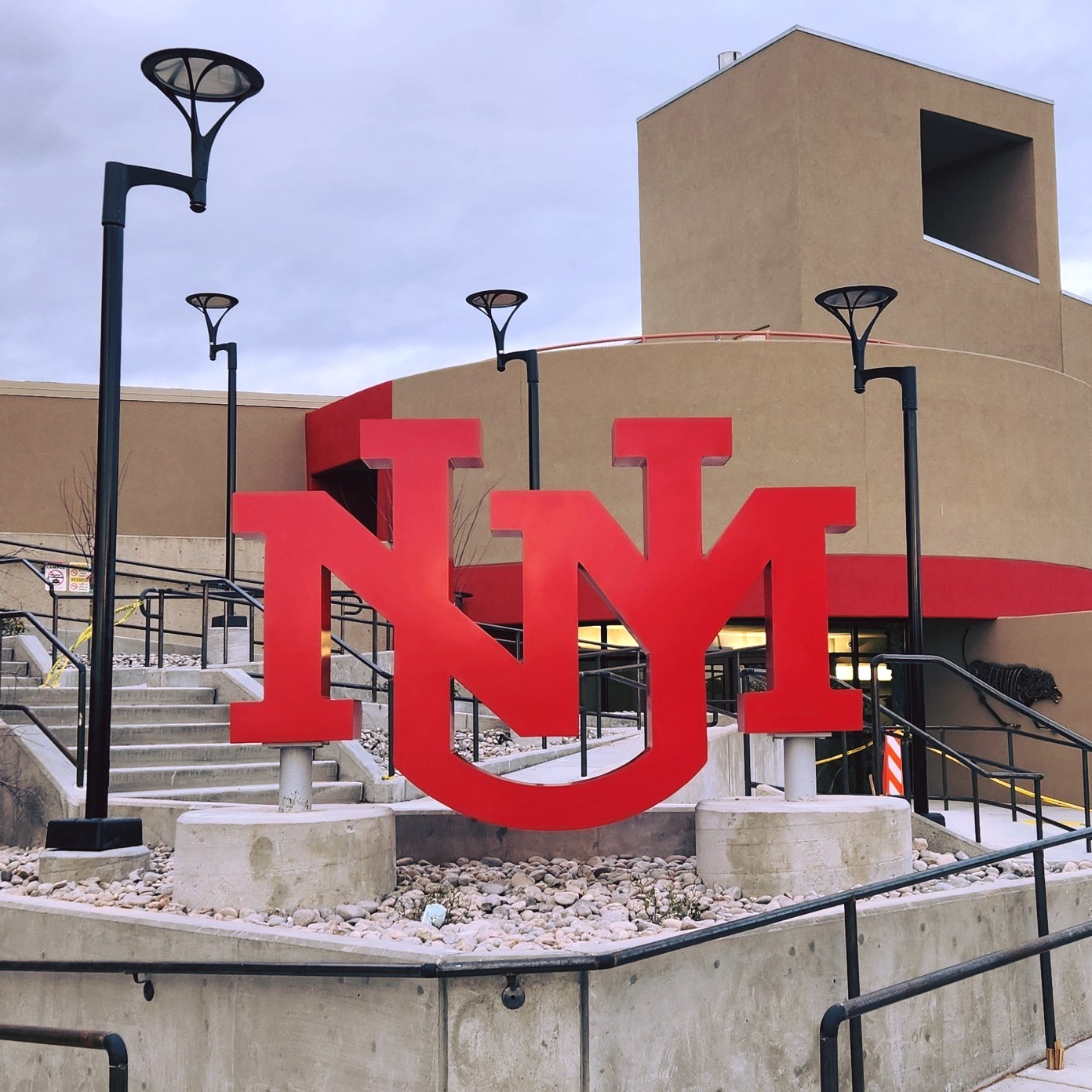
 Construction nears completion at the UNM-LA front entry. Funding comes from statewide and local general obligation bonds passed by voters in the county in Nov. 2024. Courtesy photo
By MARLENE WILDEN
Los Alamos Daily Post
marlene@ladailypost.com
University of New Mexico-Los Alamos (UNM-LA) is undergoing the most visible transformation in its recent history, a $12 million campus upgrade that Chancellor Mike Holtzclaw calls both practical and symbolic.
At its core, the effort fixes roofs, replaces windows and repairs aging structures. It also prepares the campus for workforce-focused programs that support local employers, including LANL and regional businesses.
Asked whether UNM-LA is in a phase of growth, modernization or stabilization, Holtzclaw said simply, “Yes—all of that. We’re making our campus safe, accessible and visibly worthy of a UNM education.”
A Community-Backed Investment
The renovations are fueled by strong voter support. In November 2024, 73% of Los Alamos County voters approved a $3 million local general obligation bond, unlocking roughly $9 million in state matching funds and forming the backbone for the latest campus upgrades.
Voters also approved a separate statewide bond that added $1 million to help offset rising construction costs.
The local bond added a 0.501 mill levy to residential and commercial property taxes. For a typical Los Alamos County home valued at about $590,000, that amounts to roughly $98 per year.
County officials said if the college requests a renewal after the current bond is spent, the levy would remain the same; if rejected, that portion would expire, and property taxes could decrease, assuming the tax base does not change.
The County’s recently released FY2025 Popular Annual Financial Report shows UNM-LA currently accounts for 7% of property tax revenue.
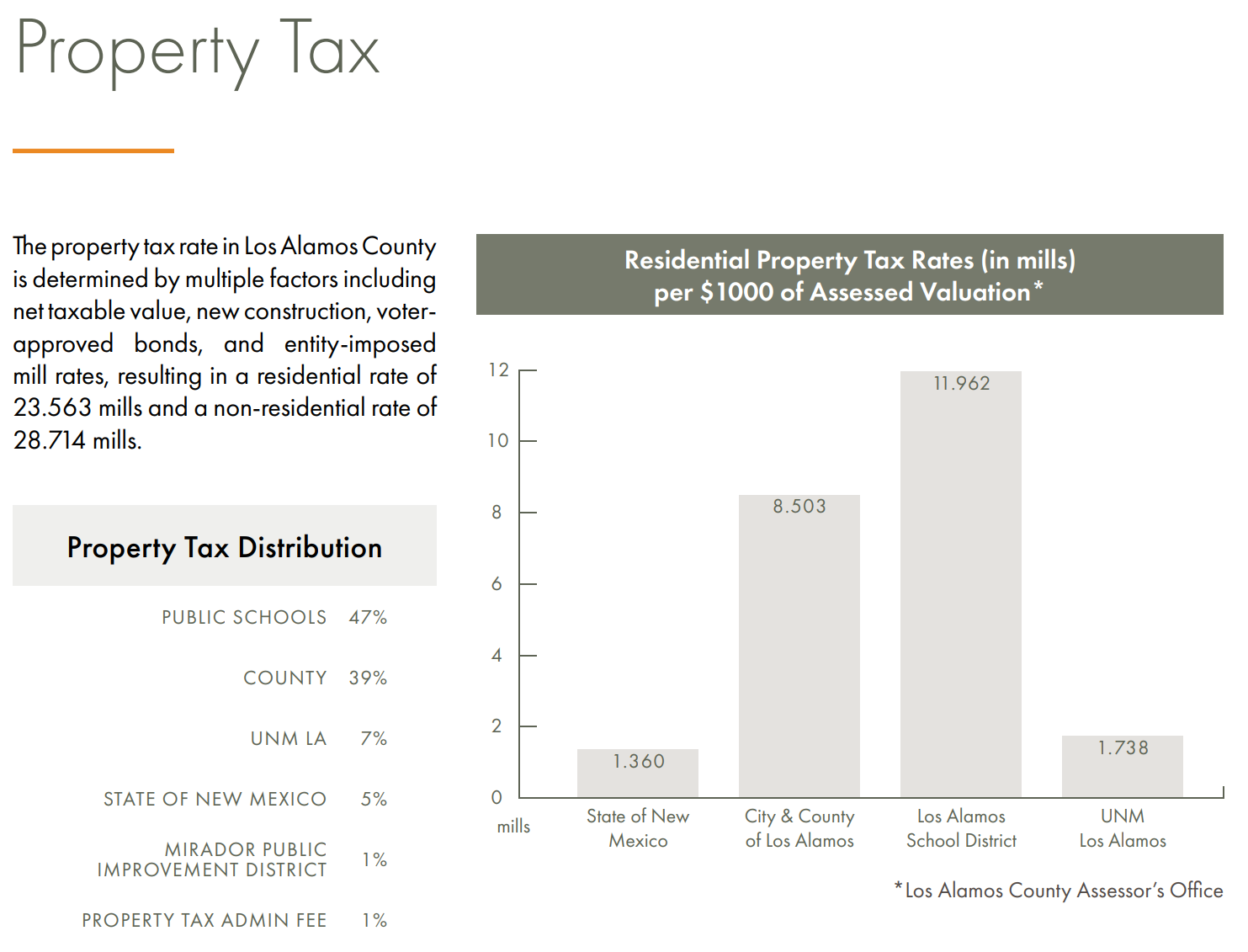 Los Alamos Popular Annual Financial Report (PAFR) for Fiscal Year 2025
The bonds are being braided with prior state appropriations and County capital allocations to tackle long‑deferred maintenance and accessibility problems, while a separate federal Title V grant has helped modernize campus technology. So far, $8.8 million has been spent.
Fixing the Infrastructure
A $2.5 million overhaul of the main classroom building, finished in fall 2024, fixed roof leaks and modernized offices, allowing faculty and staff to expand in-person instruction.
Two unused restrooms will be converted into locker rooms with showers to support new fitness courses, with plans for a workout room. Design is nearly complete, and construction is expected to begin late this semester.
In 2025, the lecture hall and conference rooms received a new roof, stucco repairs, exterior paint, LED lighting, and new windows and doors to address energy loss and water intrusion. Basement-level replacements and bathroom upgrades remain pending as part of the same capital cycle. Sen. Leo Jaramillo and Rep. Christine Chandler secured an additional $508,459 for the projects through the NM GRO Fund.
The computer and science labs underwent a $3.2 million roof replacement in summer 2025, ending longstanding leaks, along with updated lighting, flooring and paint. Roof repairs at the electronics and robotics makerspaces stopped active leaks, though a full replacement still requires $150,000 in capital outlay funding awaiting the governor’s approval.
A $3 million state funding request for student services renovations is also pending; if approved by the governor, the funds would be available in July.
Building for Hands-on Careers
Modernization also supports workforce-aligned programs. The welding and machine shop underwent a $2.5 million renovation and expansion in spring 2025, adding upgraded ventilation, HVAC improvements and a new transformer to support technical programs. A separate $461,694 project will convert half of a maintenance building into two new ceramics and art studios, with construction set to begin in May and finish before the fall semester.
College officials say the projects lay groundwork for future programming. UNM-LA is in the early design phase of artificial intelligence literacy training for current workers and is exploring longer-term certificate or associate degree programs in the field.
The college is also assessing local demand for expanded pathways in high-need construction trades. Holtzclaw estimates a three- to five-year timeline for implementation.
“The future of work in this town includes AI, advanced manufacturing and lab-adjacent technical roles,” Holtzclaw said. “We want our students, whether they go straight into the workforce or transfer, to be ready for that.”
Reimagining the Campus Core
The centerpiece is the $5.5 million Open Space Project, a two-phase redesign of the campus core. Of that total, $1.5 million is funded by the local bond.
Phase 1 rebuilt the front entry from Diamond Drive, adding ADA-compliant ramps and stairs, parking improvements, landscaping, lighting and signage. Construction is expected to be finished by the end of the month, with additional landscaping wrapping up the project by mid-semester.
 A rendering of Phase 1 work at the UNM-LA campus. Courtesy photo
Phase 2 began over winter break and is expected to take about 10 months. It will rework the hardscape and landscaping of common areas, transforming the central courtyards into collaborative study and event spaces with shade structures and outdoor furniture. The goal is to turn a once-pass-through area into a vibrant gathering place.
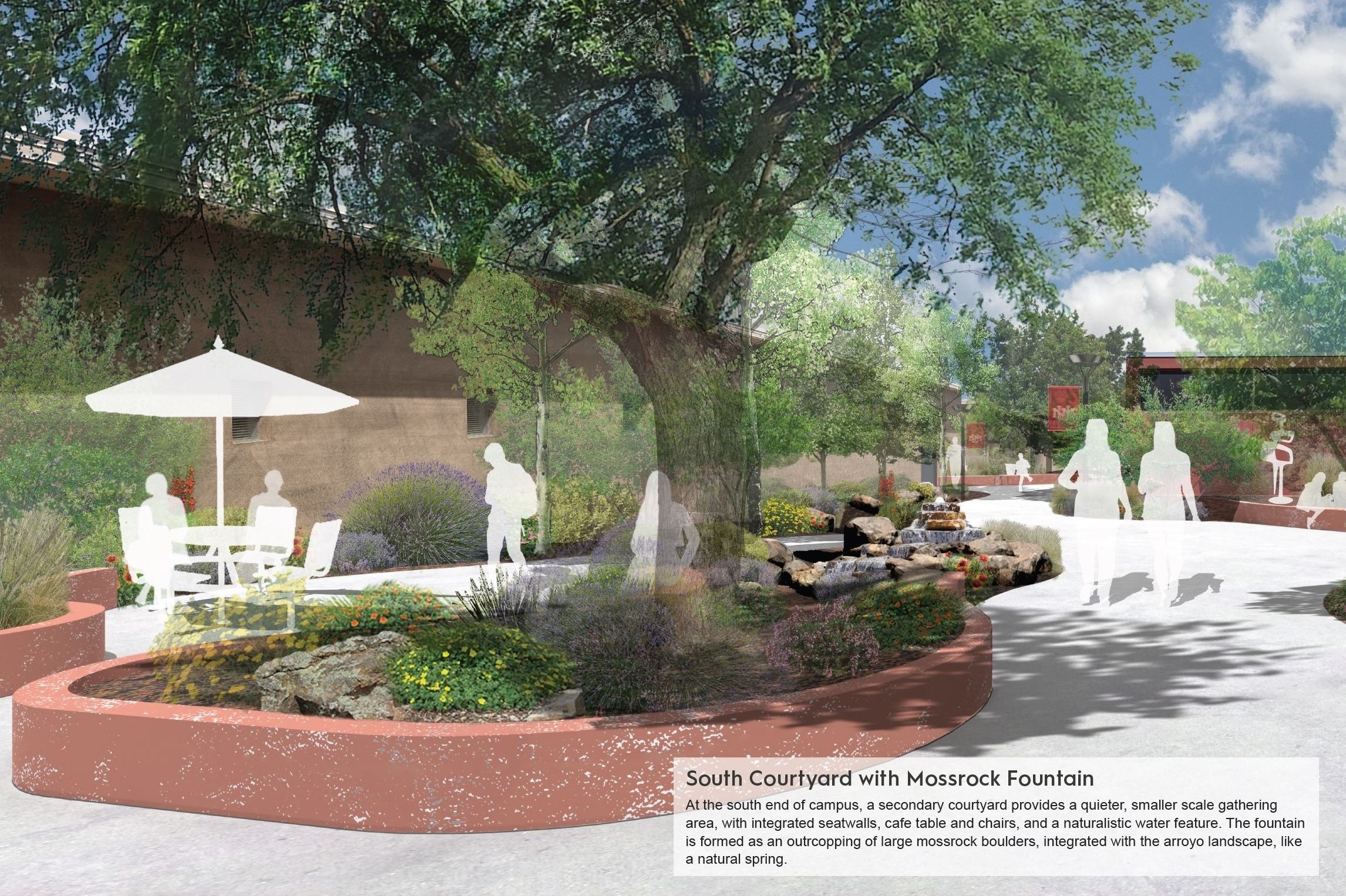 A rendering of Phase 2 work at the UNM-LA campus. Courtesy photo
Holtzclaw said the redesign helps the campus feel like a “real university environment” rather than a cluster of aging concrete buildings.
Changing Perceptions, Keeping Talent Local
UNM-LA plays a key role in dual-credit and career pathways for Los Alamos High School, aligning programs so students can begin coursework in high school, complete degrees locally and move directly into jobs. Holtzclaw said the state expects K-12 schools to offer more career and technical education, and higher education institutions are being pushed in the same direction.
But Holtzclaw acknowledges a bias: many students see community college as a “second choice” compared with selective four-year universities—even when the eventual degree bears the same UNM name. By improving facilities, the college hopes to elevate the appeal of a “financially savvy” pathway: two years close to home at lower cost, followed by transfer to UNM or another university.
“When the campus looks and feels comparable to, or better than, the high school students are leaving, that choice becomes more attractive,” he said.
Why It Matters Beyond Campus
Local accounting firms regularly hire UNM-LA students. LANL technicians advance into engineering roles through further study. Non-degree learners in ESL and adult education programs gain skills that allow them to enter or advance in the workforce.
While UNM-LA serves about 1,000 students, full-time equivalent enrollment is about a third of that. Most current students are non-traditional, often older than typical undergraduates and balancing college with work and family. About 43% come from surrounding counties, where more than half of 16‑ to 19-year-olds are neither in school nor working, according to the June 2025 labor market review from the New Mexico Department of Workforce Solutions. The New Mexico Legislative Finance Committee cites rising tuition and fees as a reason some will forgo college.
National data mirror these local challenges. The Federal Reserve Bank of St. Louis reports that about 16% of U.S. young adults ages 18 to 24 are “disconnected” from work or school. Analysts estimate the lifetime economic impact of Gen Z NEETs—those not in employment, education or training—runs into trillions of dollars in lost earnings, missed tax revenue and added public costs.
Holtzclaw said voter-backed capital improvements are key to attracting and retaining students and keeping economic opportunity circulating locally. He said UNM-LA’s upgrades treat early-career learners as strategic infrastructure, not an afterthought.
“Facilities don’t make a great education—our faculty and support staff do—but they send a message about how much we value students,” he said.