
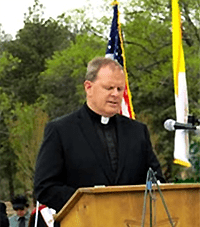
 By Fr. Glenn Jones:
Remember the old TV back in the pre-internet days? We were the “remote control” (“Glenn: get up and turn it to channel 12. And adjust the rabbit ears.”). Ah, the old black and whites. Horizontal and vertical controls. The stations signing on in the morning and off at night with the national anthem. The radio announcement: “It’s 10 o’clock. Do you know where your children are?” The old shows like Gunsmoke, Laugh-In, Get Smart, Bonanza, Hee Haw, Star Trek (what a legacy THAT one has had!). And one of my favorites was Adam-12, which centered around two Los Angeles police officers on patrol. And the logo on the side of their car always resonated so that I remember it to this day: “To Protect and to Serve…”
Good motto, that one … incorporating many of the virtues admired throughout history.
Let’s look a moment at “protect”. The biblical call to protect the vulnerable begins with the nature of God, who is described as a “father to the fatherless” and a “defender of widows” (Psalm 68:5). Every human being is created in the image of God, so oppression or assault on the innocent is an offense not only against the victim, but against their Creator. Their Father. So when we stand between oppressor and victim, we are acting as the hands and feet of God who “loves righteousness and justice” (Psalm 33:5), for we are taught by scripture (and by any beneficial philosophy) to “Give justice to the weak and the fatherless; maintain the right of the afflicted and the destitute. Rescue the weak and the needy; deliver them from the hand of the wicked.” (Psalm 82:3-4).
In the opening pages of the Bible, the fratricide Cain who had just murdered his brother Abel is confronted by God and asks a question which is pertinent even today: “Am I my brother’s keeper?!” (Genesis 4:9). As we read scripture, especially the New Testament, the answer is a rather resounding “Yes”—most particularly in the protection of the innocent. As one continues to read the first books of the Bible, protecting the innocent is framed as a moral and legal obligation, and as we read on, we see it is a fundamental reflection of the character of God and a primary responsibility of a person of faith.
Now, as we move on to the theme of “service”, we have example in this Sunday’s reading from the Acts of the Apostles (6:1-7) concerning what the Catholic Church sees as the first selection of deacons to assist in serving the people of God. Chosen by the apostles (the first bishops), these men’s work allowed the apostles to focus on teaching, administration of the Church and the celebration of what we now call sacraments. In that beginning, the deacons primarily assisted in the distribution of the Eucharist and physical necessities to those in need. But over time, their role has expanded such that Catholic deacons, too, now celebrate the sacraments of baptism and matrimony. Always their role, however—then and now—is as Jesus said of Himself: “… not to be served, but to serve” (Matthew 20:28).
Catholic priests, too, are first ordained as deacons in their “transitional diaconate”, with priestly ordination building upon that initial foundation, and ordination of a bishop builds upon that of the priest—each degree or ordination increasing not only responsibility, but accountability. But always that bedrock obligation of service remains, and the wise ordained keeps uppermost in his mind Jesus’ caution: “Every one to whom much is given, of him will much be required.” (Luke 12:48).
The apostles’ appointment of deacons to serve teaches us that biblical Church organization is not about power or prestige, but rather about the stewardship. The Apostles organized their fledgling community not in a hierarchy of importance, but in a hierarchy of service. By delegating these first deacons for service, they ensured that the physical needs of the community were met with the same spiritual dignity as the preaching of the Word. The result was clear in our reading: “The word of God continued to spread, and the number of the disciples in Jerusalem increased greatly.” (Acts 6:7).
Now, the obligation to service, of course, is certainly not only for deacons, priests and bishops, but rather for all true disciples of Jesus. Each believer is a “living stone” building up the Church of Christ. But a stone lying alone in a field serves little purpose. It is only when the stones are organized around the “cornerstone”—Jesus Christ—that they become a temple where God dwells.
In the Mass second reading for today (May 3 this year), Peter describes the Church as a “chosen race, a royal priesthood, a holy nation,” which elevates even more so the concept of service, the cornerstone being Christ Himself. So, how do we fulfill such a privilege … such an obligation?
Remember Jesus telling us that He came “not to be served, but to serve”? Well, He tells us explicitly: “… he who believes in me will also do the works that I do; and greater works than these will he do,” (John 14:12). But how can a group of fallible human beings perform “greater works” than the Son of God?
The answer lies in the Church as the Body of Christ. While Jesus, in His earthly ministry, was physically limited to one place at one time, the Church—organized and empowered by grace—can perform the “greater work” of carrying the Gospel to the very ends of the earth, and now allows Christ’s ministry to be multiplied across time and the world.
We may not be able to heal with a word or raise the dead, but He guides us foretelling aspects of our life’s judgment at our end: “Come, O blessed of my Father, inherit the kingdom prepared for you from the foundation of the world; for I was hungry and you gave me food, I was thirsty and you gave me drink, I was a stranger and you welcomed me, I was naked and you clothed me, I was sick and you visited me, I was in prison and you came to me.” (Matthew 25:34-36).
Jesus tells His disciples, “I am the way and the truth and the life.” To be organized according to “the Way” means that our methods must match Christ’s methods—characterized by humility, sacrifice, and service. With faith in our hearts and works in our hands, we remember and anticipate the fulfillment of Jesus’ words in the Mass Gospel today: “In my Father’s house there are many dwelling places…I go and prepare a place for you, [and] I will come back again and take you to myself, so that where I am you also may be.” (John 14:2-3).
Editor’s note: Rev. Glenn Jones is the Vicar General of the Archdiocese of Santa Fe and former pastor of Immaculate Heart of Mary Catholic Church in Los Alamos.