
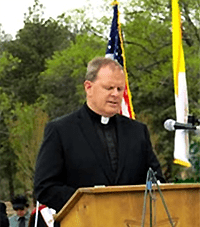
 By Fr. Glenn Jones:
Been having to do a few funerals lately in the little parish which I pastor on top of my main ministry, the latter being largely administrative (sigh). In large parishes, it’s normal to have one to several funerals each week, so I have it “easy” in that regard. We lost one of our archdiocesan priests on Good Friday, and a religious Sister working in Albuquerque a few days ago, too. Many priests and ministers live adjacent to cemeteries as well, and it helps to keep that inescapable reality always near to mind. Also, since Catholics and many other Christians pray for the dead, it helps them remember their duty to pray for those who have gone before—that God embrace them in His great mercy and love for all eternity.
Such times never fail to elicit thoughts of each of our own inevitable ends. But many people refuse to even think about their future passing through the portal of death. Not infrequently we hear of those who refused to draft a will, as if they thought that the process of doing so would somehow speed their demise. That idea happens with Catholic last rites, too: “Don’t call the priest yet! If he gives me the last rites, I’m dead for sure!” Such fears would be almost comical if they weren’t so serious.
But we needn’t fear death, and I don’t think most of us do, really; what we fear is “painful death, or a useless death, or a cowardly death—or, perhaps even more so, having lived a purposeless life. But a life of purpose in no way has to be one of fame or fortune; even the atheist will see that a good life is one centered on kindness, graciousness and charity, working for the betterment and succor of both individuals and the world. This is where true greatness lies, hidden as it might be. Whether feeding the world or simply nursing a secluded aged relative, each such life and work become a blessing, not unlike the Talmudic proverb: “Whoever saves one life saves the world entire” (Sanhedrin 4.5).
Yet, we’d be remiss in ignoring the “flip side”—the consequence of not living a good life. In mere material terms, the result might be that some actually find relief, or even joy, at our passing from this life. An abuser? Thief? Hate-monger? Miser? Bigot? Now, the Christian belief is that no one can judge the soul except God, remembering St. Paul: “Who are you to pass judgment on the servant of another? It is before his own master that he stands or falls.” (Romans 14:4). But many people tend to judge the worth of other’s lives nonetheless—often giving ourselves a pass for our own faults.
But, much more importantly there is the spiritual side of how we live our lives. Most Christians do believe in the last four things: Death and judgment, heaven and hell—the latter two being the eventual and final destinations for all—one or the other—subject to God’s judgment. Speaking about such things doesn’t make a person popular; people much prefer a tickling of their ears. But Jesus spoke of them often as reality to be faced.
The Christian’s concern is avoiding hearing words such as the prophet Daniel interpreted from the “writing on the wall” to the Babylonian king Belshazzar: “You have been weighed in the balances and been found wanting.” (Daniel 5:27). What might that “wanting”—that deficiency or defect—be? Would it be the lack of real faith in Christ? After all, Jesus Himself chastises some followers: “Why do you call me ‘Lord, Lord,’ and not do what I tell you?” (Luke 6:46), and in His pivotal Sermon on the Mount: “Not every one who says to me, ‘Lord, Lord,’ shall enter the kingdom of heaven, but he who does the will of my Father who is in heaven.” (Matthew 7:21). And what is that will? To love God and neighbor. To succor those in need or those who are hurting (see Matthew 25, most especially where He tells us who will be saved and who will be condemned). To forgive one another’s faults and transgressions.
So, if we look at our lives and wonder whether we will be found “wanting”, it’s high time to make changes. We don’t have to commit ourselves to Herculean tasks; we simply need to be more selfless and take advantage of opportunities for charity and kindness—works which even atheists instinctively (we might say spiritually) admire. Because God is love, and each act of true selfless charity is an act of love, each such work we do is both a movement of God within us and a participation in Him—like a sip from a never-exhausted spring.
To conclude, Jesus tells us repeatedly in the Gospels: “Watch! You know neither the day nor the hour!” … of our death and going to God. And if we’ve lived long, we’ve seen this played out many times: friends and family taken suddenly and unexpectedly. Remembering this, we conform the old saying to spiritual purpose: “Carpe Diem!”—Seize the Day! Not in selfish pleasure seeking, but in molding our lives increasingly toward the good, knowing even if we have lived a dissolute life to this point, the Father never stops watching for the Prodigal to come home—to come home in conversion and goodness and be welcomed into His eternal embrace. And when we start down that path to home, we can begin to say with St. Paul: “Death is swallowed up in victory. O death, where is thy victory? O death, where is thy sting?” (1 Corinthians 15:54-55).
————————————————————–
“For he will render to every man according to his works … There will be tribulation and distress for every human being who does evil … but glory and honor and peace for every one who does good …” (Romans 2:6-10).
Editor’s note: Rev. Glenn Jones is the Vicar General of the Archdiocese of Santa Fe and former pastor of Immaculate Heart of Mary Catholic Church in Los Alamos.