
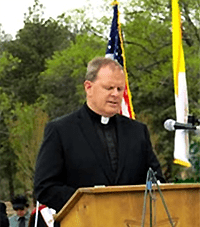
 Fr. Glenn Jones:
A very blessed and happy Easter and Easter season to all of you! And we ask for the same for the whole world. In these days of strife and division, what could be better than to have Jesus, the Prince of Peace, risen again to bring kindness, graciousness and charity to the hearts of all?
Ah, but what Catholic term as “concupiscence”—the “stain” of the turning away from God in Original Sin remaining even after baptism—keeps tending to weigh us down like a stone. How is it manifest? By our never-absent bickering, hatreds, jealousies, selfishness, along with all the negativities that we see in our world with one person against person, people against people, race against race, nation against nation. As St. Paul writes in contrasting destructive traits “of the flesh” vs the Godly traits “of the spirit”: “Now the works of the flesh are plain: immorality, impurity, licentiousness, idolatry, sorcery, enmity, strife, jealousy, anger, selfishness, dissension, party spirit, envy, drunkenness, carousing, and the like. I warn you, as I warned you before, that those who do such things shall not inherit the kingdom of God.”
Opposite of these are the favorable, beneficial and Godly spiritual works: “But the fruit of the Spirit is love, joy, peace, patience, kindness, goodness, faithfulness, gentleness, self-control … And those who belong to Christ Jesus have crucified the flesh with its passions and desires … Let us have no self-conceit, no provoking of one another, no envy of one another” (Galatians 5:19-26).
One need not even be Christian to recognize the wisdom of Paul’s words. In fact, are not the things that he proscribes the very things which destroy human communal unity, especially in that great building block of society: the family? We in New Mexico know that water weakens and disintegrates adobe bricks, and the negative traits above are like water to the bricks of families and communities at large. And as the family bricks fall, the whole edifice weakens, and soon the whole structure is in danger of collapse. And, of course, it is so much easier to destroy than to build or repair.
But, by His example and His grace, the divine builder gives us those tools of reconstruction of which Paul speaks of above, all rooted in the virtues of selflessness, humility and love of one another. What is possibly objectionable to love, joy, peace, patience, kindness, etc.? These are the most true and kingly of virtues.
If you ever read Plato’s “The Republic”, you’ll find that the governance system that he considered the best was by “philosopher-kings”—those who studied, knew deeply and would act only on what is beneficial for human society, having authority to act on that understanding. In reality, however, as we have witnessed in all of human history, power corrupts and absolute power corrupts absolutely—that ol’ persistent concupiscence at work, gnawing at souls.
Readers might be surprised that Plato regarded democracy as a poor form of government because it (as we so frequently witness) becomes a popularity contest, voters making choices regardless of the actual quality and wisdom of the candidates. Plato uses the image of a ship: just as the crew would be foolish to elect a captain based on popularity rather than navigation skills, a community is poorly served by leaders chosen for their ability to pander to the masses.
Democracy, Plato wrote, is characterized by an insatiable desire for freedom and equality which results in all desires treated as equal, and traditional structures (such as the authority of parents over children) break down into anarchy. People would live for the moment, indulging whatever whim strikes. Plato then describes how democracy collapses into tyranny: as class tensions rise between idle political agitators, the wealthy, and the poor, a charismatic “champion of the people” often emerges. This leader exploits the fears and desires of the mob to seize power, eventually transforming into a tyrant to maintain control.
But, as mentioned above, Plato regarded the best government as being of philosopher-kings: selfless, virtuous and wise individuals who didn’t really even want to rule, but rather acquiesced out of duty to the good and to not have society ruled by the corrupt. But, realistically, who could that be?
Hmmm … what a question to contemplate on Easter! …
…for, in truth, we already have the greatest possible or even imaginable “philosopher-king”: Jesus of Nazareth, Jesus Son of David. Jesus, Son of God. Not imbued with divine knowledge and virtue, but who rather IS divine knowledge and virtue. As we read: “In the beginning was the Word, and the Word was with God, and the Word was God … the Word became flesh and dwelt among us, full of grace and truth; we have beheld his glory, glory as of the only Son from the Father” (from John 1).
Even with the glory that the apostles witnessed in the post-resurrection Jesus, the greater is still yet to come: “I saw a new heaven and a new earth; for the first heaven and the first earth had passed away … a great voice from the throne saying, “Behold, the dwelling of God is with men. He will dwell with them, and they shall be his people, and God himself will be with them; he will wipe away every tear from their eyes, and death shall be no more, neither shall there be mourning nor crying nor pain any more, for the former things have passed away. And he who sat upon the throne said, ‘Behold, I make all things new … He who conquers shall have this heritage, and I will be his God and he shall be my son’” (from Revelation 21).
So let us, in remembrance of Jesus’ resurrection and looking to that day when He makes all things new, hail Him with lives of faith, striving always to live out the encompassing of the whole of the king’s commands by loving God with whole heart, mind, soul and strength, and loving our neighbor as ourselves. For, as Jesus assures us, when we serve those in need, we are serving Him, our true and eternal King.
“For the Son of man is to come with his angels in the glory of his Father, and then he will repay every man for what he has done” (Matthew 16:27).
Editor’s note: Rev. Glenn Jones is the Vicar General of the Archdiocese of Santa Fe and former pastor of Immaculate Heart of Mary Catholic Church in Los Alamos.