
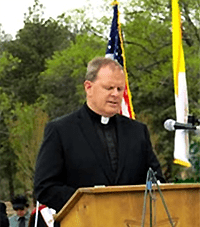
 By Fr. Glenn Jones:
We had ordinations yesterday—two young men ordained as Catholic priests for the Archdiocese of Santa Fe. While such ordinations are a time for rejoicing in the Church, priests know, too, that it is an undeserved honor and privilege—the most undeserved of all—to be called to priesthood. Like the apostles, there is nothing particularly special about such men; indeed, sometimes we wonder “Why him, O Lord?”. After all, most priests and deacons tend not to be great scholars or particularly outstanding in any sort of worldly way. For example, here in our Archdiocese we have men who were former mechanics, disc jockeys, engineers, scientists, pilots, farmers and ranchers, soldiers and sailors, airmen and Marines, and a whole panoply of other careers, education and experiences. But, ideally … hopefully, they possess a common thread: the desire to serve God and His people.
Watching a liturgy of ordination, priests cannot help but reflect upon their own ordinations, the privilege bestowed, and how well (or not) they have fulfilled their vocation of service. Have I served my Lord and His people as He would wish? Where have I failed? Where can I improve? Am I using my position humbly in service, or in self-importance and arrogance? Especially as we celebrate Pentecost and the remembrance of the Holy Spriit descending upon the disciples (Acts of the Apostles 2) this weekend and upon the Church since then, do I manifest those fruits which should spring forth from grace the Spirit gives: love, joy, peace, patience, kindness, goodness, faithfulness, gentleness, self-control? (Galatians 5:22-23) Do I set an example to be mirrored … or mocked? Do I keep in memory’s ear Jesus words: “To whom much is given, much will be required”? (Luke 12:48)
Musing about service during yesterday’s celebration, my mind went to those who have served to literally their last breath as we observe Memorial Day this weekend and honor those who have given their lives in the service of our nations. Jesus reminds us: “Greater love has no man than this, that a man lay down his life for his friends” (John 15:13). First observed in 1868, it was known as “Decoration Day” for people to place flowers and other tokens of respect upon the graves of Civil War soldiers, and has been continued and expanded to this day to all who have died defending our nation and the rights that we enjoy and, in more recent times, the rights and protection of others.
I think that we who have never been in battle take much too much for granted, thinking that Hollywood war is how war is like. But cinematography cannot capture the sights, smells, tastes, weariness, cold, heat, terrors and feels of a battlefield, a ship or plane under fire, the sentinel in his foxhole. While many battle veterans are reluctant to talk about their experiences, there are many first-person accounts available. One might do well to read some of these, especially accounts in total war such as in World War II. It may help give greater appreciation for the courage and sacrifice of those who put themselves “on the line” for us, never to return.
Now, we may argue and bicker about whether this or that war or conflict is necessary, but how can we not honor those who have had the courage to go forward and risk—finally sacrifice—their lives. Even many who have returned from battlefields have died a bit in themselves as we see in post-traumatic stress and injuries, and these, too, deserve to be honored. As the reporter in “We Were Soldiers” says at movie’s close: “[Those] who have seen war never stop seeing it.”
But let us not be remiss in forgetting our first responders who, too, place their lives on the line daily. The press trumpets singular events of perceived injustice or excessive force by law enforcement, and yet ignored are the many thousands of day-to-day services they do for the people of their communities. And there are the firefighters who throw themselves into burning buildings, often to save those who may be trapped. And the EMTs racing through crowded streets to often horrific accident scenes to save lives. We who are beneficiaries of all their sacrifices thank them never sufficiently. They are like life jackets on a boat: we tend to take them for granted until that one critical time they become essential.
Finally, as we honor the service of all who serve their fellows, we come to the very pinnacle of service: Jesus Himself, who regardless of His divinity, came to us “not to be served, but to serve” (Matthew 20: 28). Christians live each day in memory of His incalculable—indeed, infinite—service to us in His teaching, and in His death and resurrection for the salvation of those who accept Him. And yet, while we are so undeserving, God continues to serve us much more than we could ever possibly serve Him. God needs nothing from us; as we read analogically: “If I were hungry, I would not tell you; for the world and all that is in it is mine. Do I eat the flesh of bulls, or drink the blood of goats?” (Psalm 50: 12-13).
How can we offer some return for the grace—His continuing service to us—showered upon the world. Only by loving Him with all our heart and loving our neighbor as ourselves. While He needs nothing from us, He does long for something from us: our love. As we remember the coming of the Holy Spirit this Pentecost, let us truly seek to bear those fruits which spring forth from our cooperation with His grace—to repeat: love, joy, peace, patience, kindness, goodness, faithfulness, gentleness, self-control. For it is by our service to others that He is served.
Editor’s note: Rev. Glenn Jones is the Vicar General of the Archdiocese of Santa Fe and former pastor of Immaculate Heart of Mary Catholic Church in Los Alamos.