
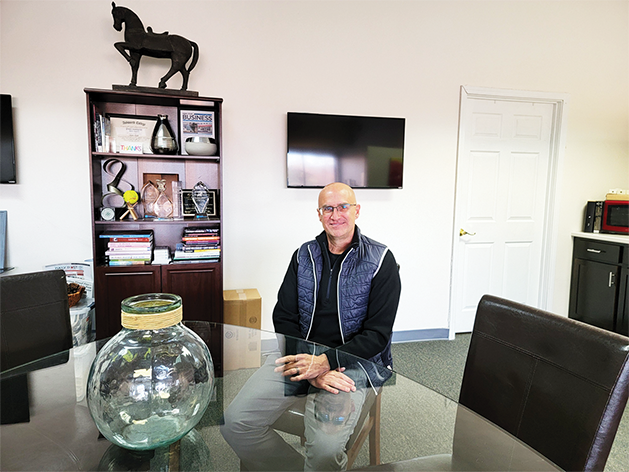
 Los Alamos Fire Chief Erik Litzenberg during an interview Tuesday afternoon at the Los Alamos Daily Post. Photo by Carol A. Clark/ladailypost.com
By KIRSTEN LASKEY
Los Alamos Daily Post
kirsten@ladailypost.com
Working for more than 20 years at the Santa Fe Fire Department, Erik Litzenberg said he was always aware of the Los Alamos Fire Department (LAFD), but it wasn’t until he had a discussion with former Fire Chief Troy Hughes that the idea to apply for the fire chief position was planted.
Litzenberg said he talked with Hughes before he retired from LAFD about who Hughes thought could step into the leadership role “and I started thinking about maybe this is an opportunity for me to realize the things that I had seen all along.”
Then Fire Chief Wendy Servey announced her retirement and Litzenberg submitted for the position. His first day on the job was Monday.
Being a part of the LAFD team feels like a great fit, Litzenberg said, noting that the fire department has a lot of strengths as well as issues that he said he feels he can help address.
First off, Litzenberg said, “Los Alamos Fire Department is a great department.”
He explained it is one of very few departments in the world going for its sixth accreditation, “which is a really big thing because it shows you got self-assessment or improvement mindset.”
Furthermore, Litzenberg noted that LAFD’s ISO or insurance rating is impressive as well as how it is structured and how the department intermixes with Los Alamos National Laboratory (LANL).
“All of those things are things that I felt I had something to add to,” he said. “It just felt like a real automatic fit.”
LAFD is both like and unlike many other fire departments, which also is something Litzenberg said he appreciates.
A unique feature is its interface with LANL.
“It allows it many great things,” he said. “The fact that it is staffed and structured as well as it is – considering the size of the community and considering the call volume they are managing and the specific risk they are managing – it is impressive and that’s unique.”
Another characteristic that is special to Los Alamos is that it is surrounded by one of the worst urban interface areas, Litzenberg said. It is what makes Los Alamos beautiful but also carries risk. He pointed out that there have been multiple wildfires in Los Alamos but there is an opportunity to make a difference with that.
“There’s uniqueness with how this community interfaces with nature … it causes risk; it also causes it to be beautiful, amazing and in many ways unique,” he said
Litzenberg added he really appreciates the community LAFD serves.
“People are interested in each other … in finding out who you are and where you come from and to me that speaks volumes of what can be done in a place in the future,” he said.
Just what the future holds is yet to be determined; Litzenberg emphasized that he is “learning every day”, and “I’m a firm believer that you design programs, you design departments, you design solutions around existing and predicting problems.”
He did pinpoint one issue, the risks of urban interface, adding that this is something affecting not just Los Alamos but all over the U.S. Warmer, drier conditions coupled with more homes being built, increase the fire risk.
“The good news is there’s lots of programs that are successful in helping manage that risk,” Litzenberg said.
The response organization is just part of the solution, he said.
“The greater part of that is how you engage other people in communities,” he said. “How you engage homeowners, how you engage homeowners’ associations, elected officials and other appointed officials, how you engage the labs … to start creating … a fire adapted community.”
He added he is also interested in systems being built around 911 such as mobile integrated health.
“But ultimately whatever programs we choose to build should be based upon the risk Los Alamos is encountering,” Litzenberg said.
Before becoming Los Alamos’ new Fire Chief, Litzenberg served in leadership roles such as the senior fire advisor for the International Association of Fire Chiefs, fire chief for both the City of Santa Fe and Santa Fe County and city manager for the City of Santa Fe. He is serving as the chair of the National Wildfire Coordinating Group Executive Board.
He explained his career in firefighting was sort of an accident. He initially wanted to attend medical school at the University of New Mexico with the goal of becoming an emergency room doctor.
Litzenberg said he thought he would be a better ER doctor “if I knew what went on pre-hospital … so I volunteered in the ambulances, in the local volunteer fire department in the Santa Fe area and realized that’s what I wanted to do for a while so I got ultimately in the career side of things … then I did a career for 20 some years in the City of Santa Fe.”
Still, he said he figured he would do firefighting for a year or two and then just move on.
“What I realized was that there are very few … thing as rewarding as being a responder in a fire department … to have folks trust in you in ways like they invite you into their home, they invite you into the day that is the worst in their life and they trust in you to change that,” Litzenberg said. “And the fact that you learned things, you got a team that you work with and a system that you work within where you actually can make that difference, that’s unique. It is special.”
Litzenberg lives in Santa Fe with his wife, five children, two dogs and two cats. He joked that as a parent, his hobbies outside of work are his children’s hobbies but he enjoys triathlons.