
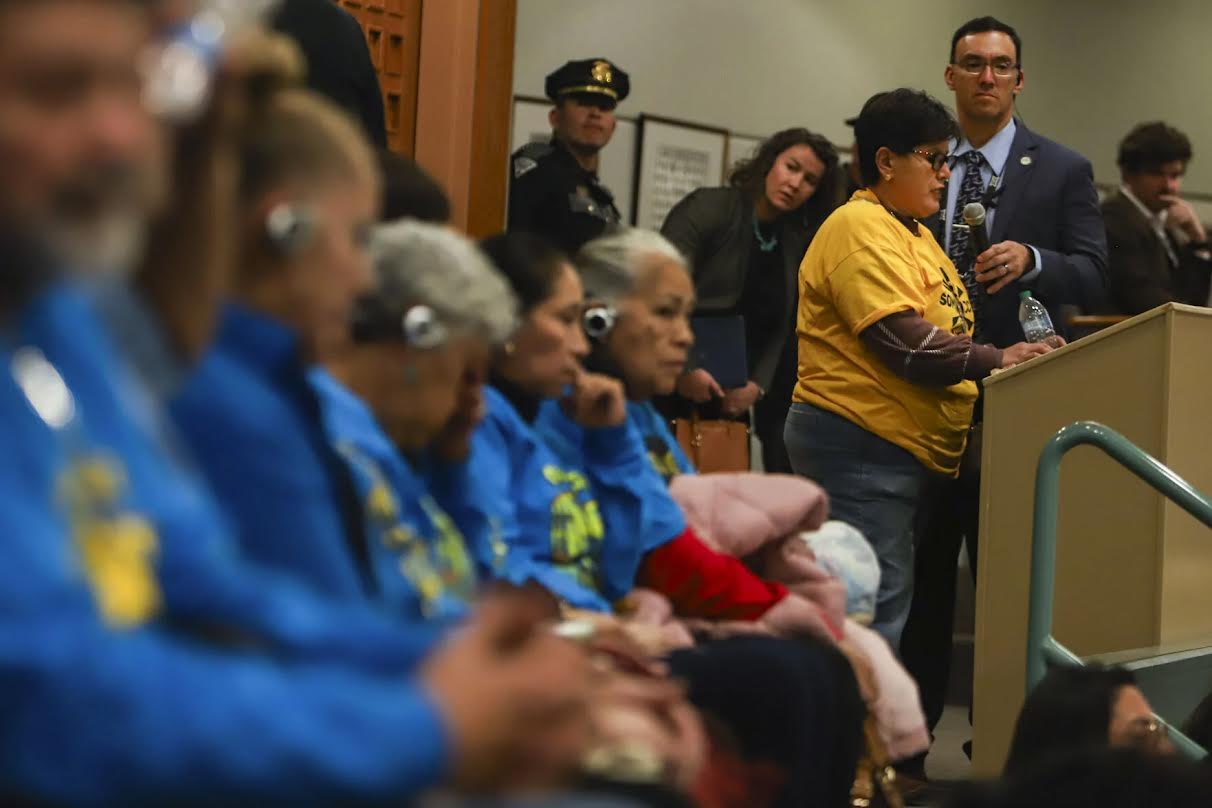
 Hermila Sotelo, a member of Somos Un Pueblo Unido Eddy County, speaks in favor of House Bill 9, the Immigrant Safety Act, during public testimony before the House Judiciary Committee on Wednesday, Jan. 28, 2026, in the House chamber of the state Capitol. Sotelo, who said she has lived in the United States for 30 years after coming to the country from Chihuahua, Mexico, has been working with Somos Un Pueblo Unido in hopes of gaining citizenship this year. Matt Dahlseid/The New Mexican
By CLARA BATES
The Santa Fe New Mexican
A bill to restrict immigration detention centers in New Mexico, potentially putting the state on a collision course with the Trump administration, took a step closer to becoming law Wednesday.
After nearly three hours of testimony and debate the House Judiciary Committee voted 7-4 along party lines to advance House Bill 9, which would ban local governments from contracting with the federal government to operate immigration detention centers. The bill, which now heads to the full House, was amended in committee to also ban contracts between the federal government and local law enforcement to enforce immigration laws.
“We are here to protect our communities, and not to facilitate cruelty and mistreatment,” said Rep. Eleanor Chávez, D-Albuquerque, one of the co-sponsors of the bill dubbed the Immigrant Safety Act.
Wednesday’s hearing was held in the House gallery rather than the usual committee room, a move designed to accommodate the crowd of around 100 people. Many attendees wore T-shirts from immigrant rights groups.
New Mexico is home to three detention facilities that contract with U.S. Immigration and Customs Enforcement, in Cibola, Otero and Torrance counties. They have faced allegations of poor conditions and due process and human rights violations. At least five people have died in ICE detention in New Mexico in recent years, Chávez said.
“From the time this bill was heard in this first committee just six days ago to now, we have seen once again, how deadly ICE enforcement has become,” Chávez said, referring to the fatal shooting of 37-year-old nurse Alex Pretti in Minneapolis on Jan. 24.
The House passed a similar bill last year that stalled in the Senate, although its chances in the upper chamber seem much better this year. Sen. Joseph Cervantes, D-Las Cruces, who chairs the Senate Judiciary Committee and who opposed last year’s bill, is now a co-sponsor. Senate Majority Leader Peter Wirth, D-Santa Fe, said Wednesday senators hope to get the bill to the governor’s desk as soon as next week.
‘Taking their jobs away’
Republicans have vowed to fight the bill, arguing it would devastate rural economies that lack other major employers and would only outsource detention to other states. They also dispute reports of poor conditions in the detention centers. Last week Republican Sen. Jim Townsend, R-Artesia, wrote to U.S. Attorney General Pam Bondi asking for federal help to block the bill.
“We’re taking their jobs away, their families’ jobs away, all because we want to just not be in the business of something that’s just going to continue in another state,” Rep. Andrea Reeb, R-Clovis, said Wednesday.
Felix Gonzales, mayor of the village of Milan where the Cibola County Detention Center is located, said the economic impact of the bill would be “devastating,” with 200 jobs potentially lost. Former state Rep. Harry Garcia, a Democrat from Grants who served until 2024, also testified in opposition.
“I don’t agree with what [ICE is] doing. Nobody does, but that’s our federal delegation, and they should take care of ICE, not us,” Garcia said. “What we’re going to do here at the end of the day [is] we’re going to hurt a bunch of people, and we’re not thinking about them, we’re thinking about just ICE.”
House Minority Whip Alan Martinez, R-Bernalillo, began his comments by saying he wanted to “clarify” that “I am not a traitor to my race because my last name is Martinez,” and “Number two: I am not a fascist,” despite what he has heard from some members of the public.
“What is the purpose of this bill, just to kill jobs in these local areas?” he said, adding that Republican legislators have “now been threatened because of this bill.”
The bill only regulates public entities, meaning private companies could still contract with ICE to hold detainees. The goal of the bill, said Rebecca Sheff, senior staff attorney at the American Civil Liberties Union of New Mexico, “is narrow and specific to get New Mexico’s public bodies out of the business of immigration enforcement.”
States with similar laws, she said, have seen “very significant” reductions in ICE arrests.
‘Cannot be complicit’
The majority of people filling the House gallery supported the bill.
U.S. Rep. Rep Melanie Stansbury, who testified via Zoom, said that while she understands the economic concerns, “New Mexico cannot be complicit in supporting these private for-profit prisons anymore. And I stand with the immigrant community, and I am grateful and proud of this legislation, and to support it.”
Fernanda Banda, co-executive director of New Mexico Dream Team, said her father in 2011 was detained by ICE in the Otero County Processing Center for several months and then deported.
“Our state has a choice: We can continue allowing these detention centers to harm families and traumatize children, or we can pass the Immigrant Safety Act and choose dignity, families, safety and care,” Banda said.
Banning police-ICE deals
The bill now includes an amendment banning partnerships between local law enforcement agencies and federal immigration enforcement, known as 287(g) agreements, which allow local officers to help carry out federal immigration enforcement.
Curry County is currently the only county in New Mexico with such an agreement.
“Our law enforcement officers should not be doing the work of the feds,” said House Speaker Javier Martínez, D-Albuquerque, who presented the amendment.
Curry County has said the agreement allows county staff to serve immigration warrants in jails and facilitate custody transfers to ICE. County Sheriff Mike Brockett last year told The New Mexican the agreement “assists DHS in prioritizing the removal of noncitizens who pose a threat to our community due to their criminal behavior.”
Reeb, whose district includes Curry County, said the county’s agreement is “low-level” and her concern is “not allowing law enforcement to even work in this limited capacity of warrant service.”
Sheff said these agreements have resulted in civil rights violations in other states.
“Localities have incurred significant liability and had to pay out significant damages and settlements for civil rights violations relating to actions that they willingly undertake on behalf of ICE that they’re not required to do,” Sheff said.