
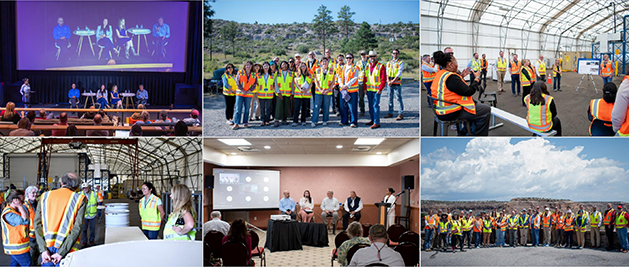
 Images of EM-LA’s various meetings with stakeholders regarding the hexavalent chromium plume. Courtesy/LAC
By KIRSTEN LASKEY
Los Alamos Daily Post
kirsten@ladailypost.com
For more than 20 years, the Department of Energy (DOE) has been attempting to successfully eradicate the hexavalent chromium plume in the aquifer 1,000 feet below Mortandad and Sandia canyons.
Los Alamos County Council learned about DOE’s Environmental Management-Los Alamos Field Office’s (EM-LA) progress on resolving this long-term issue during its Tuesday night meeting.
EM-LA Manager Jessica Kunkle emphasized that the plume does not pose a threat to the public.
“It is important to note that there is no immediate threat to any public or private drinking water wells, and this is something that has been reinforced by New Mexico Environment Department (NMED),” she said.
Kunkle explained what hexavalent chromium is – an active ingredient in potassium dichromate, which was used as a corrosion inhibitor at Los Alamos National Laboratory’s non-nuclear power plant from 1956 to 1972. The discovery of hexavalent chromium levels above NMED’s groundwater standard of 50 micrograms per liter was made in 2004. She added that the plume is a mile long and half mile wide. It is moving east to west.
In response, Kunkle said, since 2004, 17 additional monitoring wells have been installed. Also, DOE has coordinated with NMED to develop and implement an interim measure to prevent further migration of the plume from the laboratory’s boundary. This measure consists of 10 wells, five extraction wells and five injection wells.
“We do actually extract water through our extraction wells, we pump it to a water treatment system, which removes the hexavalent chromium, and then we pump the treated water back to the injection wells to re-inject the water into the groundwater aquifer,” Kunkle explained. “The injection is meant to act as sort of hydrological dam to prevent further migration. We are also critically focused on making sure that we preserve and protect the water from the regional aquifer…”
This interim measure has gone through starts and stops. Kunkle said it was started back in 2018, but NMED ordered it to cease in 2023. It partially resumed in 2024 and then NMED ordered it to cease in November 2025.
According to a NMED letter, this is because recent analytical results during the drilling of a new well beneath the Pueblo de San Ildefonso exhibited hexavalent chromium concentrations exceeding the state’s regulatory standards. The letter further states that the interim measure is “not protective and is not mitigating off-site migration …”
Kunkle disputed this during her presentation Tuesday.
“It is really important to note that the empirical data that we got from our interim measure operations effectively reduces chromium concentrations … so we are proactively working with the state to get the interim measure turned back on …,” she said.
As far as next steps Kunkle said a high priority is to evaluate and complete the monitor wells on Pueblo de San Ildefonso, as well as to consult with the Pueblo, refine a conceptual model, analyze opportunities to modify the interim measure and continue adaptive site management with all the various entities involved in this project.
Kunkle said besides working with NMED, EM-LA is collaborating with the Office of the State Engineer and Pueblo officials.
The hexavalent chromium plume isn’t the only major focus for EM-LA, Kunkle told the council. She highlighted some of the other work being done.
The mission of EM-LA focuses on four pillars, she explained. Legacy waste, which includes transuranic waste, low level waste and mixed low-level waste, is one. The second is protecting land by remediating contaminated soils on legacy landfills. The third is protecting water quality focusing on ground water, surface water and storm water. The final pillar is a small program that addresses the disposition of excess process contamination facilities for the National Nuclear Security Administration (NNSA).
Legacy waste, Kunkle said, is defense related transuranic waste that was retrieved, buried or generated prior to Oct. 1, 1999.
“We’ve actually made substantial progress in reducing the inventory of legacy waste that we have at Technical Area 54, Area G which has historically been our legacy waste … storage area,” she said. “Last year we … exceeded our waste shipping goal for transuranic waste. We targeted to ship 62 cubic meters of waste and we … exceeded that three times. We … shipped 193.4 cubic meters, which is really impressive because we actually had a late start to shipping because as you may recall … we had an outage on one of the key pieces of equipment in our waste characterization process, delaying waste characterization activities. So, we … began shipping at the end of May and we were able to make this tremendous progress in just about five months.”
Kunkle added that since 2020, the DOE has successfully removed 28,526 containers to the Waste Isolation Pilot Plant (WIPP) in Carlsbad.
Regarding buried waste retrieval, Kunkle said EM-LA completed retrieval of 158 corrugated metal pipes that contain cemented transuranic waste. The retrieval was completed at the end of Fiscal Year 2024. Shipping the waste started in late May 2025. Kunkle reported that 792 waste containers were generated and in just six months 20 percent of that waste has been shipped.
As for above ground waste inventory in TA-54, which she said is a key priority to residents, the biggest segment is process containers. There are just under 1,000 process containers that previously possessed some amount of transuranic waste. Kunkle said she is tasking her team to come up with a novel approach to process these containers so they can be characterized as low-level waste and therefore be shipped to a more offsite disposal facility rather than shipping them to WIPP.
This is beneficial because it saves space at WIPP and it is more cost effective, she said. The plan is to do this in Fiscal Year 2026.
Finally, Kunkle touched on the disposition of the Ion Beam Facility. She explained that the facility was built in 1951 and was determined to be decommissioned in 1999. The scope of the project includes surveying and sampling, demolishing and removing the slab. Soil remediation is underway and demolition of the administrative wing and the horizontal accelerator will begin the first half of 2026, she said.
All in all, Kunkle said it was a good year. All the Fiscal Year 2025 milestones were completed and of the 1,405 known or suspected contaminated sites on the NMED consent order, 589 certificates of completion were issued.
“That’s a tremendous success,” Kunkle said.