

SFNF News:
SANTA FE — If you see brownish-yellow or red discoloration of trees in and around Back Canyon Campground in the Santa Fe National Forest (SFNF), it may be the result of defoliation from the Douglas-fir tussock moth (DFTM).
Trees may appear to be dying, but those brown branches signal the outbreak of the Douglas-fir tussock moth, a native defoliator whose larvae (caterpillars) feed on the needles of a variety of fir tree species. The caterpillar’s appetite can result in partial or complete defoliation, resulting in tree mortality or vulnerability to bark beetles.
Currently in 2024, caterpillars are being found in parts of the Carson, Santa Fe, and Cibola National Forests. The caterpillars have thousands of tiny hairs covering their bodies. The female moths, egg masses, and cocoons also have hairs, which can cause tussockosis, an allergic reaction from direct skin contact with the insects themselves or their airborne hairs. Symptoms may include itchiness, skin rashes, skin irritation, watery eyes, runny nose, and sneezing.
More severe reactions, though less common, include blisters, coughing, shortness of breath, wheezing, and chest tightness. Tussockosis severity may vary between individuals, by the amount of exposure, and the level of the outbreak.
Everyone should avoid touching or handling this insect! If contact does occur, immediately wash the area of exposure. If symptoms become severe or problematic, immediately seek medical care.
Inspections will be conducted in upcoming months to monitor the level of defoliation occurring on Douglas-fir and white fir trees along Hyde Park Road. Aerial survey will also be conducted to identify specific locations and provide size of the defoliation. Fall and winter season surveys will be conducted to further assess the outbreak.
Practices designed to promote and maintain a healthy forest through thinning dense stands and promoting tree age and species diversity creates the best condition to reduce DFTM outbreaks. For updates visit the SFNF website and SFNF social media (Facebook and X).
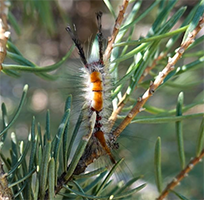
Douglas-fir tussock moth caterpillar
Do Not Touch! … No Tocar!
Forest areas in New Mexico are experiencing increased and observable levels of Douglas-Fir Tussock Moth (DFTM) caterpillars. This native insect to the Southwest periodically reaches outbreak levels that last up to four years.
Currently in 2024, caterpillars are being found in parts of the Carson, Santa Fe, and Cibola National Forests. In some instances, new areas of DFTM activity are being observed across the state. Increased seasonal pheromone trapping for male moths are currently underway to further determine the potential outbreak status for 2025.
Mature caterpillars are identified by three, long, black tufts; one located on the rear of the insect and two on the head. The caterpillar feeds on needles of Douglas-fir and white fir often resulting in severe defoliation damage, which is sometimes followed by top-kill and subsequent attacks by bark beetles. Douglas-fir tussock moths have one generation per year. Eggs are laid in July-August and remain dormant over winter, hatching in mid-May early June the following year.
First and second instars disperse by wind using silken thread. Young caterpillars feed on new foliage and eventually (mid-growth) feed on all age classes of needles. Pupation occurs in silk cocoons on undersides of branches during JulyAugust. Adults emerge (10-18 days) and the flightless female immediately signal males and mate.
Females typically deposits egg masses on the cocoon from which it emerged. The DFTM caterpillars have thousands of tiny hairs covering its body. The female moths, egg masses, and cocoons also have hairs. Tussockosis can occur as an allergic reaction from direct contact with insect or airborne hairs. Symptoms may include itchiness, skin rashes, skin irritation, watery eyes, runny nose, and sneezing.
More severe reactions, though less common, include blisters, coughing, shortness of breath, wheezing, and chest tightness. Tussockosis severity may vary between individuals, by the amount of exposure, and the level of the outbreak. Everyone should avoid touching or handling this insect.
If contact does occur, immediately wash the area of exposure. If symptoms become severe or problematic, immediately seek medical care.