
 NNSA-LA Manager Ted Wyka
By KIRSTEN LASKEY
Los Alamos Daily Post
kirsten@ladailypost.com
NNSA-Los Alamos Field Office (NNSA-LA) offered an update on laboratory operations and unveiled its site wide environmental impact statement (SWEIS) during Tuesday’s Los Alamos County Council meeting.
NNSA-LA Manager Ted Wyka and Deputy Field Office Manager for Mission Security and Environmental Stewardship Stephanie Stringer provided the briefing.
Budget
As far as its budget, Los Alamos National Laboratory (LANL) is operating under a full budget and is expected to receive about $5.3 billion in federal appropriations and a significant portion of that will go to expanding nuclear weapon activities, Wyka said.
Hiring
Wyka said it is expected that LANL will hire between 1,000 and 1,400 new employees this year. This number covers those who are retiring as well as new staff, he said, adding that no hiring freeze is expected.
Randija Canyon land transfer
The NNSA-LA is finalizing a contract with the U.S. Army Corps of Engineers to conduct two important studies in Rendija Canyon, Wyka said. The first is a housing feasibility study and the second is a more comprehensive, unexploded ordinance scan.
Electrical power capacity upgrade project
Wyka reported that the project will begin upgrades to on-site substations as early as May and will continue to do substantial electrical utility work across the site through 2028.
Depressurization of four flanged tritium waste containers
Depressurization of the four containers began Sept. 15, last year, and the final container was shipped off site to Texas on Nov. 14, Wyka said. He reported that there were no operational safety issues and all the emissions were well below the EPA radioactive air emission standards.
Stringer presented the SWEIS to council. She explained the SWEIS covers operations for the next 15 years or through 2038. It analyzes the future planned operations at LANL and the impacts to the local environment, focusing on three different alternatives: no action, modernized operations and expanded operations alternative.
Stringer explained that the alternatives build off each other.
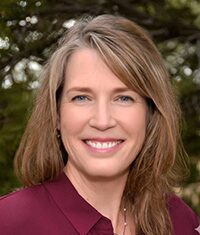 NNSA-LA’s Stephanie Stringer
No action alternative
This alternative includes ongoing operations plus previously approved projects with separate completed NEPA (National Environmental Protection Act) documents. An example would be the electrical power capacity upgrade project.
“Operational changes as part of the no action alternative include implementing the pit production mission,” Stringer said. “So, currently that is 30 pits per year with a surge capacity of up to 80 per year. So that is what’s on the record and what we have NEPA coverage for.”
It also includes decontamination, decommissioning and demolition activities for approximately 186 excess facilities. It also encompasses all the legacy contamination cleanup that Environmental Management does.
Modernized operations alternative
This includes all the no action alternative projects as well as new facilities, Stringer said. It will also cover replacing facilities approaching their end of life, upgrading existing facilities to extend their lifetime and improving work environments. It will also include decontamination, decommissioning and demolition of 156 additional excess facilities.
Expanded operations alternative
It includes the no action and the modernized alternatives, Stringer said. It addresses new facility construction such as a new x-ray free electron laser facility near Los Alamos Neutron Science Center (LANCSE), a micro reactor, true waste staging and other projects. The alternative also covers utilities and infrastructure improvements such as roads and parking. Operational changes include feral cattle management and additional wildland fire risk reduction treatments.
Stringer emphasized that “Not all of these projects are approved, nor will they all be implemented, but we did want to ensure that we did the analysis to be comprehensive for all of the planning so that we were ready to proceed on the projects that we did want to move forward on.”
She added, “A lot of it depends on getting funding for them and just evaluating the need as we go.”
SWEIS also details environmental resource areas, Stringer said. A sampling of these areas are land resources, cultural, paleontological resources, socioeconomics, geology and soils, water resources, air quality and noise and ecological resources.
Stringer explained for each of these resource areas, the SWEIS presents the potential impacts on the alternatives and identifies best management practices and any mitigation measures required to eliminate or limit those potential impacts.
“So, we want to understand what those impacts are, and we want to do everything possible to minimize or avoid any of those potential impacts as part of this process,” she said.
Through the process of developing SWEIS, Stringer said there were notable changes. She mentioned the rescission of executive orders relating to environmental justice and climate change impacts from greenhouse gases. The rescission on environmental quality NEPA regulations was another notable change.
Councilor Melanee Hand asked what the next steps for the SWEIS are.
Wyka said once it is signed and approved, then “we’ll issue record of decisions, on things that we intend to implement, near termed, based on appropriations and funding, then we’ll continue issuing recommendations, records of decisions, on things that will be implemented.”
He added, “So this defines everything within our scope that we know of and everything that we’re going to be doing over the 15 years, and we looked at the expanded option as our recommended option, and then we’ll issue record of decisions shortly after the issuance of a final SWEIS on things that we intend to implement.”
Council Vice Chair Ryn Herrmann wondered what priority fire mitigation has in the SWEIS.
“Fire mitigation is probably one of the more important things we do up here, especially with the history of our wildland fires …,” Wyka said.
He mentioned that LANL has a type one commander on the staff, “which there’s only a handful of those in the country.”
Herrmann commented that “I’m really disappointed about the rescission of the executive orders regarding environmental justice and climate change … I just find that disappointing.”
Stringer noted that environmental justice is in the appendices of the SWEIS and that the laboratory continues to look at the same things as before.
Council Chair Randall Ryti noted that there are news reports of the number of pits growing from 30 to 80. He wondered how does that relate to the SWEIS?
“We don’t set policy, we implement whatever is defined by the president, as well as the Department of War,” Wyka said.
“So, we’ve designed up to at least 30 with a surge capacity of 80,” he added. “And if our requirements are increased or changed, then we would do a supplemental analysis to confirm whatever numbers we’re supposed to go to.”