
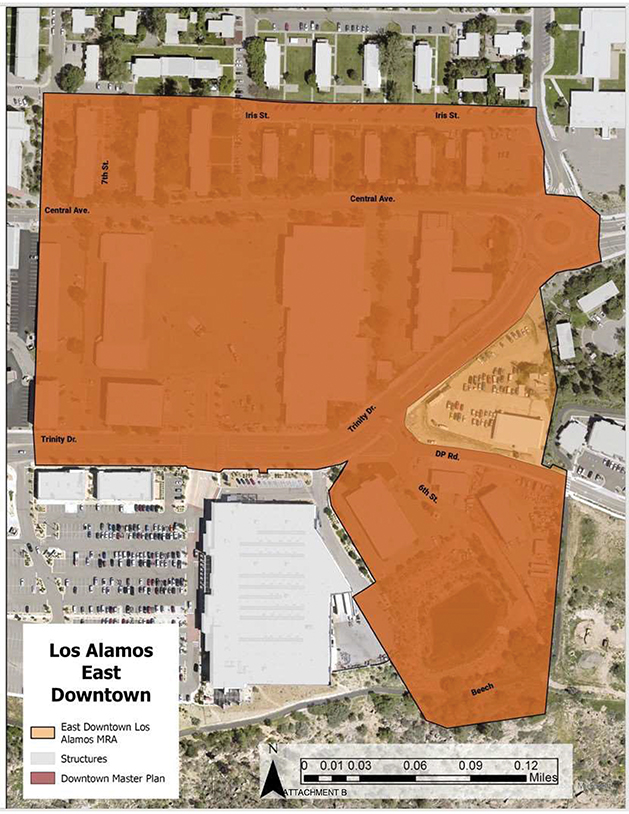
 The boundary map for the MRA for the eastern portion of downtown Los Alamos. Courtesy/LAC
By KIRSTEN LASKEY
Los Alamos Daily Post
kirsten@ladailypost.com
Work on the metropolitan redevelopment area (MRA) plan for the eastern portion of downtown Los Alamos will continue; Los Alamos County Council unanimously approved to see the plan through to its completion during its regular meeting Tuesday.
Council directed staff to present the finalized plan for consideration before the end of this summer.
During the discussion of the MRA, County Manager Anne Laurent reported that she estimates the plan is about 85 percent complete.
Council Vice Chair Suzie Havemann asked what the plan will look like when it returns to council.
Laurent explained the MRA plan will address generically what different tools can do as well as what is included in the Los Alamos Downtown Master Plan. The final 15 percent that needs to be developed will address how the MRA will link to different projects and the actual implementation.
Councilor Randall Ryti said he felt it was worth it to complete the MRA plan; noting that it is almost completed, and the plan could also help jumpstart the MRA in White Rock.
MainStreet and Creative District Executive Director Jacquelyn Connolly gave a little bit of background on the MRA.
She explained that the Los Alamos MainStreet started discussing the MRA with the County and New Mexico MainStreet about two-and-a-half years ago. New Mexico MainStreet approved the MRA.
“We pursued this effort as a way to provide as many tools as possible to inspire the redevelopment of a key area that was identified in our downtown masterplan and that every local would like to see revitalize,” Connolly said. “We’d also hope that this would help us be able to move forward on the White Rock plan by identifying simultaneously the tools necessary to bring things to fruition. Although that path has taken some time to get here, New Mexico Mainstreet approved the area designated …the County Council approved the designated area last spring and the next step of finalizing the MRA plan is close to completion, and we would like to see this project completed.”
MainStreet Futures Committee Chair George Marsden encouraged council to continue with the MRA.
“I am someone who drives by this gateway to our town every day on the way to work,” he said. “It kills me that the only thing I’ve seen changed is that we tore down the Hilltop House. That that felt like a victory kills me on the inside. I don’t want us to leave anything off the table, I want us to use every tool that we can to work on revitalizing this important part of our community. This part of town is the first thing people see when they come in and what they see doesn’t tell the story of who we are and it needs to tell that story.”
Laurent brought the MRA to the council to gauge how it felt about the MRA and what direction to take with it.
Laurent presented council with options on what it could pursue:
- Complete the MRA plan;
- Explore the economic piece and tax incremental finance (TIF) district before adopting the plan, which would require hiring a consultant; or
- Re-evaluate the MRA’s priorities and its boundaries before moving forward.
To help decide, Laurent explained what an MRA is.
It is a “statute in the state of New Mexico that empowers municipalities to really look at areas that are suffering from blight, physical and economic deterioration,” she said, adding that “(An MRA) basically gives you additional tools in a toolbox for economic development for the local government to incentivize redevelopment,” she said.
Tools provided through an MRA include:
- TIF: a TIF creates a gross receipt tax baseline, and any increase afterwards will be captured in a fund that can only be used in the MRA.
- Private/public partnerships: Laurent said this is something that is already done through the Local Economic Development Act (LEDA). Basically, she said an MRA takes the rules around LEDA about increasing GRT, increasing employment but there is focus in an MRA of how to use LEDA for those partnerships. The biggest benefit is when the government owns the land and can sell the land at a discount or do other things. However, she noted that the County doesn’t own land in the eastern downtown area.
- Tax abatement: This increases the tax base by incentivizing certain types of businesses.
- Zoning code exemptions: These can be used for a special district with certain exceptions. Laurent said Los Alamos has rezoned the downtown to incentivize mixed use and higher density as well as reduce parking in the downtown area.
- Direct contribution: This would be for building facades and streetscapes. Laurent said this is usually tied to getting back something in return such as expanded GRT and creating jobs.
- Fee waivers: These include no building fees and other things.
Laurent identified the proposed priorities for the MRA:
- Demolish vacant and blighted structures and build something new.
- Improve the entryway into Los Alamos.
- Replace demolished areas with higher density and mixed-use development such as street level storefronts with smaller footprints that support small businesses and affordable housing.
- Improve public infrastructure such as utilities and amenities.
- Increase GRT for the community.
There are also concerns attached to the MRA, Laurent said. These include:
- The MRA boundary is small compared to other municipalities’ MRAs.
- Within the MRA boundary, there are few owners and no County-owned parcels. Laurent said the timeline for redevelopment would be out of the County’s hands and solely in control of the private property owners.
- The public is concerned that the MRA will displace those who rent on the north side of Central Avenue since most of the vacant buildings are intended for demolition, Laurent said. She emphasized that the
- County does not want to displace anyone with the MRA.
- The anti-donation clause will need to be addressed. Laurent said whatever isn’t mentioned in the plan will need to be defined in some sort of future participation agreement or process. Since this involved taxpayer dollars, the public benefit will need to be defined, she said.
- If a TIF is implemented, it will be limited to the boundary of the MRA.
- The priorities in an MRA can be done without an MRA and Laurent noted that the County has accomplished some of the things including offering pedestrian and bike friendly standards, demolishing the Hilltop House Hotel, pursuing wayfinding signage and planning for a future capital project to improve Central Avenue from 4th Street to 9th Street.
As far as the timeline of the MRA, Laurent reported that the assessment of the eastern downtown area happened in February 2024 and the ordinance and boundary was established in May 2024.