
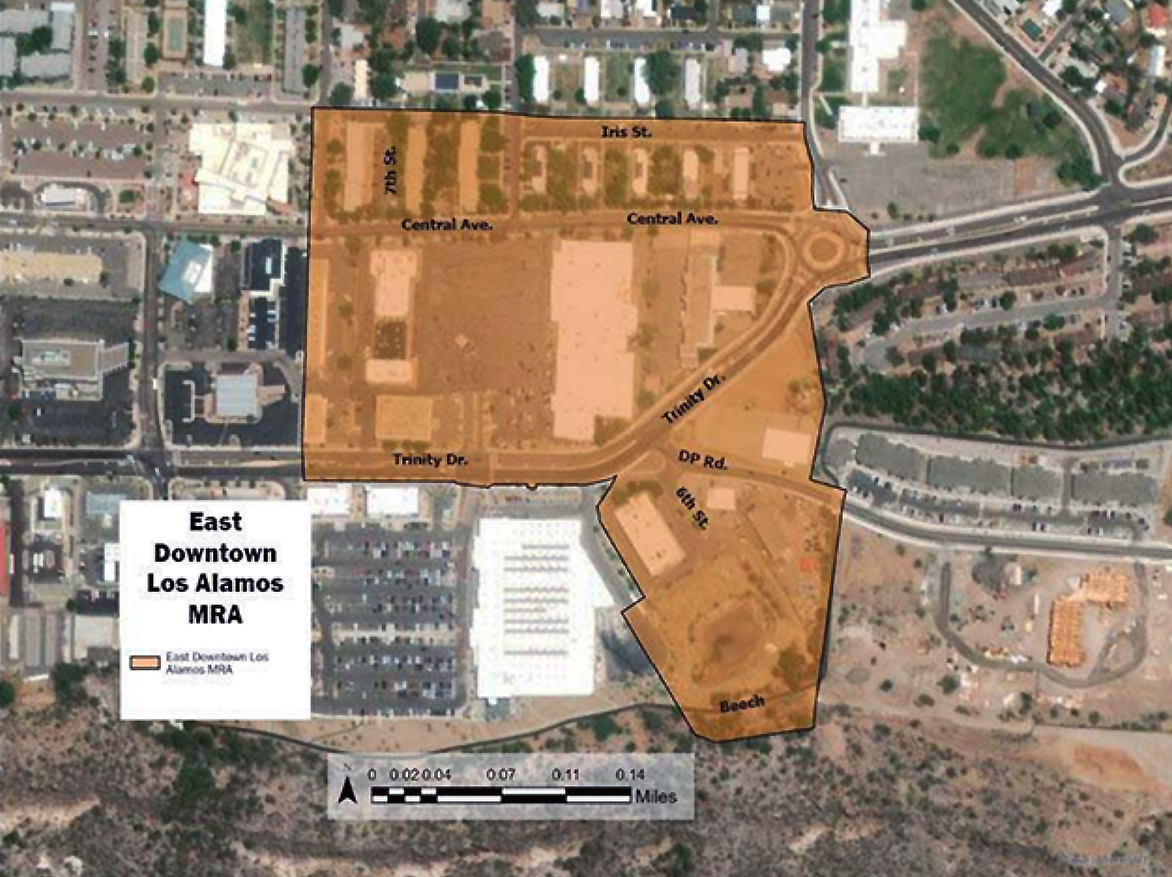
 The boundary map for the eastern downtown Los Alamos MRA. Courtesy/LAC
By KIRSTEN LASKEY
Los Alamos Daily Post
kirsten@ladialypost.com
The Metropolitan Redevelopment Area (MRA) is officially in place for the eastern section of downtown Los Alamos. Los Alamos County Council approved 5-1, with Councilor David Reagor opposed, to adopt the MRA during its regular meeting Tuesday, Sept. 9. Councilor Beverly Neal-Clinton was absent.
Supporters of the MRA emphasize this can help inject revitalization into the eastern downtown area marred by vacant buildings and blighted properties.
Reagor expressed skepticism, noting that the north side of Trinity Drive, which is included in the MRA boundaries, shouldn’t be because it contains fully occupied apartments. He added that he felt is also went against state law.
County Manager Anne Laurent and Council Chair Theresa Cull noted that the council did approve the boundary lines for the MRA in May 2024. Reagor had voted against it. Laurent added that the north side of Trinity was included because it is considered to be one of the gateways into eastern downtown.
Amy Bell with Anthropopulous, which assists with MRAs and is funded by New Mexico MainStreet, added that “the boundary was cooperatively developed with County staff and stakeholders … while the statute seems to allow communities to invest in areas that have incidences of blight, not all the buildings or all of the parts of the MRA must exhibit blight … it is voluntary.”
Councilor Randall Ryti said that the White Rock MRA also includes non-blighted areas.
Reagor said he wasn’t satisfied.
“I’ve never gotten anybody in the County or various other consultants to explain why you are including those apartments,” he said. “It never does make any sense.”
Economic Development Program Manager Anita Barela provided some background information on the MRA. The MRA is guided by New Mexico statute that allows municipalities to designate specific blighted, under-developed areas for economic revitalization, she said. By creating the MRA, tools and incentives can be used to encourage public/private investment.
“Using these tools, the developer can purchase the land or buildings for administrative or project purposes as well as redevelop and revitalize,” Barela said. “If the purchase aligns with the MRA plan in a designated area, they can adapt, re-use or demo a deteriorating structure, they can rezone and update a rezone to regulate a rezoning area, transportation and infrastructure improvements can be made and (allow for) development of cultural, community and rehousing projects.”
Barela added that the MRA boundary runs from a portion of 9th Street, the apartments running south of Kiva Street, to the west side of the roundabout on Trinity Drive. From there, the boundary runs down the southern portion of the area near the old Smith’s retention pond and west on Trinity Drive until it ends on the southeast corner of the Del Norte Credit Union. The boundary covers approximately 29 acres.
Why was the eastern portion of downtown Los Alamos chosen for an MRA?
“It’s the gateway to Los Alamos,” Barela said. “It is the first impression for incoming visitors. The area is marked by vacant storefronts, low commercial activity and deteriorating infrastructure.”
Barela further explained that the downtown master plan rates the redevelopment of the area as critical to the future of vitality in Los Alamos. It aligns with the County’s strategic goals, including vitality, economic development and affordable housing.
So, what is the MRA permitted and not permitted to do?
Barela said the MRA is not permitted to force property owners to participate, grant eminent domain authority or raise property taxes. Also, it does not spend public money without a clear and distinct benefit to the community. On the flip side, it does allow for public investment with a clear community benefit, establishes redevelopment and housing goals, and revitalizes areas experiencing blight or stagnation. Furthermore, it supports partnerships with private developers, property owners and businesses.
Barela emphasized that participation is voluntary.
MRAs present several benefits to the community, such as revitalizing and possibly redeveloping underutilized parcels, grants to support small businesses, and providing infrastructure and property tax incentives, she said. Housing is expanded, especially for the workforce and affordable housing units, and quality of life is enhanced. Long-term sustainability is encouraged through a more diversified economy. Finally, complementary tools such as the Local Economic Development Act (LEDA) can be utilized.
Bell provided more details on the MRA.
“This MRA plan identifies challenges specific to those experienced within the MRA boundary,” she said. “It highlights relevant redevelopment goals and recommends revitalization strategies for that area within the context of the overall downtown master plan.”
These strategies, Bell said, include incentives for development or renovation of street level spaces, incentive projects such as mixed-use, apartments/condos, micro units and short-term or term temporary housing, grant funding for facades, storefronts or landscaping, incentives for diverse public spaces such as mini plazas, amenities for walking, biking and public transit and infrastructure such as power outlets and public EV chargers.
To implement the MRA, Bell said the County can elect to exercise its MRA powers through the Council or establish an MRA commission. Funding can be done by creating an MRA fund or a tax increment financing district (TIF). One of the major strategies, Bell said, would be public/private partnerships and County investment.
Ryti asked about the timelines for funding for projects in MRA districts.
Laurent explained that if a TIF were pursued, it would require an additional process, adding that there has been some discussion for public/private partnerships.
“I do know that we have interested parties, private owners who are looking to potentially submit applications … but I don’t know what the timelines of those might be, those would be up to the private developers,” she said.
Ryti asked how long the terms of the public/private partnerships would be. Bell said the state statute doesn’t identify terms; they would be figured into the development agreement. However, a TIF can be up to 20 years.
Ryti also wondered if the MRA would allow rents to be affordable.
There could be some opportunity to do that, Laurent said.
“My understanding is by the County’s participation for public benefit, we can negotiate as a public/private partnership, some smaller footprints, some public benefits that are around small businesses’ vitality, but again it is a voluntary thing, it is not necessarily a rent control thing, (which) we cannot do per state statute,” she said.
With MRA adopted, Bell said more information about it should be available on the County’s website this month, with applications opening this month as well.
Additional Q&A answer sessions on the MRA are being scheduled for October.