
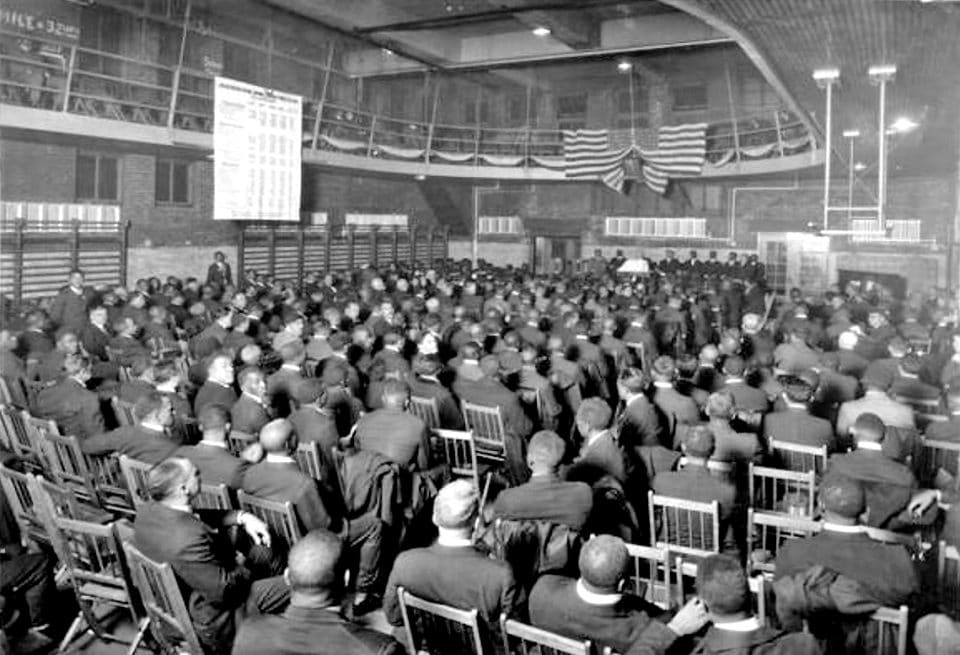
 National Colored Work Conference, Dec. 4, 1921, in Cincinnati, Ohio at the Central Parkway WMCA. Courtesy/YMCA
By JAMES C. JOHNSON
For YMCA of the USA
February 2020
Since its 19th century establishment, the YMCA has expanded its mission globally, becoming a historical pillar among nonprofit organizations across the world. This global reach has propelled the organization to become one of America’s leading non-profit organizations.
Additionally, the YMCA movement has united communities throughout America in times of great need and in times of celebration. From times of economic distress to influencing American educational systems, the YMCA has played a pivotal role in this country’s society.
From its founding in 1844, the YMCA strived to put Christian principles into practice through programs that built healthy spirit, mind, and body for all. Although this was the mission of the organization, there were many cultural and political barriers, which often restricted such advancement.
Ten years before the end of slavery, Anthony Bowen founded the first black YMCA in Washington D.C., in 1853. Born a former slave, he was the first black man to become a clerk in the U.S. Patent Office. While there, Bowen became aware of the YMCA through his white co-worker, William Chauncy Langdon. Langdon shared with him that he was a board member of the Washington YMCA, and boasted about the impact that the YMCA had on the all-white community.
It was then that Bowen made the courageous decision to provide much needed resources for his own community.
The concept of Black YMCA’s manifested into tangible growth. In 1896, there were 60 Black YMCA’s identified by the organization. By 1924, a total of 28,000 members occupied more than160 Black Y’s.
The Wabash Avenue YMCA in Chicago, IL., gained national recognition. During the YMCA’s 53rd Anniversary Dinner, Booker T. Washington said, “This YMCA building branch for our people will come further, in my opinion, in helping the Negro young man in finding himself, to articulate himself, in its civilization, than any other movement that has been started in the city of Chicago.”
It was also at the Wabash YMCA where Dr. Carter G. Woodson organized the Association for the Study of Negro Life and History in 1915. These meetings birthed the creation of Negro History week in 1926 and consequently evolved into The Black History Month, we celebrate today. In 1976, President Gerald Ford established Black History Month as a national month of observance.
In his message, Ford said, “In celebrating Black History Month, we can seize the opportunity to honor the too-often neglected accomplishments of Black Americans in every area of endeavor throughout our history.”
Although racism and discrimination were a known experience in the South during this time, the northern inner cities of America also struggled with establishing an inclusive environment. From the social to the political discourse of this country, Blacks in America often found themselves without adequate housing or compensation for their work.
This led to a movement of Black mobilization through workshops and conferences, such as the Colored Work Conference that was held in Cincinnati, Ohio on December 4th, 1921 at the Central Parkway YMCA. These meetings equipped a new generation of Black leaders to combat the systematic oppression of the North, while providing safe spaces to share their stories.
This new era of advocates challenged individuals and institutions. In the 1930’s, an integrated student YMCA assisted in persuading the Board of Regents of the University of Minnesota to desegregate on-campus housing. In 1942, Black Directors called for the YMCA’s National Board to appoint a commission to study discrimination throughout the Association.
The commission found that, the services available to Negroes were typically casual, fragmentary, rather marginal, often hesitant, and largely lacking that wholeheartedness approach that would seem characteristic of a century-old movement still eager to win the youth of the world to the Christian ideal.
In 1967, racial discrimination was officially banned in all YMCA’s by the National Council. However, in 1969, the Montgomery YMCA refused to allow two black children to attend a summer camp. This prompted Morris Dees, an Alabama lawyer, to file a lawsuit against the YMCA on the grounds that the YMCA was violating the Civil Rights Act of 1964 by engaging in racial discrimination in public accommodations. By 1970, U.S. District Court Judge Frank Johnson ruled that the city had, “invested in the YMCA with a municipal character”, and order that the YMCA end its discriminatory practices.
At this time in American history, there was a sense to move the country forward in a more progressive manner. Two years later in 1972, the National Conference of Black and Non- White YMCA Staff and Volunteers (BAN-WYS) and the Association of Secretaries (AOS) adopted a resolution to establish the birthday of Martin Luther King Jr. as a national association-wide holiday. This led the efforts to establish MLK Day as a Federal holiday. In 1986, National Executive Director, Solon B. Cousins, appointed a nationwide taskforce on how YMCAs in the Black communities can be better supported, which led to the creation of the National Black Achievers Network.
The National Black Achievers Networks served as the precursor for the highly successful Young Black Achievers Program. The program has been a pillar in underserved communities by providing educational and career opportunities to middle and high school students. Powered by volunteers, workshops are conducted to help instill students with the proper social and academic skills needed to be competitive in a globalized society. In 2015, a University of Kentucky study showed that, “Based upon comparisons of ACT scores and Advanced Placement enrollment, the participants in the Black Achievers Programs seem to outperform their peers in academic attainment.”
The case for true diversity and inclusion is still being made even in this millennium. From the election of America’s first Black President in 2008 to the hiring of the YMCA’s first Black national CEO in 2015, it can be argued that there is still much progression needed for people of color.
When the Bridgespan Group asked YMCA of USA’s CEO Kevin Washington what steps are being taken to promote diversity and inclusion, he replied, “At the national office, we are educating staff about the origins of race and racism, to help inform our work to build cohesive communities. We’ve created a National Diversity Task Force at the national board level. We monitor our organization with what we call DIG Metrics: Diversity, Inclusion, and Global Metrics. As we put together what we’re calling our dashboard for our Thriving Ys effort, diversity and inclusion will be one of the metrics, measuring whether or not you’re moving your YMCA forward.”
As we enter into a new decade, both America and the YMCA are moving towards a more equitable culture. People of color are beginning to occupy positions and spaces that historically, they were once denied. From legislation to the collaboration of community partners, the YMCA is leading the charge for true change; once again, being a cornerstone in America’s history.
Did You Know?
- 1947: In this year while Jackie Robinson became the first black MLB player, he also became a coach at the Harlem YMCA w/ teammate Roy Campanella.
- 1953: 16-year-old Wilt Chamberlain led the Philadelphia Christian Street YMCA to the National YMCA Basketball Championship.
- 2010: Emerging Multicultural Leadership Experience (EMLE) was developed.