
 Crustose lichen grows like a crust that is tightly attached to the underlying rock substrate. Photo by Robert Dryja
By ROBERT DRYJA
Los Alamos
It is easy to see the world as composed of discrete plants and animals while walking across the countryside. Short juniper trees grow at lower elevations while tall ponderosa trees grow at higher elevations. Squirrels can be seen scampering across the ground and then up tree trunks. Hummingbirds arrive in the spring and then leave in the fall. Unusual looking things also can be seen.
For example, a curious sort of organism can be seen living on the ground. It often can be seen on rocks. It is primarily white in color and does not show the greenness of plants. Is there a plant that does not have any green chlorophyll in it? On the other hand, is there some sort of animal that lives in the same spot, growing slowly year by year?
The idea of completely discrete plants and animals begins to change when learning what is happening in your digestive system. It is possible to observe hundreds of different species of bacteria with a microscope. The bacteria are happily living on the food you have eaten and in turn help to provide processed food to you.
It becomes even more surprising when looking inside of a cell with a microscope. Something called mitochondria can be seen depending on the kind of cell. A red blood cell does not contain mitochondria while a liver cell may have more than 2,000. A heart muscle cell may have more than 5,000. What are all those mitochondria doing? They create the chemicals that provide energy to the rest of a cell. So much for thinking of a plant or an animal is a discrete creature.
It is one thing to consider what is going on inside a cell when a microscope is needed. But what is going on with that white organism that can be easily seen covering rocks? It turns out that green, single celled plants called algae are living inside it. They are being hidden by the white colored surface. The white surface is a kind of living, protective shell for the algae and the algae in turn provide nutrition to the shell. Welcome to the world of lichen. Two otherwise discrete organisms have come together. A lichen without algae is a type of fungus. It cannot live as a lichen without algae inside it. An algae cell in contrast can live independently. The fungus is living in a parasitic relationship with the algae because it depends on algae to provide nutrition. The algae in contrast is in a symbiotic relationship because it can live separately from the fungus.
Lichens reproduce in two main ways. First, the fungus part of a lichen can grow spores. These then can be carried away to germinate elsewhere. If the spore begins to grow with right species of algae nearby, it may envelop the algae to become a lichen. A second way involves fragmentation. A piece of lichen may break off with algae in it and this fragment grows into a new lichen. A lichen alternatively can produce microscopic, dust-like particles. These particles contain algae cells that are surrounded by fungus cells. These particles are called soredia. Soredia can be carried long distances by wind or water.
Lichen can be placed in four groups depending on their growth patterns. Some grow as a crust that is tightly bound to the underlying rocky surface. Others grow more like sheets that are not tightly bound to the subsurface. Sheets can lift upward. The tightly bound crusty lichen are known as crustose while the sheet-like lichen are known foliose.
A third group looks like small circular pebbles lying on a sheet. The pebbles may be orange colored at one stage of their growth but then may turn white. These are called squamulose lichen. The fourth and final group grow tubes that stand upward, looking like small branches. These are known as fruticose lichen.
Lichens result in an updating of what is meant by “discrete”. On the one hand, lichen only exist when two separate organisms associate together. The association results in a new, discrete type of organism.
On the other hand, two different kinds of organisms can live separately and discretely.
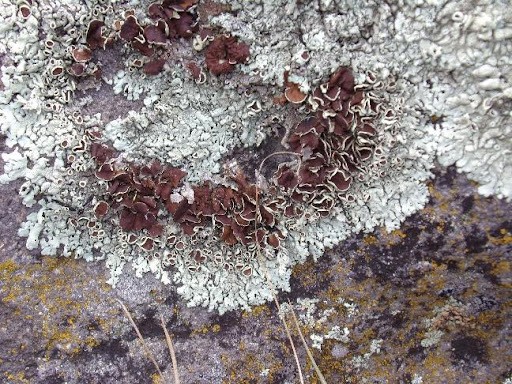 Foliose lichen grows like narrow, leaflike sheets not tightly bound to rock substrate. Photo by Robert Dryja
 Squamulose lichen grows somewhat flattened pebbles that are clustered together. Their color may change as they grow, from orange to white as shown in this picture. Other colors are possible. Photo by Robert Dryja
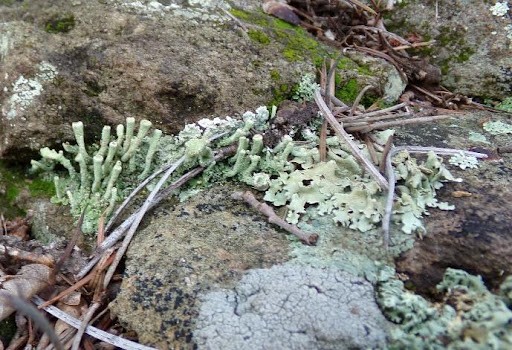 Fruticose lichen grows with free standing, branching tubes. Photo by Robert Dryja