
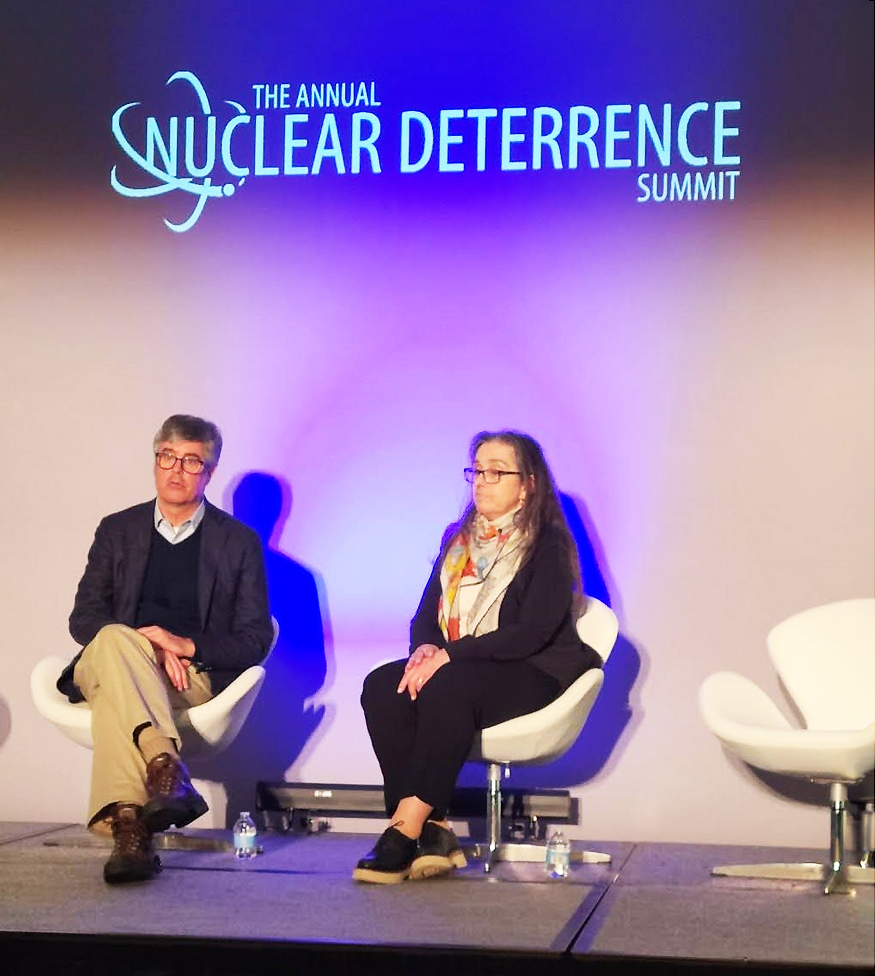
 Lab directors Thom Mason of Los Alamos and Kimberly Budil of Lawrence Livermore discuss efforts to modernize aging nuclear infrastructure and accelerate weapons development during a panel at the Nuclear Deterrence Summit in Arlington, Va. Photo by Marlene Wilden/ladailypost.com
By MARLENE WILDEN
Los Alamos Daily Post
marlene@ladailypost.com
ARLINGTON, VA.—Appearing together at the annual Nuclear Deterrence Summit, held Jan. 26-28, the directors of Los Alamos, Lawrence Livermore and Sandia National Laboratories said they are seizing an unusual window of regulatory reform to cut red tape slowing the nuclear security enterprise.
The Department of Energy (DOE) is pursuing one of its most ambitious deregulation efforts in decades. Known as Project Velocity, the initiative—outlined alongside other reform measures in an Oct. 17 memo—rewrites dozens of safety, construction and oversight rules to accelerate warhead modernization.
Lawrence Livermore Director Kimberly Budil and Los Alamos Director Thom Mason described this round of changes as fundamentally different from past efforts, turning long-standing lab concerns into concrete revisions. Previous regulations, often written in response to specific incidents, became politically and operationally difficult to unwind.
Earlier reforms targeted “low-hanging fruit” manageable with a secretarial memo, Mason said. Project Velocity involves systematically reviewing roughly 80 DOE orders to determine which requirements remain necessary and which add unnecessary costs and delays.
The lab directors said duplicative reviews and bespoke rules are being replaced by risk-based, data-driven oversight that leans on commercial construction standards and, where hazards permit, AI-enabled analysis. The key test will be whether reforms enable more efficient delivery of new systems—such as the W93 submarine-launched ballistic missile and the B61-13 gravity bomb—without compromising accountability.
Mason called the pace “breathtaking” but cautioned the current phase is more challenging. He stressed reforms will only last if labs improve mission performance while safeguarding classified information, nuclear materials, workers and the public. Failure could lead future administrations to reinstate old, burdensome frameworks.
LANL’s lab director placed the reforms in the broader strategic context outlined by Brandon Williams, National Nuclear Security Administration (NNSA) administrator and DOE undersecretary for nuclear security, confirmed in September. Williams described the current geopolitical climate as the most dangerous since the Cuban Missile Crisis, urging an “America First” shift from stockpile stewardship to a production-focused nuclear enterprise aligned with the National Defense Strategy, which had been publicly released just a week prior.
“The NNSA is no longer defined solely as a scientific stewardship organization. We are focused on weapons production, delivering real capabilities and innovations at speed to meet today’s threats,” Williams said.
His remarks coincided with the Bulletin of the Atomic Scientists setting the Doomsday Clock at 85 seconds to midnight—the closest ever to catastrophe—highlighting a renewed nuclear arms race amid the longest-ever hiatus in nuclear testing.
Removing the Padding: Putting Urgency Back into the Blueprints
Complementing Mason’s comments, Mark Davis, LANL’s deputy laboratory director for operations, said major construction will require cultural shifts in planning and management. Years of unnecessary bureaucracy have dulled urgency, he said.
 Mark Davis, deputy laboratory director for operations at LANL, addresses the panel ‘Transforming Project Execution: Insights and Innovations from NNSA Leaders’ at the Nuclear Deterrence Summit. Photo by Marlene Wilden/ladailypost.com
The lab must speed weapons work while upgrading aging facilities and expanding plutonium pit production. This effort extends beyond the PF-4 plutonium facility to include waste management, security infrastructure, analytical chemistry, bioassay and metallurgy.
Davis cited a recent upgrade that expanded PF-4 access lanes from two to five, cutting worker wait times by 60 percent and boosting time spent on mission-critical work.
He pointed to adopting commercial construction standards under DOE Order 413.3B and using small, empowered integrated project teams as key to keeping modernization efforts on track. Other panelists highlighted virtual reality tools to streamline planning and execution.
Davis said risk management must shift focus from individual exposure to enterprise-level consequences. “Leadership needs to make it clear they support risk-informed decisions,” he said. “Our people often think leaders don’t have their back if they get it wrong.”
He explained overly conservative planning assumptions have slowed performance and that tightening baselines to reflect mission realities rather than worst-case scenarios would restore accountability.
“Once you put a schedule in writing, that’s what people are going to work toward,” Davis said. “Padded schedules and bloated budgets with a bunch of contingency and management reserves are just not the way to go.”
Moving Beyond ‘Global Zero’: A New Era of Nuclear Realism
LANL weapons director Bob Webster reported the lab is hitting key milestones ahead of schedule and is expanding the scientific toolkit supporting the U.S. stockpile.
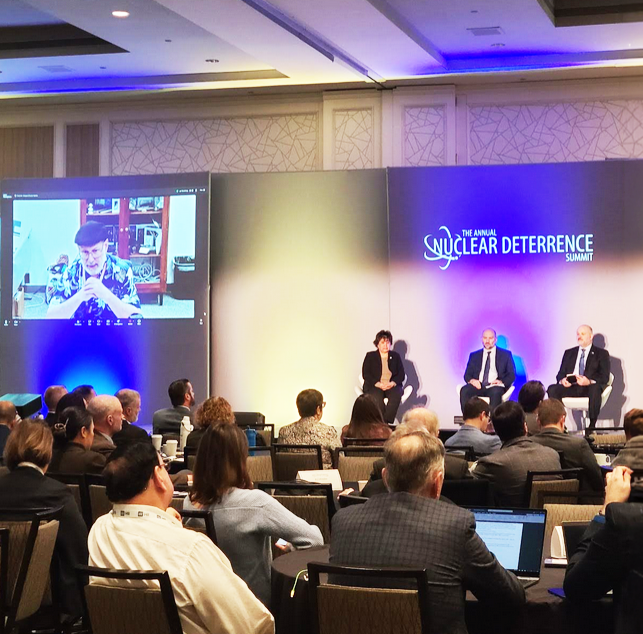 Bob Webster, deputy laboratory director for weapons at LANL, provides a remote update during the weapons director session at the Nuclear Deterrence Summit. Photo by Marlene Wilden/ladailypost.com
Webster detailed completing the final unit under the W88’s Alteration 370 upgrade program in record time and ramping plutonium pit production toward higher annual targets. The W88, a submarine-launched ballistic missile warhead supporting the sea-based leg of the nuclear deterrent, illustrated faster delivery without a return to nuclear testing.
Webster said modernization relies on advanced experimental and computational tools, including a newly deployed Nvidia-based supercomputer moved into a secure environment. “We took [Venado] into the secure so we could use AI tools to ask questions of it that you don’t want to ask in the open, because it might actually get the answer right,” he said.
Webster emphasized growing integration between weapons modernization and nonproliferation, noting defense programs provide infrastructure and experimental capabilities to analyze and influence global nuclear behavior.
As the U.S. modernizes its arsenal, he said, “it has to be sensitive to how the rest of the world will react” and how those actions are perceived.
Weaving the Digital Thread: Rewiring Nuclear Weapons Modernization
The summit’s final day showcased the push to digitize nuclear weapons design and production—an effort being treated as a governance reform, not just an IT upgrade. Launched in summer 2023 and co-chaired by NNSA Assistant Deputy Administrator Kent Jones and Sandia Director Laura McGill, the initiative seeks to establish a secure “digital thread” linking requirements, models, simulations and factory data across sites.
Sandia leads this effort with the W93 warhead program as a pathfinder, while Lawrence Livermore encourages sharing approved software and tools across the complex. Los Alamos faces pressure to adopt common tools or risk becoming a bottleneck.
Panelists discussed how artificial intelligence and new data centers make the digital thread operational. NNSA Chief Information Officer Jamie Wolff said AI is already reducing routine paperwork and beginning to support complex missions on secure networks. But much of the discussion—covering data management, cybersecurity, accreditation, workforce skills and power supply—highlighted how much infrastructure still needs to be built.
Microsoft executive Brian Lopez noted that extreme weather, which also affected summit attendance, poses challenges for AI data centers. He cited an internal memo received over the weekend calling for generator power to prevent disruptions to Texas communities. Lopez flagged the strain AI data centers place on the grid, warning that today’s power and cooling networks are not built for the scale of computing now proposed and will require years of coordinated upgrades.
Speakers agreed building secure computing hubs requires strong industry partnerships, resilient power infrastructure and investment in local workers and training.
Reflecting the summit’s core focus on sustaining the resilience and readiness of America’s nuclear deterrent, Adm. Richard Correll, commander of U.S. Strategic Command, said: “We will continue to deter and manage escalation by providing all credible options to the president that cause any potential adversary to say, ‘Not today.’”