
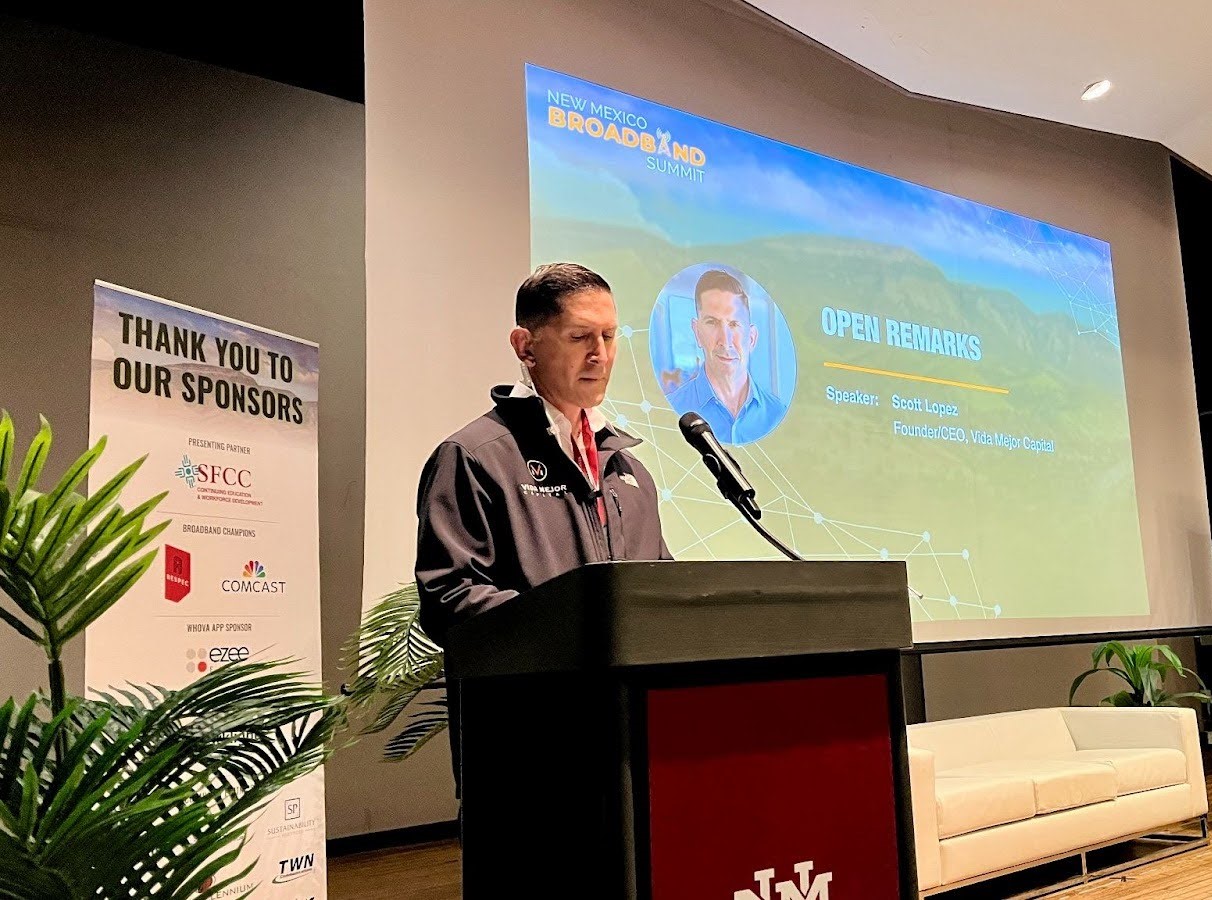
 Scott Lopez delivers opening remarks at the New Mexico Broadband Summit on Dec. 3 at UNM’s Continuing Education Center in Albuquerque. Courtesy photo
By MARLENE WILDEN
Los Alamos Daily Post
marlene@ladailypost.com
New Mexico policymakers and industry officials on Wednesday said stronger collaboration among state agencies, internet providers and utility crews is imperative to preventing the kind of service failures that repeatedly disrupted Los Alamos this year. Such coordination is essential to advancing practical, long-term improvements as the state prepares for a major expansion of broadband infrastructure funded by federal dollars.
Addressing the crowd at the New Mexico Broadband Summit, Vida Mejor Capital CEO Scott Lopez described the event as a “convener of the ecosystem” and underscored the need for alignment among those who build, finance, regulate and maintain broadband lines, especially as upgrades accelerate.
The summit, now in its third year, drew more than 400 attendees, including legislators, cabinet officials, tribal leaders, service providers, engineers and construction firms, all focused on reducing friction and improving cooperation.
Lopez stressed that building resilient networks requires redundant fiber routes and clear communication among every entity that owns or works near critical infrastructure. Recent fiber cuts along N.M. 4 demonstrated how many communities still rely on vulnerable single in-and-out systems.
For Los Alamos residents who endured as many as four major countywide outages in the last 12 months—with the most recent being a full-day shutdown of internet and cellular service on Nov. 11—those improvements are crucial. Lopez said fiber remains the “preferred technology” but reliability depends on integrated decision-making with contractors.
Permitting and construction remain hurdles
State Land Commissioner Stephanie Garcia Richard delivered the keynote, noting that fiber projects often require approvals from multiple agencies. Many routes cross state trust lands, making timely permits from her office essential.
“Getting projects permitted is a challenge everywhere in the country,” Lopez said. “But when you put permitting agencies, ISPs and contractors in the same room, everything moves faster. Timelines improve when the people who submit the permits know the people who review them.”
Industry experts also discussed supply-chain constraints, citing growing competition between broadband builders and hyperscale AI data centers expanding across the Southwest. Fiber and conduit manufacturers said these large-scale projects are drawing from the same materials needed for broadband.
“Fiber is future-proof, meaning it can handle growing data needs without major infrastructure upgrades,” Lopez said.
Preparing the workforce for the next phase
Workforce readiness was another major focus. Santa Fe Community College, the summit’s presenting partner, spotlighted its fiber-optic technician programs that train workers for the state. Lopez noted broadband jobs extend beyond trenching and splicing.
“We need cybersecurity experts, network operations staff, accountants and customer support specialists,” he said. “When these new networks go live, someone has to keep them running.”
With Los Alamos National Laboratory expanding its AI, quantum and advanced energy research, infrastructure resilience is becoming both a scientific and economic imperative. Growing demand from data centers could influence project timing statewide.
Fiber ring aims to prevent outages
Jeffrey Lopez, director of the New Mexico Office of Broadband Access and Expansion (OBAE), said 2025 marked significant progress, including efforts to improve reliability, reduce failures and speed construction. He said investments will translate locally through the new San Ildefonso–Los Alamos redundant fiber route, expected to be fully complete by June 30, 2026, with hopes to have all core components in place by the end of January.
Modern fiber can scale to meet LANL’s expanding workloads by upgrading existing cables without the need to build entirely new infrastructure, Director Lopez said.
“The current focus is building middle-mile connections, creating a ring so a single cut doesn’t knock out service,” he said. “Fiber is highly capable. As demand grows, you can add strands and expand capacity. And with careful mapping, the network will keep pace with future research needs and everyday use.”
Taken together, these projects reflect a shift from simply adding bandwidth to engineering resilience into the network from the start, Lopez said.

OBAE Director Jeffrey Lopez. Photo by Daniel Rios/U.S. Senate
A reason for cautious optimism
In 2023, the federal government launched the roughly $42.5 billion Broadband Equity, Access, and Deployment (BEAD) program to expand high-speed internet, particularly in underserved areas. Funds are allocated to states, which then run competitive grant programs for local providers and other entities. New Mexico’s allocation is about $675 million, ranking among the top 10 states nationally on a per-capita basis.
Most BEAD-funded projects are expected to ramp up construction in 2026–2027, with many coming online around 2028. Scott Lopez said major improvements will be gradual and should be measured in years, not months. Residents should anticipate more construction crews, though he emphasized that work does not necessarily mean more outages. Representatives from the Public Regulation Commission and NM811 attended the summit to promote safer, better-coordinated digging.
“The path forward depends less on discovering a missing fix and more on ensuring work is planned effectively, so small oversights don’t become major failures,” he said. “Public meetings, outreach, dashboards and portals—those all help.”