
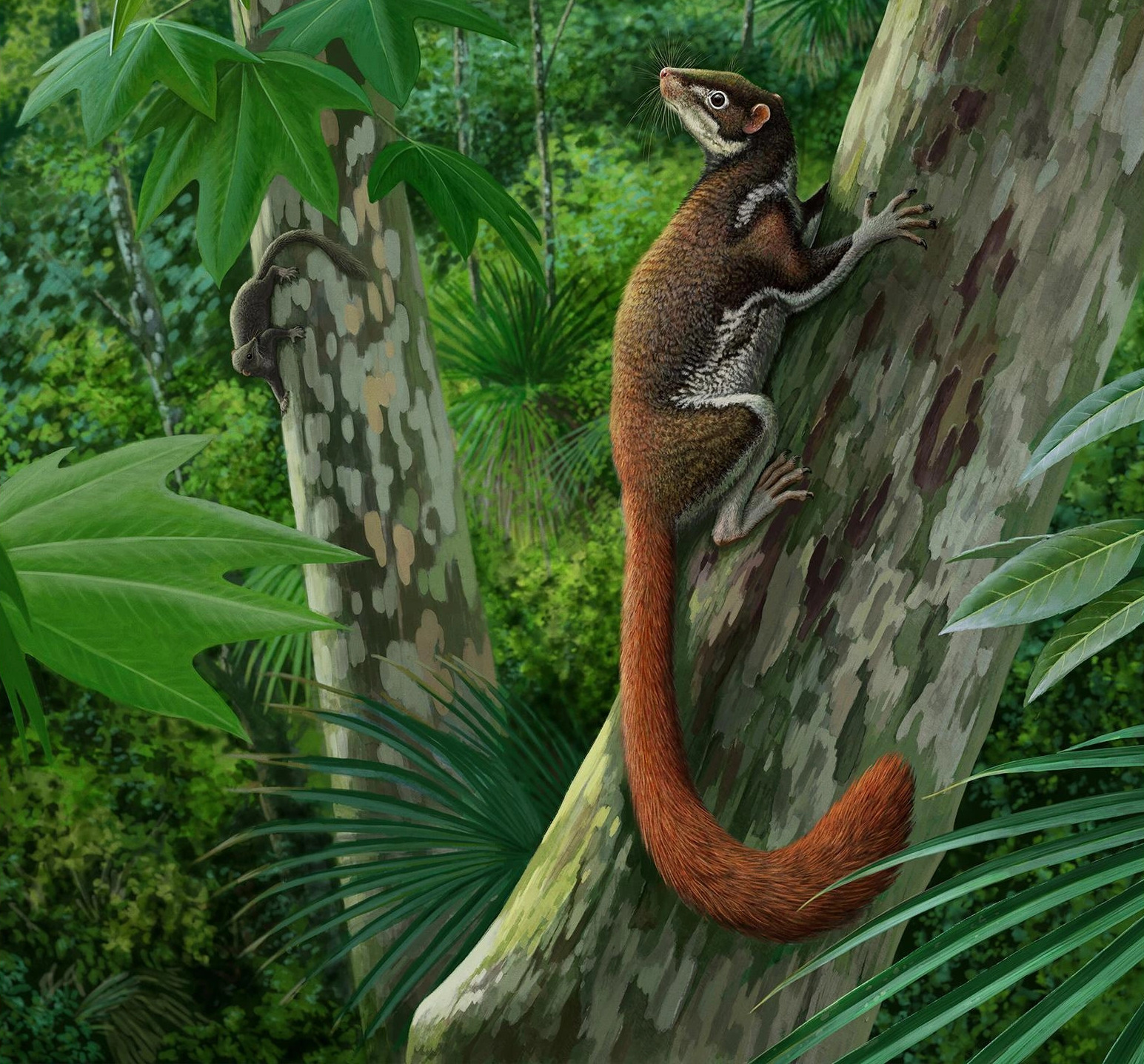
 A rendering of Mixodectes pungens, a species of small mammal that inhabited western North America during the early Paleocene, roughly 62 million years ago. Courtesy/NMMNHS
NMMNHS News:
ALBUQUERQUE — A recent study co-authored by a New Mexico Museum of Natural History & Science researcher sheds new light on an ancient species of mammal that evolved shortly after the demise of the dinosaurs, one that has vexed scientists for more than a century.
“This new and important study that sheds light on the history of life on our planet is another example of how the New Mexico Museum of Natural History & Science continues to be a science-based institution bringing unique stories into the public domain,” said Dr. Anthony Fiorillo, Executive Director of the New Mexico Museum of Natural History & Science (NMMNHS).
The study, published in the academic journal Scientific Reports March 11, identifies a nearly complete skeleton of Mixodectes pungens, a species of small mammal about the size of a cottontail rabbit, that inhabited western North America during the early Paleocene, roughly 62 million years ago. This specimen was collected by co-author and NMMNHS Paleontology Curator Dr. Thomas Williamson from the San Juan Basin in northwest New Mexico, and offers scientists a better understanding of Mixodectes’ anatomy, behavior, diet, and position in the evolutionary tree.
“This first-of-its-kind skeleton not only helps us understand how Mixodectes lived, but it also gives us insight into how these unique creatures evolved and who their closest living relatives are,” Dr. Williamson said.
Stephen Chester, associate professor of anthropology at Brooklyn College, City University of New York, is the paper’s lead author. Other co-authors include Eric Sargis, anthropologist at Yale University, Jordan Crowell of The Graduate Center at the City University of New York, Mary Silcox of the University of Toronto Scarborough, and Jonathan Bloch of the Florida Museum of Natural History at the University of Florida.
Mixodectes was first identified by famed paleontologist Edward Drinker Cope in 1883, but with remnants largely limited to fossilized teeth and jawbone fragments, it was difficult to glean much about the early mammal.
Based on the skeleton discovered in San Juan Basin, the most complete discovered to date, the study demonstrates that mature adult Mixodectes weighed about 3 pounds, dwelled in trees, and largely dined on leaves. It also shows that these arboreal mammals — an extinct family known as mixodectids — and humans occupy relatively close branches on the evolutionary tree. Yale University’s Sargis said these ancient animals are close relatives of primates and colugos — flying lemurs native to Southeast Asia — making them fairly closely related to humans.
Mixodectes was quite large for a tree-dwelling mammal in North America during the early Paleocene — the geological epoch that followed the Cretaceous-Paleogene extinction event that killed off non-avian dinosaurs 66 million years ago, the researchers noted. Based on its diet, which consisted primarily of leaves, researchers concluded Mixodectes occupied a unique ecological niche in the early Paleocene that distinguished them from their tree-dwelling contemporaries.
Two phylogenetic analyses performed to clarify the species’ evolutionary relationships confirmed that mixodectids are euarchontans, a group of mammals that consists of treeshrews, primates, and colugos. Evidence remains mixed as to whether these animals are archaic primates.
To learn more about the work of NMMNHS’s paleontology curators, visit nmnaturalhistory.org/science/sections/paleontology.
About the New Mexico Museum of Natural History and Science
The New Mexico Museum of Natural History and Science is a division of the Department of Cultural Affairs, under the leadership of the Board of Trustees of the New Mexico Museum of Natural History & Science. Programs and exhibits are generously supported by the New Mexico Museum of Natural History Foundation, through the generous support of donors. Established in 1986, the mission of the New Mexico Museum of Natural History & Science is to preserve and interpret the distinctive natural and scientific heritage of our state through extraordinary collections, research, exhibits, and programs designed to ignite a passion for lifelong learning. The NMMNHS offers exhibitions, programs, and workshops in Geoscience, including Paleontology and Mineralogy, Bioscience, and Space Science. It is the Southwest’s largest repository for fossils and includes a Planetarium and a large format 3D DynaTheater.