
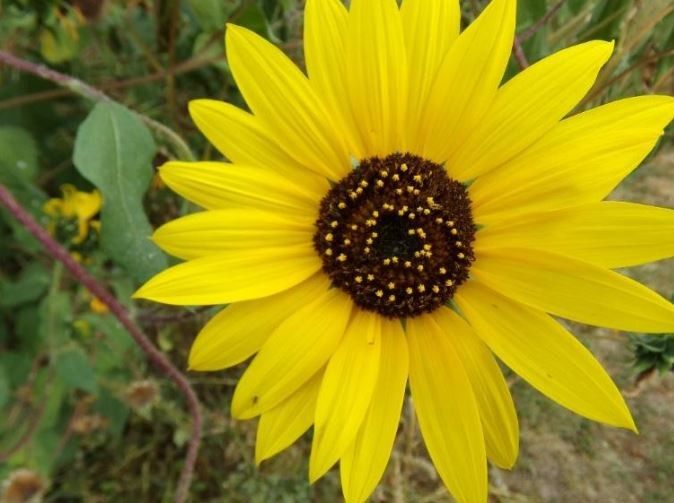
 A sunflower showing its central disk of small flowers called florets surrounded by a ring of large petal flowers. Courtesy photo
 By ROBERT DRYJA
Los Alamos
Sunflowers of all sizes had been blooming during the summer but now have faded with the arrival of autumn.
Sunflowers are eye-catching in several ways. It is easy to think that a sunflower is one single flower, (see Picture 1). A central disk is surrounded by yellow petals, suggesting a single flower. But what are those small yellow patches on the central disk? A closer look shows that they are small flowers. The small flowers are called florets and there may be hundreds growing in the central disk. A careful examination of the large yellow petals also shows they are separate flowers surrounding the disc. The disk florets grow fertile seeds while the yellow petal flowers are sterile.
Sunflowers are interesting from a biological point of view. They also are interesting from a mathematical point of view.
The mathematics becomes visible when looking at the disk of a large sunflower that is reaching maturity. Picture 3 shows the distinct spirals that the florets create. One spiral rotates clockwise while the other rotates counterclockwise. Often there are 34 spirals in one direction and 21 spirals in the other direction. Together the total is 55 spirals. Smaller sunflowers may be composed of 8 and 13 spirals. All of these numbers are part of the mathematical Fibonacci series: 0, 1, 1, 2, 3, 5, 8, 13, 21, 34, 55… A Fibonacci series is created by adding together the preceding two numbers.

Each number in a Fibonacci series can be used to draw squares. These squares in turn can be arranged to form a spiral. This spiral arrangement becomes clearer when semi-circles are drawn inside each square, (see Diagram 3). An artistic surprise occurs when a Fibonacci spiral is placed on top of the florets of a sunflower. The growth spiral of the sunflower florets closely matches the mathematical spiral, (see Picture 4).
But why do florets grow with this particular kind of spiral? It turns out that this results in the most efficient use of space for growing florets. If the florets grew in straight rows from the center, then more and more space would become vacant between the rows going the outside, (see Diagram 4). What is even more surprising is this particular kind of spiral results in the most efficient placing of the florets. A spiral could have more or less of a curve but then not as many florets could grow in the disk.
The spiral created by the florets is distinct in the mid-section of a disk. However, it is not perfect for its entire length from the center to the outside. Florets are still growing in size and shape toward the center of the disk and so are not yet aligned along the curve. Florets toward the outside are blooming with pollen and so the distinct line of the spiral disappears.
Still, the spirals are remarkable from biologic and mathematical perspectives. Take a a look at a pinecone that has not yet opened. Its bracts are analogous to florets and are arranged in Fibonacci spirals.
 The central disk is cut in half to show the vertically growing florets. Pollen grows at the top while seeds grow at the bottom in white overies. Courtesy photo
 The spirals in a sunflower disk. The florets around the outside are the first to open, creating columns that release pollen. Courtesy photo
 Spirals growing in a sunflower are based on Fibonacci numbers. Diagram 1 shows a set of 21 counterclockwise spirals while Diagram 2 shows a set of 34 clockwise spirals. Courtesy photo
 Fibonacci numbers are used to draw squares. Each square then can have a semi-circle drawn in it, creating a spiral. Courtesy photo
 A Fibonacci spiral and the spiral of sunflower florets closely match one another. Courtesy photo
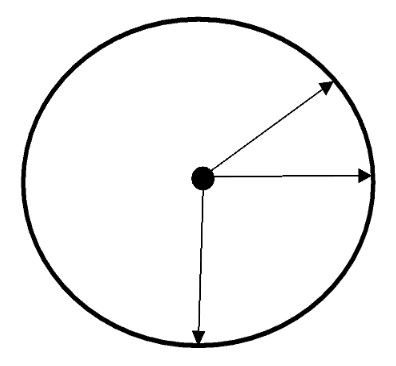 If florets grew in straight rows from the center, then increasingly vacant space would develop between the rows toward the perimeter. Fewer florets would result. Courtesy photo