
 By ROBERT DRYJA
Los Alamos
Consider some the dimensions of a gambel oak tree. It may grow as tall as 30 feet. It is considered to be a large shrub or small tee. Its leaves may be 2 to 7 inches long and 1.5 to 3.5 inches wide with deep lobes, (see Picture 1 below). Its fruit is the acorn seed pod. The lower half of a seed pod connects with a branch. It has a bowl shaped cup at this connecting end. A seed pod may weigh about 1/10 of an ounce.
Now consider a moss. Unlike a gambel oak tree, a moss “branch” may be 0.1 to 3.9 inches long, far less in comparison to the trunk or branches an oak tree. The main branch of a moss may have many small branches encircled with leaves. The leaves may range from 1/20 to 1/3 of inch in length. Based on proportions, the leaves of a gambel oak tree are huge in comparison. Depending on the measurement, an oak leaf may be 21 to 40 times longer compared to a moss. (see Picture 2 below).
This proportional difference reverses when the equivalent support stem is considered for a moss seed pod. A moss grows a stem called a seta. A seta has a pod at its end, called a sporangium. The sporangdium has a number of spores develop in it. The seta may be up 2 inches in length compared to about 1/2 inch for the “stem” at the base an oak seed pod. Proportionally, The moss seta is up to 8 times longer when compared to an oak, (see Picture 3 below).
The variations among plants are reflected in this comparison of oaks and mosses. What is interesting is that a large plant in terms of proportions is not necessarily large in all of its characteristics when compared to a small plant. A small plant may have some characteristics that are large when compared on a proportional basis.
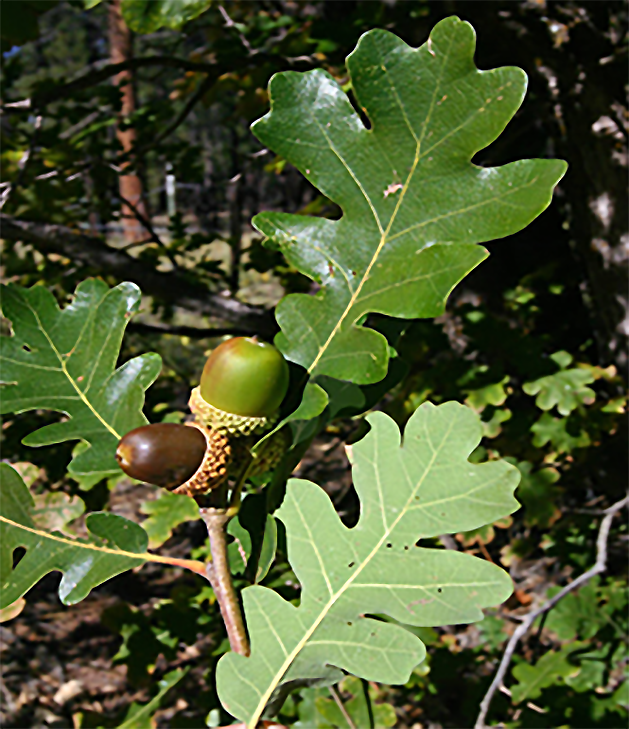 Picture 1: Gambel oak leaves and two seed pods. Photo by Robert Dryja
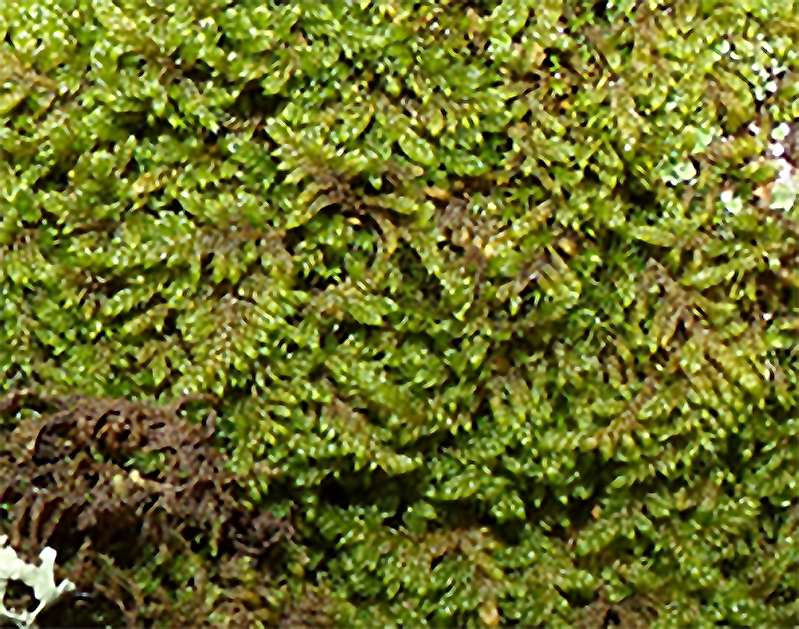 Picture 2: The main branch and many small branches of a species of moss plant. Photo by Robert Dryja
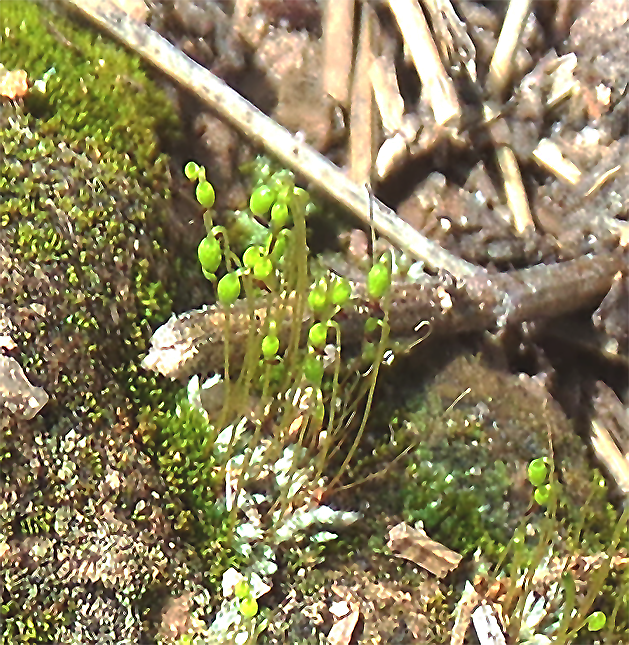 Picture 3: A moss grows spores in a sporangium capsule at the end of a stem called a seta. These stems can be proportionally much longer than the stem at the base of an oak acorn seed. Photo by Robert Dryja