
 The aspen trees are about eight feet tall and a few feet from one other in the Quemazon mesa area that extends eastward from the rim of the Valles Caldera mountains. Photo by Robert Dryja
By ROBERT DRYJA
Los Alamos
The Quemazon mesa area is a geologic thumb that extends eastward from the rim of the Valles Caldera mountains.
It has a relatively flat, sloping top that represents a kind of natural garden for plants growing after the Cerro Grande Forest fire from 22 years ago. Variations in the growth of plants can be seen over the summer. Groves of Aspen trees provide one variation for April and May.
Aspen trees appear in small groves, but one grove can look very different from another. One grove may have trees that are similar in size and with no leaves. Another nearby grove in contrast may be completely covered with leaves. This difference can be explained by how aspen tree grow.
An aspen tree has roots that grow horizontally from its trunk. These roots are relatively close the surface. New trunks can grow upward every few feet. The result is a grove of what appears to be many separate trees but actually is an extension of a single plant. (This is called cloning.) A grove on the Quemazon mesa may be 20 to 100 feet wide but is actually one tree. A clue that a grove is composed of a single plant is given by the similar size of the trees. They all began growing up from the ground at about the same time following the forest fire. The trunks in one grove may be covered with leaves while the trunks in another nearby grove have not yet grown leaves.
Aspens that are a result of cloning can spread over a much larger area, given enough time and the land formation. The Pando grove in Utah covers over a 100 acres. An estimated 40,000 trunks weighing 6,600 tons compose the one plant. This makes it the heaviest known organism. The root system is estimated to be several thousand years old, but any single cloned aspen trunk lives for 100-130 years.
Clonal growth has an advantage in relation to forest fires. The roots are protected by growing underground. A new plant appearing about the ground already has an extensive root system to support its growth. Aspen trees therefore appear as the first new tree growth following a fire. It may be decades for other kinds of trees, such as ponderosa pine, to become the dominant species.
Cloning means that a group of aspen trees have the same genes from a parent tree. Aspen also can reproduce sexually by combining separate sets of genes. There can be an interaction of male pollen with female flowers. Remarkably small seeds are created. Tree branches may appear to have fuzzy caterpillars called catkins hanging from them. Small wispy white balls with a seed can be seen drifting away in a faint breeze. Thousands of seeds may be disbursed from a catkins. They may be carried by breezes for long distances.
An aspen tree therefore has two kinds of reproduction, each with a particular advantage. Clonal reproduction results in a small number of closely spaced tree trunks but which are likely to live. Heterosexual reproduction results in a much wider dispersion but only a few seeds successfully germinate.
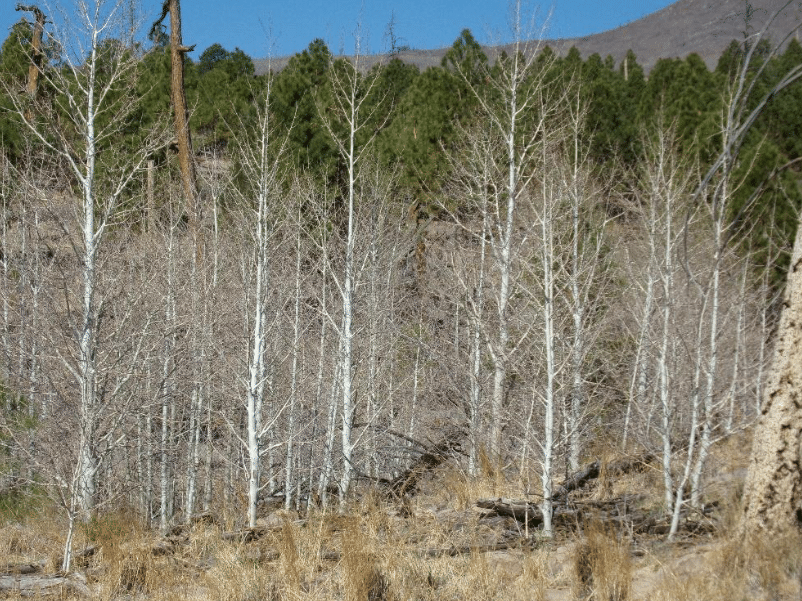 The aspen trees are about 10 feet tall. This grove is a short distance from the grove shown in Picture 1 above. Photo by Robert Dryja
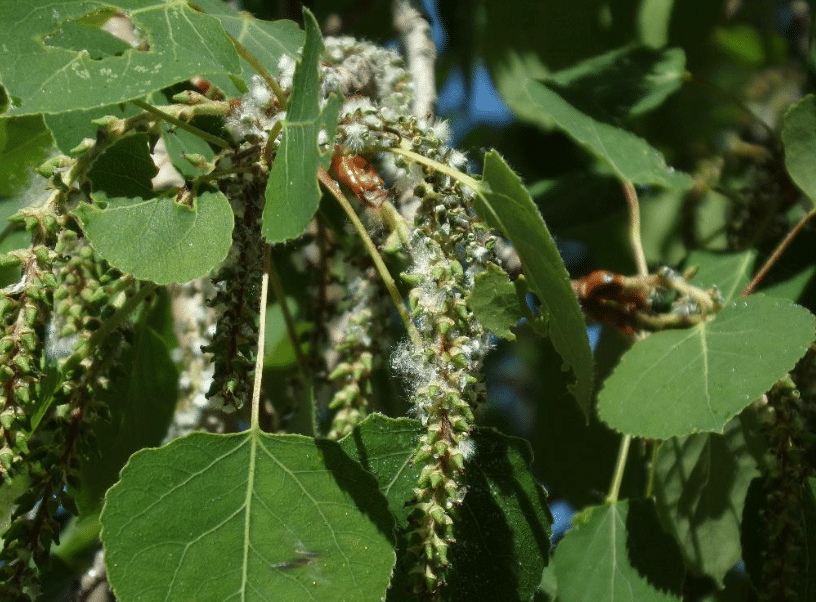 Catkins hanging from a branch. White fuzz toward the top of a catkins is about to be blown away, carrying seeds with it. Each green pod toward the bottom contains growing seeds. Photo by Robert Dryja