
 By ROBERT DRYJA
Los Alamos
Plants and animals have evolved a wide variety of strategies to help them survive. Some species may look similar to one another but have distinctive survival strategy differences.
The canyon tree frog provides an example. It lives near streams and ponds in the New Mexico mountains. It grows to be about two and a half inches in length. It is the variation in its colors that stands out.
It may range from a dark grey rocky color to a woody brown color. (See pictures 1 and 2 below)
These color patterns are not permanent but change depending on whether it is standing on a rock or a branch. A color change to match the surroundings is a strategy that helps its survival. It then becomes difficult to see for predators.
It is therefore surprising when looking at another species of frog that is similar in size. The color of the Panamanian golden frog stands out rather than acting as camouflage from predators. (See picture 3). What is going on?
 Picture 1: A grey colored canyon tree frog sits on a rock of matching color, appearing like a lump of rock. Photo by Katja Schulz
The golden frog once lived along streams and ponds in the high country of Panama. Its environment was analogous to the mountains of New Mexico. The golden frog generated a strong poison in its skin. A predator would discover the frog tasted bad and was poisonous the first time it tried to eat one. It would thereafter avoid attacking the frog again because it was easily identifiable by its color. Different strategies for survival create different colors for frog species.
The golden frog, unfortunately, had other problems that could not be addressed by its color. First, it was popular for catching and then being kept as a pet or being sold. Second, the jungle of Panama was being cut back for agricultural or urban development. Its environment was being reduced. Third, a type of fungus became very common.
The chytrid fungus emerged in Panama as well as throughout the Americas. It was a major contributor to the golden frog dying off. The golden frog has not been seen in the wilds of Panama since 1989 and was declared extinct in 2004. It now survives only under controlled conditions in several zoos in the United States. It has not been released into the wilds of the United States since it may catch the chytrid fungus. It also may release the chytrid fungus to other frogs such as the canyon tree frog.
The canyon tree frog has an environmental advantage in the relation to the chytrid fungus. It may perch in the open on a rock for long periods of time, exposing its skin to sunlight. Its skin becomes dry and so the fungus is not able to easily grow on it. The frog also becomes warmer in the sunlight and in the air immediately around it. The fungus does not grow as well in a warmer setting. Canyon tree frogs have been tested for the fungus, but the fungus does not grow as well compared to the golden frog. A canyon tree frog may become infected but not severely enough to die.
 Picture 2: A canyon tree frog has changed its color to match the tree branch it is sitting on. Courtesy photo
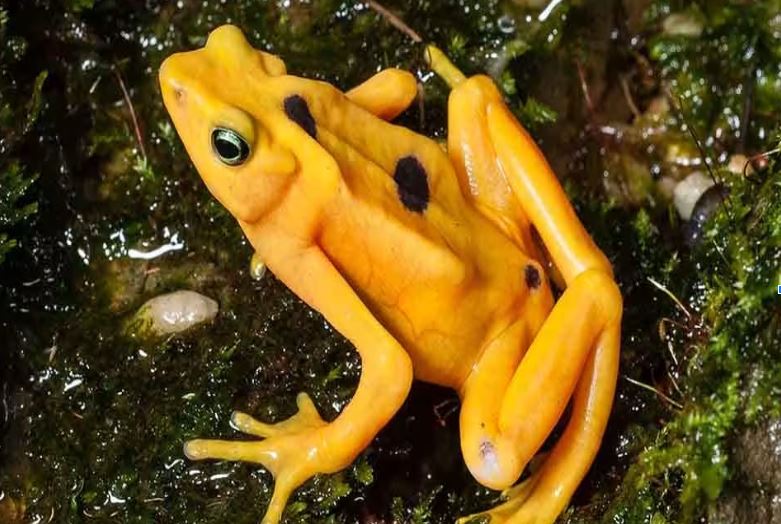 Picture 3: The color of a Panamanian golden frog makes it stand out. Its color acts as a warning, not a type of camouflage. Photo by John P. Clare