
 Photograph A of a possible Rhinogradentia with a large nose similar to Sketch A. Courtesy photo
 Sketch A of a Rhinogradentia with a distinctive nose and short fur. Courtesy/Natural History Magazine
By ROBERT DRYJA
Los Alamos
We have reviewed Rhinogradentia previously and their emergence in the forests of the Co-ro-na-do Mountains of New Mexico.
Rhinogradentia were an isolated species of small mammals that were adapted to living at the warm Hy-yi-yi archipelago in the South Pacific. They were discovered and observed by a Swede named Einar Petterson-Skamtkvist during World War II. Rhinogradentia, popularly called snouters, have followed a parallel evolution to Darwin’s finches.
The finches have evolved different shapes to their beaks based on the differing ecological conditions among the Galapagos Islands. Rhinogradentia evolved different shapes for their noses, adapting to the varying ecological conditions of the Hy-yi-yi archipelago.
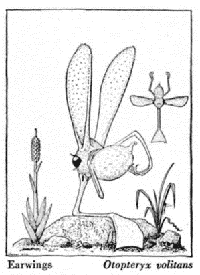
The Hy-yi-yi archipelago collapsed below the ocean as a result of atomic bomb testing taking place at the nearby Bikini and Enewetak Atolls. The Rhinogradentia in the South Pacific became extinct but different species had been brought to New Mexico. The objective was to evaluate the impact of nuclear radiation on these small mammals. One species, Archirhinos hacckelii, had a large muscular nose that allows the Rhinogradentia to flip itself long distances. This avoided having to clamber over rocky land. Another species, Otopteryx volitans, had wing-like ears. It could fly across an island.
Enclosures had been built in the Co-ro-na-do Mountains but a number of the Rhinogradentia escaped by flipping or flying over the fences. This occurred in the early 1950’s. New generations are born on an annual basis and so seventy-five generations now have lived in the mountains. This has provided sufficient time for Rhinogradentia to start to evolve in response to new ecological conditions.
Rhinogradentia had little fur when living on the warm, moist Pacific islands. It therefore would not surprising if they evolved more fur for the colder weather and winter snows of the New Mexico mountains. Indeed, the following sketches and photographs show this is what may be happening.
Photograph A above shows a small mammal with a distinctive large nose, similar to the nose of the Rhinogradentia in Sketch A. The small mammal also has more fur in comparison.
Photograph B below shows another possible Rhinogradentia with large ears, similar to those in Sketch B.
 Photograph B of a possible Rhinogradentia with large ears similar to Sketch B. These ears may evolve further so that it will be able to fly. Note that it has more fur compared to Sketch B. Courtesy photo
 Sketch B of a Rhinogradentia with ears large enough to fly. Courtesy/Natural History magazine
Note that the mammals shown in Photographs A and B are not evolving exactly like the Rhinogradentia in Sketches A and B.
The mammal in Photograph A has both large ears and a large nose while the Rhinogradentia in Sketch A only a has large nose. The mammal in Photograph B only has large ears while the Rhinogradentia in Sketch B has both large ears and large nose.
DNA from preserved Rhinogradentia from the South Pacific needs to be compared with the mammals shown in the photographs. This could confirm how Rhinogradentia have evolved in the mountains of New Mexico.
Ponder this on April 1st.