
 By ROBERT DRYJA
Los Alamos
Lizards are remarkable in many ways. On one hand all the species are similar, based on the length of their tails. Half to three-fourths of their total length is in their tail. Their tail appears more as a continuation of their central body section. It is not that distinct except when emerging after their back legs. Their head and body sections also are more of a single unit.
They do not have a distinct neck between their head and body. Their front legs are what clearly shows where the separation occurs. A lizard would look more like a snake if it did not have legs.
Lizard species vary greatly in size and weight. Whiptail lizards are small, weighing about an ounce and grow to be six to nine inches in length. The gila monster lizard in comparison can weight from 3 to 5 pounds and be up to about 22 inches in length.
The green iguana lizard is even larger. It can weigh up to 18 pounds and reach up to 6 feet in length. They have a patch of skin hanging under the chin along the throat, called a dewlap. The komodo dragon lizard represent the giant among lizard species. It can weigh up to 330 pounds and be 10 feet long.
Suppose humans came in a variety of species like lizards. A 330 pound komodo dragon weighs 5,280 times as much as a whiptail. Proportionally, hypothetical human species could vary from 150 pounds to 396 tons.
A 10 foot long komodo dragon is 13 times longer than a whiptail. Hypothetical human species then could vary from 6 feet to 78 feet long.
 The head, central body, and tail of a whiptail lizard would not stand out if the legs were absent. Courtesy/Beth Cortright
The differences with human species become even more remarkable when the sex of the whiptail lizard species is considered. The whiptail is composed only of females. Two related but distinct species cross-bred to create the present kind of whiptail. New Mexico whiptails have one-half of all their chromosomes derived from one type of parent lizard and one-half from the other species. This kind of hybridization typically results in sterility in the young. However sometimes offspring are produced that are genetically identical with their mother, or all female. This is called parthenogenesis. Imagine if a human species was composed of all female chromosomes that could reproduce successfully.
Some people like to keep lizards as pets. The whiptail lizard understandably would be a popular choice but the komodo dragon also is suggested from time to time. Komodo dragons are carnivores that may eat the equivalent of 80 percent of their body weight at one time. Imagine a 330 pound komodo dragon eating 264 pounds. Never the less, the interest in pet ownership remains as shown in Picture 4.
Some zoos in the United States have komodo dragons. But have any dragons escaped from a zoo over the years? Do the forests of the Jemez Mountains provide a good environment for them? A local artist has a painting on the side of her home that indicates that perhaps a komodo dragon has evolved in the Jemez Mountains.
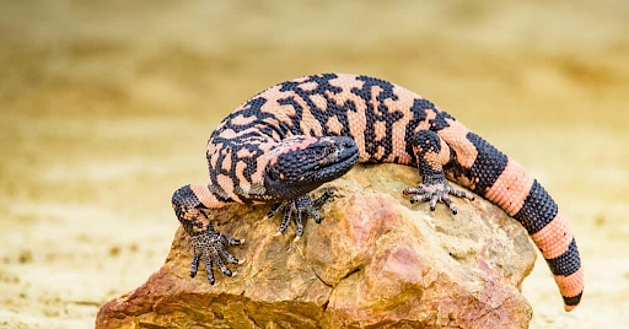 The colors of the Gila Monster help it to blend in with landscape around it. Courtesy photo
 The Green Iguana has scales that stand out distinctly. Courtesy/Midway Veterinary Hospital
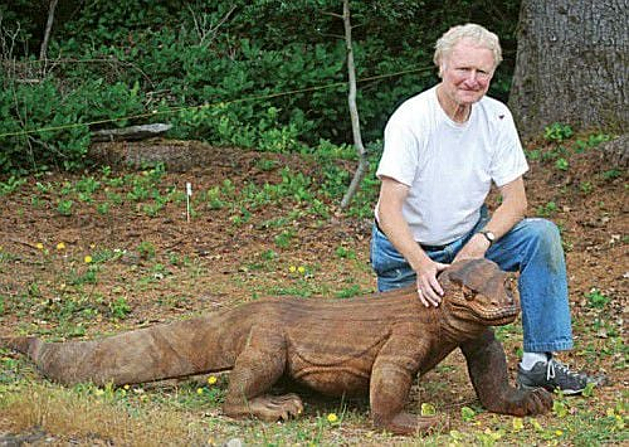 A pet owner poses with his model Komodo dragon. Courtesy photo
 Did a Komodo dragon in the nearby mountains inspire this wall painting? Photo by Robert Dryja