
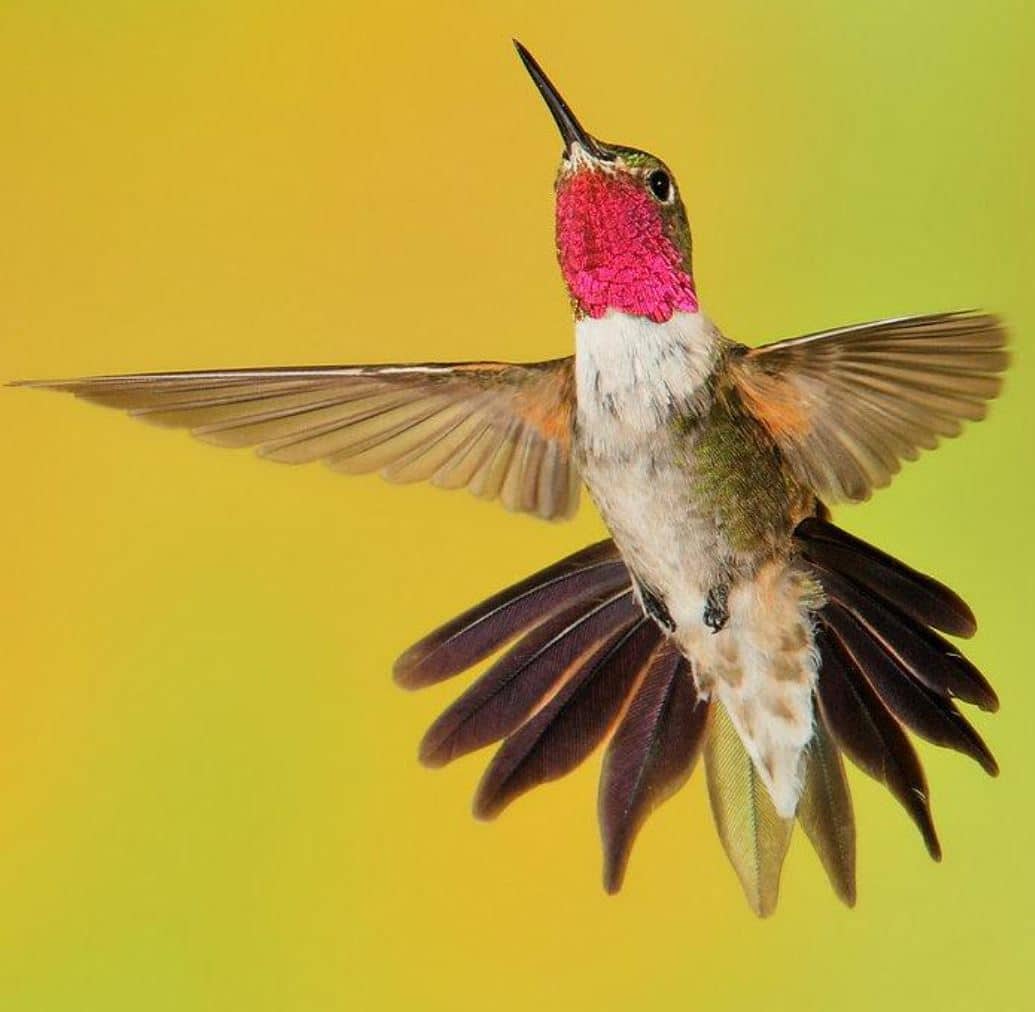
 A broad tailed hummingbird. Photo by Bob Walker
 Two hummingbird eggs in a nest. The nest is about two inches wide. Courtesy Photo
By ROBERT DRYA
Los Alamos
The month of April will arrive shortly and a remarkable bird will be returning at the start of this month.
A calendar can be nearly organized around its arrival date in early April. This bird will be migrating back from its winter stay in southern New Mexico or northern Mexico. This is 300 to 400 miles away in a straight line going south. This line does not consider flying up and over mountains or down into canyons. It also does not consider winds that will be pushing the bird back and forth for even more miles of travel. This bird therefore will fly at least 600 to 800 miles for its annual cycle of summer and winter migration. “Hummingbird” is the name of this bird. It often returns to the same nesting area as part of this annual cycle.
The migratory distance is impressive. The physical dimensions of a hummingbird are equally impressive. The average hummingbird weighs about 4 grams, or 0.14 ounce. The range is from to 2.4 to 4.5 grams. A penny weighs 2.5 grams and a U.S. nickel weighs 5 grams in comparison. This places the weight of a hummingbird in the range of about 1/10 of an ounce. Imagine weighing a 1/10 of an ounce and able to fly hundreds of miles annually.
A hummingbird accomplishes this migratory cycle by eating up to 1/2 of its total body weight in flower nectar every day. A 4-gram hummingbird may sip 2 grams of nectar. The nectar is used for daily energy needs or stored as additional weight for a later migration. Imagine a 100-pound person eating 50 pounds of food each day but maintaining the 100 pounds over a year. A hummingbird clearly is high energy consumer. The heart of a hummingbird supports this high energy use. It can beat as fast as 1,260 beats per minute. Energy use decreases greatly at night when a hummingbird is sleeping. Sleep is more like hibernation with heart beats decreasing to 50 to 180 beats per minute. Humans in comparison have 60 to 100 beats per minute, day or night.
A hummingbird’s ability to complete long-distance journeys is even more remarkable when considering its brain. Hummingbirds migrate by themselves, not in groups. How does a young hummingbird know when start migrating and which direction to fly when it makes its first migration? Its brain evidently is genetically designed to sense the earth’s magnetic field and the sun’s location from day to day. Its genetics also may direct its brain on how to recognize topographic characteristics. A hummingbird may recognize topographic features when it flies over them again from year to year.
The brain of a hummingbird is about 4.2 percent of its total body weight. The brain of a 4-gram hummingbird therefore approaches about 0.2 grams. A human brain weighs about 3 pounds, or 1,361 grams. Even with all that brain, can you imagine a teenager walking by himself to Mexico? How many teenagers talk about sensing magnetic fields in themselves? Do you hear teenagers poining out the position of the sun each day at dawn, noon time, or sunset? Being called a “bird brain” is more of compliment than a put down.
Research shows that hummingbirds can recognize the physical arrangements of flowers. It can recognize which flowers in a group are a good source of nectar and which ones to ignore. This means a hummingbird does not waste its energy going randomly from flower to flowers looking nectar. This ability extends to bird feeders. For example, feeders may be in a row but hummingbirds only go to the first one in the row if they know it contains sugar water. They only change to the next feeder when the first one has been drained.
The egg of hummingbird is about ½ inch long and a 1/3 of an inch wide. It weighs about 1/28 of an ounce or 1 gram. This sounds small until it is compared with an adult. An adult may weigh about 4 grams. An egg therefore weighs about ¼ of an adult. Imagine a 100-pound human mother with a baby that weighs 25 pounds at birth. A hummingbird may lay up to three eggs in a season. Imagine a human mother delivering 75 pounds of babies in one summer. A mother hummingbird therefore devotes a lot energy to creating her young as well as migrating.
Hummingbirds are small but have remarkable attributes. Appreciate them the next time you see one flying by or paused at a feeder. There is so much more to them in addition to their bright colors.