
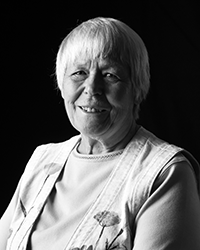
 Dee A. Morrison, 2025 Living Treasure of Los Alamos
By CRAIG MARTIN
Los Alamos Living Treasures
Dee Morrison and her easy smile have been a cornerstone of Girl Scouting in Los Alamos since she arrived in 1983. In those years, she held nearly every possible leadership role at the local and regional levels, and she has garnered just as many leadership awards to honor her tireless service to scouting. But the countless girls and adults she mentored remember her most with her guitar, singing Girl Scout songs around a campfire.
Dee grew up in the mountains of Idaho. Her parents met in Australia where her father was stationed during World War II. Her first Girl Scout experience was at the age of eight when she joined the local troop. Her parents served on the camping committee and Dee attended Girl Scout summer camp every year. There she learned outdoor skills, enhanced by camping trips with her family. In winter the family skied. It was an outdoor life.
Dee never thought much about the guitar. “Guitars were in Country and Western music and rock and roll, and I didn’t care much for either,” she said. But at the age of 16, at camp, another Girl Scout knew every folk song possible and showed Dee the versatility of the instrument and the broad range of singalong songs. “I was hooked and learned to play on a terrible used guitar until my grandparents brought me back a new one from Japan.” She still plays that guitar.
Dee, along with her late husband Bob and their three children Jeni, Tim, and Tyler, moved to Los Alamos in 1982. She looked around and said, “A great town, it has quaking aspens on the hills and our door is 15 minutes from the ski lift.” Within weeks Dee attended the local Brownie Roundup and volunteered to lead her daughter’s troop. “And by the way, do you need a trainer for outdoor skills and do you need a song leader?” Los Alamos Girl Scouting could never have imagined what a life-long leader they had just discovered.
For Girl Scouts in Northern New Mexico, Dee serves the role of “Music Consultant.” She has a song for all occasions and all topics. Dee’s music became an integral part of troop meetings, leadership training, summer camps, Twilight Camps, and Council meetings. Dee not only leads singing, but she teaches girls and adults how to lead in singing and teaching the songs to others. By attending the annual National SongShare, she learns new songs to share with the local Scouting groups. Dee and her Girl Scout granddaughter Taylor even wrote a song “Let’s Have Some More S’mores” to recognize the importance of that marshmallow treat at Twilight Camp.
But it wasn’t just about the songs. Dee has taught thousands of girls and adult leaders how to be safe and to have fun in the outdoors, not only in summer but in winter. In 1994, Dee and several other leaders created a winter outdoor program, Winterfest, at Camp Elliot Barker. The program introduced middle and high school girls how to cross-country ski, snowshoe, build a fire in snow, and how to have fun on a sled. This empowering event continues today.
With her deep commitment to Girl Scouting, Dee has held local and regional leadership positions in many aspects of the scouting organization. In recognition of her willingness and skills in leadership, she has been the recipient of a long list of scouting awards, including the Thanks Badge, a national award that is the highest honor given to an adult whose exceptional service has impacted an entire Girl Scout Council.
But adults need to have fun, too. In 1987, Dee and several other Girl Scout leaders decided to form something like an adult troop to have their own adventures in the outdoors. Calling themselves WOW, Women on Wheeler, the group planned a backpack trip from Camp Elliot Barker to the summit of Wheeler Peak. Dee taught them all how to backpack. They had so much fun they planned a trip or two—biking in Europe, skiing to yurts, canoeing in the Boundary Waters—most every year for the next three decades. They expanded the group to include any female over 18 who was willing but not necessarily able to carry her own backpack. This led to the group’s motto, “It’s a guilt-free trip,” demonstrating the support the women gave to each other. Dee empowered all the participants by teaching them not only outdoor skills but gave them the confidence to be in charge of a group.
Her own interest in Los Alamos history led Dee to the nascent docent program of the Los Alamos Historical Society. There she helped establish guided tours in the historic district and soon began to tote suitcases of artifacts to local classrooms. The suitcase program “took the museum into the classroom”, the cases filled with relics pertaining to various eras of local history to teach fourth graders in their New Mexico history classes. A former fellow docent and now fellow Living Treasure inductee, Georgia Strickfaden, said, “I never told Dee how much she influenced my growth as a guide and teller of the Los Alamos story, but she did!”
Outside of scouting and history education, Dee has been a ski instructor at Pajarito Mountain and continues to ski there every winter. To expand her musical horizons, Dee learned how to play percussion so she could participate in the Los Alamos Community Winds, gradually working up the percussion ranks from triangle to tympani. Recently, Dee’s heart for service has led her to assist with serving lunches at the Senior Center. Diners know her for going out of her way to assist those who need a little extra help.
Her infectious enthusiasm helps others believe that they, too, can make a difference. “The jobs of volunteers are just as important to a community as the work people get paid to do,” Dee believes. “And besides, helping other people is just plain fun.”
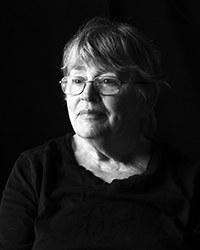 Shelby L. Redondo, 2025 Living Treasure of Los Alamos
By BERNADETTE LAURITZEN
Los Alamos Living Treasures
She was 34 years old when she arrived in Los Alamos in 1983, but even then, she knew she had a strong need to be part of a community. This new home was “My community, my children’s community,” and the need to make positive change began in earnest.
Today, we start a little further back. She graduated from Keyser High School (West Virginia) in 1967, then attended a branch of West Virginia University, which was then called Potomac State College. She studied Agronomy (field crops and soils) and after a camping trip to Utah was inspired to transfer to Utah State University. There she not only received her bachelor’s degree but met Tony, the man she would marry. She followed that by obtaining a master’s degree in education at California State University.
While she and Tony considered eloping, her mother was adamantly against it. They married in June 1971 in Keyser. Her brother even went AWOL from Vietnam for a few days to give the bride away. He then returned to the Da Nang Air Force Base as an airplane mechanic and volunteer Red Beret, rescuing wounded soldiers.
The Redondo family arrived one week before Los Alamos National Laboratory celebrated its 40th anniversary. When the week at the Los Alamos Inn ended, they were unable to stay longer with the huge event descending upon the town. They decided to camp with their two boys and their dog Rontu at Bandelier. It sounds idyllic until the rain arrives. Tony’s Group Leader, Ross Lemmons, was tipped off by a fellow employee and headed to Bandelier to invite them to stay in his home.
She knew one thing when they arrived in Los Alamos that she still holds dear today. “I always felt that it was important to invest in one’s community.” She did just that many times over and always with a goal to assist others. Her handprints are all over programs like: Los Alamos Public Schools, Los Alamos County Aquatic Center Advisory Subcommittee, poll working, voter registration, Los Alamos Retired and Senior Organization, and the Summit Garden Club.
She really found her niche when she retired and began to volunteer for Habitat for Humanity (H4H). Building Kindness, under the umbrella of H4H, was created from an endowment by a couple at the Lutheran Church. Their goal was simple: provide home repairs for low-income people. She volunteered with the group for three years. At that time, they bloomed into their own non-profit, renamed Mesa-to-Mesa, and she was a member of the board of directors.
Shelby’s stories of that time are heartwarming, particularly when she saw that the projects provided the most gratifying experiences for her.
“I’ll never forget the lady with lupus who spent an entire year without hot water,” Shelby said. “We installed a hot water tank in her mobile home; as a result, her first reaction was to take a bubble bath.”
Another project started with a woman who needed help in reducing her monthly heating bill of $500. After patching a hole in the wall and various leaks, they soon found something bigger. This grandmother had patched numerous holes in her kitchen floor. The bigger story was that there was no floor, just the bare ground. The Mesa-to-Mesa team made her a new kitchen floor; she reacted by dancing on it.
The lessons taught her that we could improve people’s lives by reusing materials and furniture that others were planning to discard. The donation of old cabinets prevented hundreds of cockroaches from entering the home. They added steps that allowed a home to have more than one entry and provided all homes with smoke detectors.
Another volunteer opportunity that had an impact on her life dealt with the community’s need for a leisure pool. She was passionate about improving the opportunities for children to learn to swim and providing a fun, recreational, and safe facility for them. There were far too many children in our town who were not learning how to swim.
Her goal was to convince the County Council, and it started with a Letter to the Editor in the Los Alamos Monitor. One of her school bosses may not have liked that, but it made an impact. It may have taken 30 years to accomplish the goal, but how did it feel to see it come to fruition? Her eyes started to fill with tears.
“I cried, I cried, that was the first time I got to see it. They opened it to County employees and their families. I watched this child, this toddler and I started to cry. One of the lifeguards went by and I said, “That’s a future lifeguard right there, this toddler.”
The devoted soccer-loving family includes two sons born in Mérida, Venezuela, Tomás in 1977. He was born in a newer public hospital that lacked toilet paper and had cockroaches running across the bed. Michael arrived in 1980 and they were joined in Los Alamos by sister Rebecca in 1985. The children began their volunteerism with free snow shoveling. While she wasn’t always certain that a few dollars didn’t trade hands, she did instill in them the importance of giving back to one’s community.
Shelby and Tony are lucky to have all three Hilltoppers still in Los Alamos. Tomás earned two bachelor’s degrees in University Studies and Photojournalism from Colorado State University. Michael graduated from the University of New Mexico with two bachelor’s degrees in Spanish and Biology. Michael served time in the Peace Corps and returned to UNM for a master’s degree in Urban and Regional Planning with a concentration in Natural Resources. He worked as a firefighter after the Cerro Grande Fire, was the Los Alamos County Probate Judge and is currently the County Clerk. Rebecca earned a bachelor’s degree in fine arts from the University of New Mexico and an associate’s degree in Machining from Central New Mexico College. She currently works at Mesa Public Library.
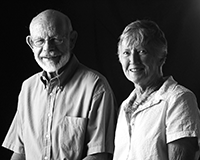 Georgia W. and Gerald E. Strickfaden, 2025 Living Treasures of Los Alamos
By CRAIG MARTIN
Los Alamos Living Treasures
Georgia and Gerry Strickfaden’s Los Alamos roots go way back. Gerry moved to Los Alamos at the age of five, but “Georgia has the honor of being born in the middle of Central Avenue,” Gerry jokes. At the time, of course, the old Army hospital stood there.
Although they were contemporaries at Los Alamos High School, Gerry Strickfaden and Georgia Wilder never met there. Several years later, when both were enrolled in Eastern New Mexico State in Portales, they got to know each other when they shared a ride to Los Alamos in a roommate’s car. When spring break came around, Gerry had a car and offered Georgia and four other women a ride back to Los Alamos. On the return to Portales, the four other women were gone. “He was a sane drive and a good conversationalist,” Georgia said. Five years later, they married in Los Alamos.
Early in their marriage, Georgia ran into an old high school classmate, Margaret Wohlberg, who was the first executive director of the Los Alamos Historical Society. Margaret suggested that Georgia become a docent at the new museum. “What’s a docent?” Georgia asked. But with experience as a schoolteacher, Georgia immediately took to the idea of telling stories about Los Alamos. Her enthusiasm led Los Alamos Scientific Laboratory to hire her, along with Alice Mann, as guides to show prospective employees and especially and their families around Los Alamos. As tour guides, they focused on giving a sense of the community to the newcomers, but they found there was a lot of interest in the history of the town, too.
Although the lab offered her a more lucrative job in statistics, Georgia looked in a different direction. “I thought about it, but I’d have to be inside all day. I couldn’t stand the thought of not being outside.”
Georgia had found her niche and in 1985 she established Buffalo Tours, later renamed Atomic City Tours. Over the next few decades, Georgia drove thousands of new arrivals and tourists around town in her little van. She helped them understand the real Los Alamos, telling the complete story from the Ranch School boys, the families that gave the town its unique flavor, and the residents’ connections to the surrounding communities. Georgia noted, “Many people said I had changed their perception of the Manhattan Project from being ‘five guys in a room’ to that of a community-wide effort that included extensive collaboration, families, and recreational activities.”
A friend who accompanied her on several tours noticed that Georgia approached the audience differently, tailoring the tour based on the questions they asked. “I came away from each tour on a high,” Georgia said.
Georgia’s passion for telling Los Alamos stories reached beyond her hometown, and in 2015, she was named “Tourism Professional of the Year” by the New Mexico Hospitality Association. Locally, the County Council proclaimed January 8, 2020, as “Georgia Strickfaden Day” in Los Alamos.
When Gerry switched his employment from the Zia Company to what was then Los Alamos Scientific Laboratory, he had the fortune of being assigned as officemate to Harlow Russ. Russ helped to develop and assemble the Little Boy and Fat Man atomic bombs that were dropped on Japan in August 1945 and later wrote a book about his experiences. Russ shared stories and showed Gerry the artifacts of Project Alberta that Russ had included as photos in the book, helping spark Gerry’s never-ending interest in the engineering history of Los Alamos.
Gerry’s contributions to historical education are not as visible as Georgia’s, but he has tirelessly searched through Army Corps of Engineer’s records to document the significance of buildings, roads, trails, and artifacts. For years served on the Fuller Lodge-Historic Districts Advisory Board and helped shape the County’s policies and protections of its historic resources.
Together, Georgia and Gerry have organized and guided more than 20 fundraising tours of the Trinity Site, offering onsite tours while presenting background information and providing unique insights from their experiences and research. They also collaborated on documenting the historical significance of the United Church and the Women’s Dorm. Recently, they partnered with Lemonade Living to expand the use of the historic Grant and Lujan Cabins at the Los Alamos Stable Area for individuals with disabilities.
Georgia and Gerry share widely divergent interests in different modes of transportation. Georgia learned to be an equestrian and is known for exploring the canyons and mesas of the Pajarito Plateau on horseback. Her enthusiasm led to her extensive involvement in the Los Alamos Stable Owners Association. As a young engineer, Gerry served on pit crews for race cars around the state. Eventually this led to an interest in restoring old cars and his well-researched restorations are completed with minute attention to historical details.
The Strickfaden home reflects their love of New Mexico and its history. The walls of their passive solar house, designed by Gerry, are decorated with art and photographs from around the state; the bookshelves and tabletops covered with seemingly every book ever written about Los Alamos or the latest editions of New Mexico Magazine. Of course there is also a large garage, currently the home of Gerry’s latest project, restoring an Alfa Romero from its thousands of pieces.
With their kind and genuine spirits, they continually contribute unrecognized acts of thoughtfulness to their friends and neighbors. Remaining active in the United Church, County boards, and the Stable Owners Association, together the Strickfadens continue to shape not only how the story of Los Alamos is told, but the future of the community. Together and individually, they bring infectious enthusiasm to any project to which they turn their attention. For many years, they have been making Los Alamos a better place.