
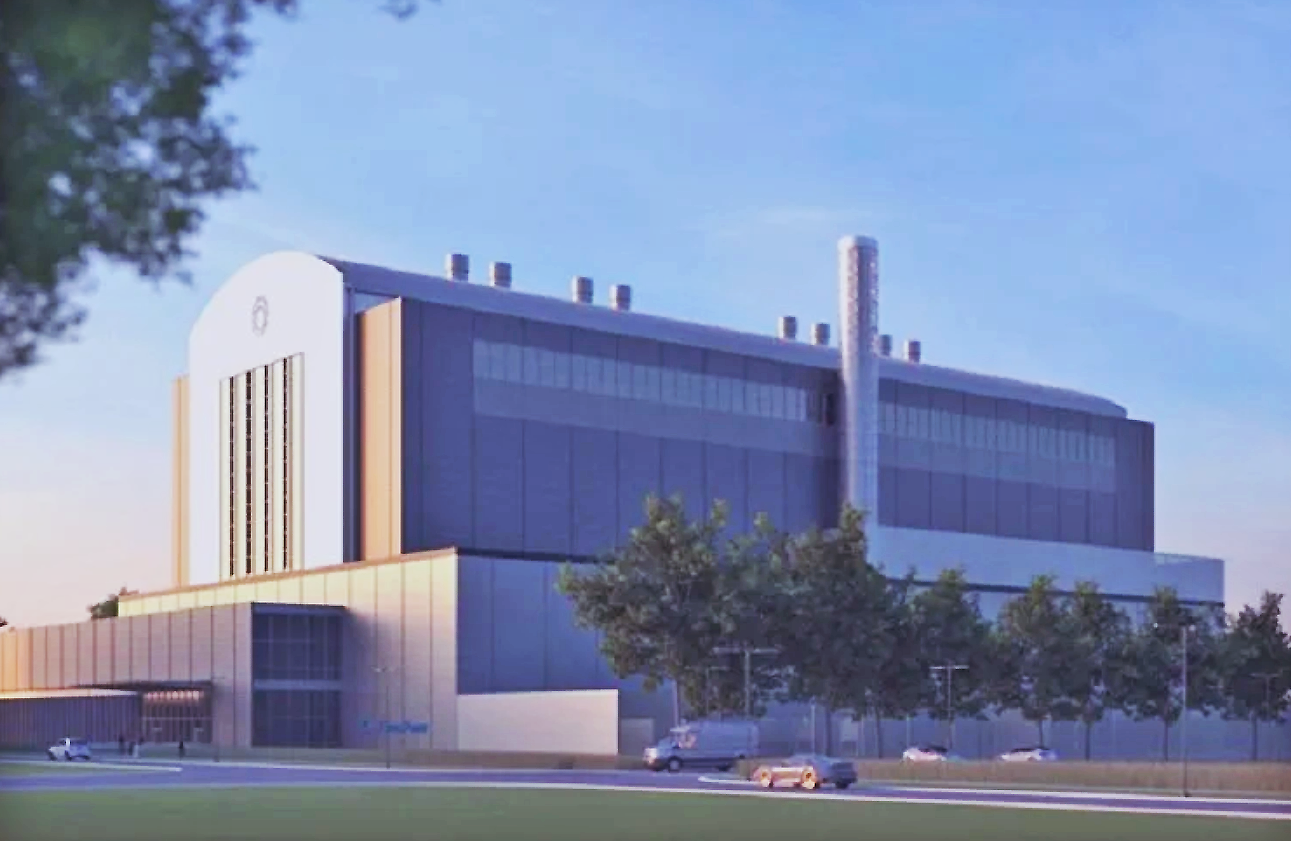
 A rendering of the planned Hermes 2 facility near Oak Ridge National Laboratory, where Kairos Power will build a molten‑salt‑cooled small modular reactor to help fuel Google’s expanding data centers. Source: Kairos Power
By MARLENE WILDEN
Los Alamos Daily Post
marlene@ladailypost.com
New Mexico is racing to keep up with a surge in electricity demand driven by artificial intelligence, high-performance computing and data center expansion. State officials are increasingly focused on making sure residential and small-business customers aren’t left footing the bill.
The tension surfaced again during the latest public town hall at Los Alamos National Laboratory (LANL), where Director Thom Mason said rapidly growing AI and computing workloads are already approaching operational thresholds.
Mason described the lab’s Electric Power Capacity Upgrade Project (EPCU), including major internal distribution upgrades and a new transmission line from Santa Fe, as “foundational” to LANL’s future. The project supports expanded modeling and simulation systems and enhanced experimental facilities under the federal Genesis Mission, launched by recent executive order.
“We were becoming limited by the amount of power available in Los Alamos,” Mason said.
He emphasized that the EPCU project is federally led and funded by the Department of Energy’s National Nuclear Security Administration. The town hall did not address potential cost pass-throughs for local utilities, such as Public Service Company (PNM).
Still, the scale of the upgrades underscores a broader statewide challenge: how to accommodate high-tech growth as AI-driven electricity demand accelerates nationwide.
Attorney General: Protect households from tech-driven costs
New Mexico Attorney General Raúl Torrez made one of his strongest statements to date in a Nov. 19 op-ed in the Albuquerque Journal, arguing that households should not pay the electricity costs of technology companies or industrial users, nor should they face excessive energy burdens.
Torrez urged regulators to adopt rate designs that ensure large energy consumers pay the full cost of serving their massive loads, cautioning that without clear rules, unchecked industrial growth could drive up monthly bills.
Torrez added on social media, “Big tech’s increasing power needs are being discussed across the country. It is critical that we continue to protect working families and small businesses from subsidizing new data centers in New Mexico.”
A Bank of America Institute report this fall showed U.S. utility bills climbed 3.6% year over year in Q3, citing AI-driven electricity demand as a factor.
Power demand renews focus on nuclear
Without major investment, U.S. grid capacity could fall short of peak demand in some regions by around 2028, according to DOE reports.
Christopher Russo, vice president of the Energy Practice at Charles River Associates, points to converging trends: the growing need for very large-scale, long-duration power supplies and the rise of tech companies with enough capital to fund costly new generation projects—including advanced nuclear reactors.
“These factors have all come together over the last two to three years to create the best climate for nuclear in a very long time,” Russo said.
Russo noted nuclear’s role as a carbon-free source for grid stability grows more vital as solar and wind output fluctuate. He added that the rise in renewables requires a corresponding increase in controllable baseload power and that storage, at levels needed, “is still a long way off.”
Nuclear investment, though, remains risky and heavily dependent on regulatory certainty. Early performance of next-generation reactors in Ontario, Georgia and Wyoming could shape investor confidence “for decades,” Russo said.
He warned the industry is in a “footrace with load growth.” If nuclear projects fail to scale quickly enough, other energy sources, potentially more expensive or more carbon-intensive, could fill the gap.
Sector economists add that higher nuclear costs from schedule overruns could raise electricity rates and push wealthier customers off the grid as non-grid energy options become cheaper—a trend noted in industry analyses of small modular reactors, which could leave lower-income households to bear more of the system’s burden.
Nuclear industry sees opportunity—and risk
New Mexico’s emerging role in advanced nuclear development introduces another dimension to the debate. LANL is working with Kairos Power and fusion startups to supply materials, test fuel and support early-stage reactor development.
Mason said expertise developed for national security missions is increasingly being applied to civilian nuclear projects, helping companies navigate “first-of-a-kind” licensing and fuel challenges.
The New Mexico Nuclear Alliance, a trade group formed in July to promote nuclear energy development in the state, says New Mexico is positioned to benefit from the industry’s momentum.
“Nuclear can come in and play an extremely important role, but the safety of the reactor design has to be there,” said Scott Lopez, founder of the alliance.
“Under New Mexico’s Energy Transition Act, utilities must get to carbon-free by 2045. Every project, including AI data centers, has to fit that framework,” Lopez said. “PNM is aiming for 2040. By around 2030, we’re hopeful that small and medium-sized reactor designs start to come online, giving utilities more options to meet that demand.”
Local impacts and open questions
In Los Alamos County, where LANL accounts for an estimated 80 percent of electricity use, officials welcome assurances to households but remain uncertain how a strain on finite resources could affect long-range planning.
“We do not expect its AI and HPC expansion to directly affect county residential or small-business electric rates, since the lab operates its own electric distribution system under a separate federal power-supply contract,” said Philo Shelton, the County’s utilities manager.
Water supply remains a larger unknown. Shelton said the County is working closely with the lab as it completes a sitewide environmental assessment to better understand cooling needs.
“Our community has limited water rights,” Shelton said. “We don’t want those needs to affect residential customers, and our water sales agreement with the lab allows us to negotiate additional supply that could come at a higher cost than it has paid in the past if, for example, we need to drill a new well.”
Balancing growth and affordability
State and local officials widely agree that AI, data centers and nuclear technology offer significant economic potential—but only if growth does not come at the expense of affordability.
Torrez said New Mexico must “carefully balance economic development with fair and sustainable energy policies,” a sentiment echoed by analysts who raise the concern that load growth is not guaranteed and could leave utilities or ratepayers exposed if projects fail to materialize. Russo said investors are watching whether regulators will allow higher prices tied to rapid, big tech-led growth or intervene to shield consumers.
“Everyone likes markets, at least until they start costing consumers more every month,” he said. “Only time will tell.”
For now, LANL officials say the distinction between federally funded infrastructure and local utility operations can be managed through appropriations tied to the Genesis Mission and other national security programs. Local leaders acknowledge that the broader question of who ultimately pays—and what new rate structures and cost-allocation approaches might be needed—is merely beginning to take shape.