
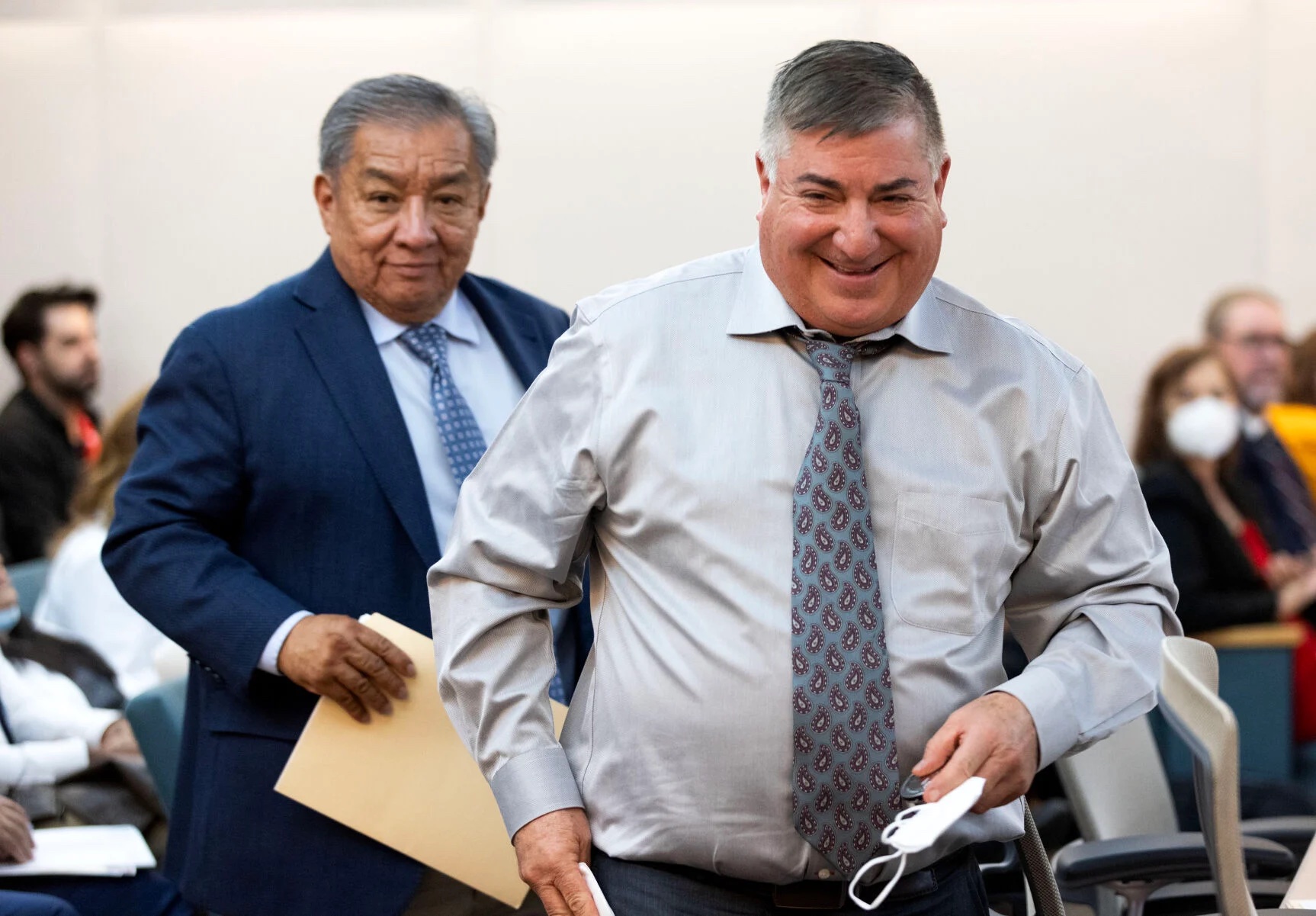
 State Sen. George Muñoz arrives at the Senate Health and Public Affairs Committee for a hearing on a key behavioral health bill at the state Capitol Wednesday, Jan. 29, 2025. Photo by Michael G. Seamans/The New Mexican
By MARGARET O’HARA
The Santa Fe New Mexican
A committee hearing room at the state Capitol was spotted with white coats Wednesday afternoon.
Even Sen. Martin Hickey, an Albuquerque Democrat and the only doctor in the Legislature, wore his white coat in his seat on the rostrum.
Doctors — and many other advocates — packed the meeting room as the Senate Health and Public Affairs Committee heard a bipartisan package of three bills aimed at reforming and funding New Mexico’s behavioral health system to meet growing needs. One of the measures, which would establish a $1 billion trust fund for behavioral health services, secured unanimous support from the lawmakers, advancing it to the powerful Senate Finance Committee.
Two others are scheduled to be considered again next week after their sponsors consider proposed changes.
“Medical care takes a team, a vital part of comprehensive health care. We all work together to take care of the whole patient,” Dr. Angelina Villas-Adams, president of the New Mexico Medical Society, told lawmakers.
Under SB 1, a behavioral health trust fund would be administered by the New Mexico Health Care Authority to pay for mental health and substance abuse treatment and behavioral health infrastructure.
After it’s fully funded, the trust fund would spin off $50 million annually for services, Sen. George Muñoz, a Gallup Democrat who co-sponsored the bill, said as he introduced it. Muñoz chairs the Senate Finance Committee, where the bill faces its next hurdle before a vote on the Senate floor.
“Our goal is to take the state’s nonreoccurring dollars and make them reoccurring,” Muñoz said, referring to lawmakers’ plan to put part of $3 billion in one-time spending in investment funds that create revenue streams.
Freshman Sen. Jay Block, R-Rio Rancho, shared his story of growing up with addiction in the home and suffering post-traumatic stress disorder following military service. He said he would support the proposed trust fund because, he said, “I don’t want another kid to go through what I went through or another veteran to go through what I went through.”
While Senate Bill 1 would set the long-term vision for behavioral health spending in New Mexico, Senate Bill 2 would provide an “initial down payment” of $140 million to support a variety of behavioral health initiatives, Muñoz said.
Big-ticket appropriations in SB 2 include $43 million to support transitional acute care facilities and $48 million for the expansion of housing aid and services, including accommodations for patients undergoing behavioral health treatment and substance abuse recovery, as well as transitional housing and homelessness assistance.
Other appropriations would go toward mobile crisis response services, outpatient treatment, education and outreach.
Representatives from Pojoaque, Acoma and Taos pueblos and the Department of Public Safety spoke in favor of SB 2, as did the Veterans and Military Families Caucus.
Senate Bill 3, known as the Behavioral Health Reform and Investment Act, would create a structure for spending revenue generated by the trust fund and one-time appropriations, requiring region-specific plans to address local behavioral health needs.
Under SB 3, the Administrative Office of the Courts would be responsible for dividing the state into “behavioral health regions,” coordinating the development of regional plans, including a timeline and performance measures for evaluating progress.
The bill was presented by two often at-odds party leaders: Senate Majority Leader Peter Wirth, D-Santa Fe, and Senate Minority Leader Bill Sharer, R-Farmington.
“This is the guardrail bill to ensure that there’s accountability for the management and use of these funds,” Wirth said.
Sharer added, “I would not have signed onto this without the guardrails, so that to me is the piece of this that makes this worth doing.”
Some committee members proposed changes to expand the bills’ stakeholder input requirements and discussed whether the Administrative Office of the Courts is the most appropriate agency to coordinate behavioral health-related changes, delaying a vote on the two measures.
“I don’t want to push this; it’s too important, and we have the time,” Wirth told the committee, which will take up the package at its next meeting Monday.