
SFNF News:
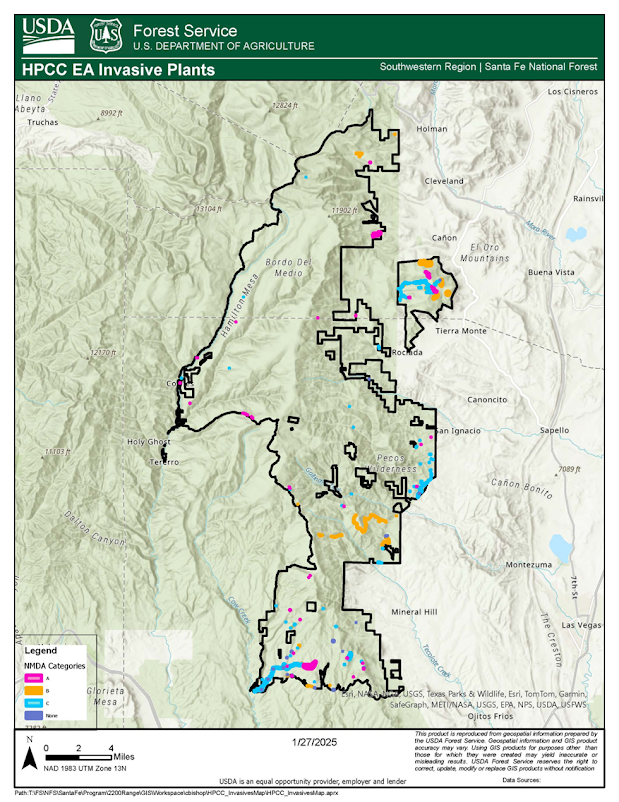
SANTA FE — Starting July 1, the Santa Fe National Forest (SFNF) in collaboration with the National Forest Foundation (NFF) will use a variety of vegetation management strategies to treat invasive species on 1,400 acres per year totaling 4,200 acres over 3 to 4 years within the Hermit’s Peak Calf Canyon (HPCC) burned area. “By implementing adaptive invasive plant management strategies, such as targeted herbicide application, we can foster the recovery of native plants that are resilient against disturbances like floods and wildfires,” Christine Bishop stated, Invasive Plant Program Manager.
A contractor will use both herbicide application and manual removal, focusing the work along fire containment features like fire lines or fuel breaks. Signs will be posted near treatment areas stating the name of the herbicide or management strategy used and the dates of when to avoid the area. During project implementation, alternative recreation and access options will beidentified on the SFNF website.
Crews will carry out this work between June and October 2025. Herbicide will be applied directly to leaves or spot-sprayed in specific areas using a backpack sprayer or squirt bottle. Before applying the herbicide, weather conditions will be monitored. If rain is forecasted within 48 hours before or after the scheduled application, the treatment will be postponed until conditions improve. Throughout the project, a contractor will document and map both new and existing areas with invasive species and will provide updates to the SFNF on their progress.
Post-fire recovery efforts have been ongoing since the Hermit’s Peak Calf Canyon wildfire burned USDA Forest Service land and private property in Mora and San Miguel counties, New Mexico, in 2022. Collaborating with federal, state, and local government agencies, as well as Tribes and Land Grants, current recovery strategies include removing hazardous trees that pose risks to roads, powerlines, and structures, investing in the New Mexico Reforestation Center, planting tree seedlings across 4,000 acres, and aerial seeding across 12,000 acres.
For updates on HPCC recovery work visit the SFNF website, and social media (Facebook and X).
About the Forest Service
The USDA Forest Service has for more than 100 years brought people and communities together to answer the call of conservation. Grounded in world-class science and technology– and rooted in communities–the Forest Service connects people to nature and to each other. The Forest Service cares for shared natural resources in ways that promote lasting economic, ecological, and social vitality. The agency manages 193 million acres of public land, provides assistance to state and private landowners, maintains the largest wildland fire and forestry research organizations in the world. The Forest Service also has either a direct or indirect role in stewardship of about 900 million forested acres within the U.S., of which over 130 million acres are urban forests where most Americans live.