
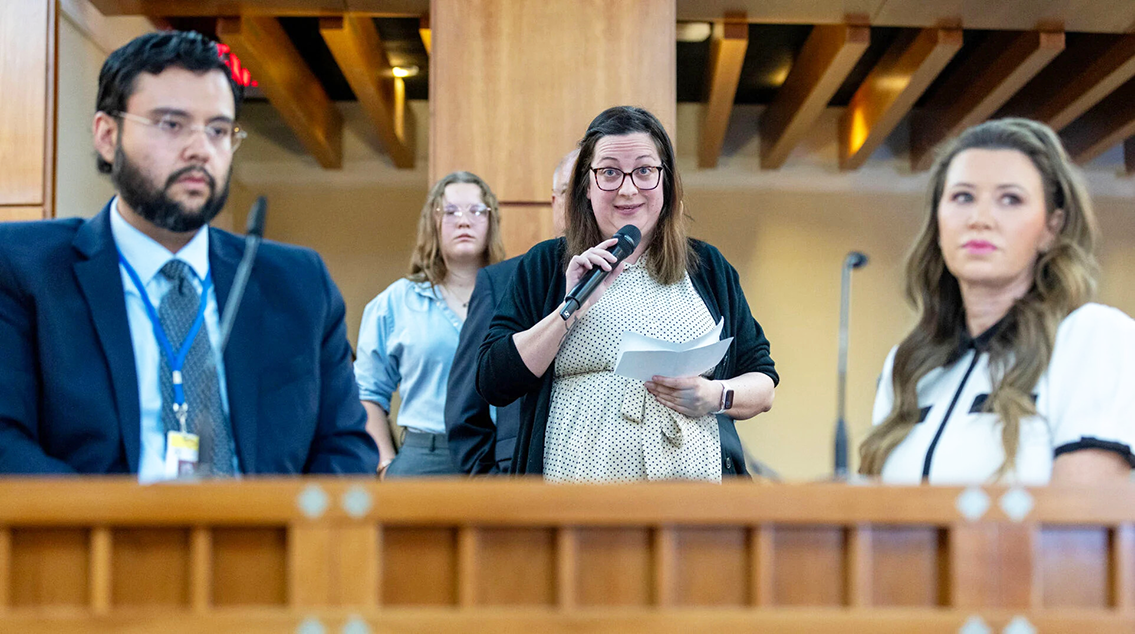
 Whitney Holland, president of New Mexico’s teachers union, gives testimony in support of Senate Bill 11 during a hearing at the state Capitol on Wednesday, Jan. 29, 2025. Photo by Michael G. Seamans/The New Mexican
 Sen. Crystal Brantley, R-Elephant Butte, presents Senate Bill 11, which discourages cellphones in classrooms, during a committee meeting at the Capitol on Wednesday, Jan. 29, 2025. Photo by Michael G. Seamans/The New Mexican
By ANDRÉ SALKIN
The Santa Fe New Mexican
The education community, which has been grappling for years with the detriments of disruptive classroom phone use, has mixed views on a proposal to spend $10 million to encourage school districts to adopt devices enabling locked cellphone policies.
“I don’t know if $10 million is going to actually be enough,” said Santa Fe Public Schools Superintendent Hilario “Larry” Chavez. “You know, we are also piloting cellphone-blocking devices. And they’re pretty costly. So, you know, I can just imagine if we’re buying one for every classroom.”
“Also,” Chavez continued, “bags get destroyed or no longer lock, so you’ll need replacement bags. We’re seeing that in our schools.”
Sen. Crystal Brantley, R-Elephant Butte, is sponsoring the bill, which passed out of the Senate Education Committee last week. Brantley modeled the bill off of Taos Municipal Schools, one of the state’s first districts — if not the first — to implement a districtwide locked phone policy starting last fall.
Taos uses not the Yondr bag Santa Fe does but the CellLockED one, which Superintendent Antonio Layton said cost the district $15 to $20 per bag. Taos bought its bags using the district’s safety and security funding — another point of contention during last week’s committee hearing. Layton said he would like to see his district get reimbursed for the cost.
“Considering that we’re having some influence of legislation, I would hope that maybe there can be considerations for our district to get the reimbursements, even given the fact that we were very frugal in making sure that we spent our public funds wisely,” Layton said.
Layton said he had no idea his district would be a model for the bill, and that Brantley never reached out to consult with him while drafting the bill.
“ We have a positive outcome in that we see more student engagement incidents within the schools that we implemented with,” Layton said. “It’s gone down tremendously. So we’re pretty pleased with it. Of course, you know, We’re looking forward to seeing what the numbers look like because all of this was just to also help, um, increase our proficiency.”
Layton said he could imagine the bill helping with districts facing pushback from parents over the policies. But, Taos’ roll-out, which was heavily based in community involvement, Layton, said, was instrumental in gaining community acceptance.
Layton wished though, that the policy was a universal mandate rather than an encouragement, and offered his help to other school districts seeking to adopt a locked-phone policy.
Albuquerque Public Schools have experimented with some locked policies, like a phone lockbox at the district’s Taylor Middle School, implemented in 2021 after concerns of post-COVID learning loss.
“We will review the legislation and its potential effect on the district,” wrote Phill Casaus, executive director of communications and engagement for Albuquerque Public Schools. Casaus added the district already has a policy prohibiting cellphones in the classroom, except in special circumstances.
The bill passed out of committee on a 7-2 vote. Whitney Holland, President of the American Federation of Teachers New Mexico union, spoke in support of the bill at last week’s hearing.
”As an education union, our top priority is fostering an environment where students can learn and educators can teach. The overuse of cellphones in schools has become a significant barrier to the school,” she said.
A recent survey of educators, she said, found phones were the single largest challenge for educators and that phone use, “distracts students, disrupts classroom engagement and contributes to anxiety and bullying.”
One lone speaker stood before the committee in opposition to the bill — Brennan Shock, a student at Cliff High School in Silver City, whose school uses shoe holders to restrict phone use.
“ One question I have,” he said, “is how does this teach us down the road be responsible and manage our own time if we … have to put our phones up and not be responsible?”