
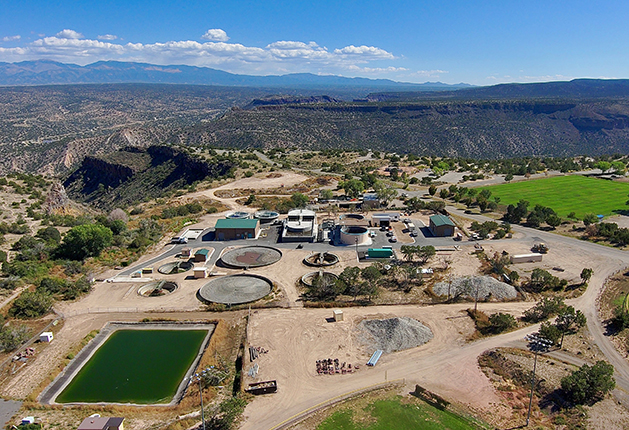
 An aerial view of the Water Resource Reclamation Facility in White Rock. Courtesy/LAC
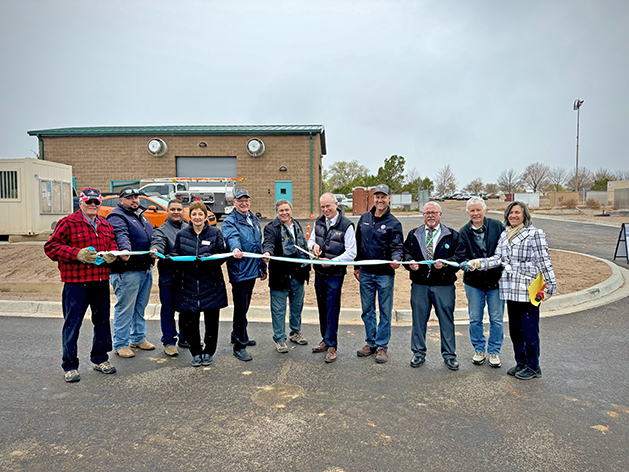 The ribbon cutting held Nov. 5 celebrates the completion of the Water Resource Reclamation Facility. From left, BPU Chair Robert Gibson, DPU Wastewater Superintendent Joshua Silva, DPU Project Manager James Martinez, Council Chair Denise Derkacs, County Utilities Manager Philo Shelton, Councilor David Reagor, NMED Cabinet Secretary James C. Kenney, DPU Deputy Utility Manager Clay Moseley, NMED Deputy Cabinet Secretary John Rhoderick, Councilor Theresa Cull and Deputy County Manager Linda Matteson. Courtesy/LAC
By KIRSTEN LASKEY
Los Alamos Daily Post
kirsten@ladailypost.com
It might be hard to conceive but the new wastewater treatment plant in White Rock, now known as the Water Resource Reclamation Facility, is notable for its innovation in cleanliness.
Sure, the facility handles some very foul, very non-aesthetic material, but the technology and processes utilized to treat that material produces some of the cleanest effluent water ever, according to Deputy Utility Manager for Gas, Water, and Sewer Services Clay Moseley.
As Moseley pointed out, the technology in the previous plant was cutting edge – in 1960. It used clarifiers and rock media trickling filters to remove biological items, he said. The plant utilized two clarification processes but still ended up with wastewater that had a fair amount of nitrogen and other components. It removed 98 percent of materials but that remaining 2 percent still had a lot of things that are now considered pollutants.
“It was clear water,” he said. “It looked good, but it had a lot of nitrates, nitrites and ammonia.”
As the plant’s age grew, it was more difficult for it to meet federal and state discharge permit limits.
In comparison, the new plant is entirely different. Moseley said the system includes adding oxygen for bacteria metabolism, exposing water to UV and operates a filtration system.
“We are now producing the highest class of clean effluent water,” he said. “…it is much safer and cleaner to be in contact with humans in our parks and elsewhere.”
“I am pleased to be able to offer that quality of product,” Department of Public Utilities (DPU) Manager Philo Shelton, added. “Regionally, water that eventually reaches the Rio Grande is clean and will not impact our neighbors.”
Plus, Shelton said DPU is well under the discharge permit requirements from the state’s environment department. The new plant treats 350,000 gallons a day but has the capacity to handle 700,000 gallons.
Moseley explained the County uses treated effluent water to irrigate its parks and public fields. The treated water from the White Rock Water Resource Reclamation Facility is primarily used to water Overlook Park. If White Rock grows and the amount of treated water increases, special pipelines can be installed to irrigate Chamisa and Pinon elementary schools, Moseley adds.
“In the future we are ready to do that,” he said.
During the winter months or when the fields are not being irrigated, Moseley said the treated water is diverted back to the Rio Grande River.
DPU leadership began planning for this new, cutting-edge facility more than 10 years ago, he said. However, work began in earnest in 2019, and actual construction started in 2021. The pandemic made the project more interesting, and unfortunately more expensive, Moseley said, adding that the project team constantly needed to pivot. Plus, there were supply chain delays. The plant was finally turned on in May and water from the old plant was diverted to the new plant.
Moseley said an innovative idea really helped the project.
He explained the consulting engineering team suggested issuing requests for proposals (RFPs) to all the vendors that sold equipment needed for the new plant in 2019. The RFPs were awarded pre-pandemic, so those agreements were firmly in place. Plus, the plant was built around those pieces of equipment.
“It was a stroke of luck and I think it would have been a major problem had we not done that,” Moseley said.
As the project pivoted, the budget also evolved, Moseley said.
At first, Moseley said the cost was expected to be $14 million but this price tag was revised in 2017 to total $17 million. In 2019, the cost shot up to $20 million, which is what it was initially financed for through the New Mexico Environment Department (NMED) Construction Programs Bureau. With the supply chain delays and prices increasing, Moseley said the final cost was $30 million.
NMED supported the project, he said, and provided the loan at a very low interest rate – 2 percent. Moseley said the state Finance Authority was able to negotiate an even lower rate – less than 1 percent, which is a huge savings to County rate payers over the life of the loan.
“They are really trying to promote investment into infrastructure,” he said. “There is a lot of work and trouble taken to get a project off the ground … it takes a lot of organization and managerial oversight … to get a project done and there is a lot of risk. That’s why this feels very satisfying.”
Moseley credited the project team for the plant’s successful completion as well as the construction contractor, RMCI that is based in Albuquerque.
The old plant is shut down but that doesn’t mean that it is entirely out. Mosely said the process of decommissioning it has continued since going offline. Looking toward future needs, the plan is to use some of the old basins for additional water storage. He explained the basins can be repurposed to store water surplus, noting they are made of great concrete, and they are watertight. This, he said will be a “tremendous cost savings in the future.”
With the White Rock Water Resource Reclamation Facility completed, the 20-year-old Los Alamos wastewater treatment plant is now being eyed for improvements.
Moseley said the goal has been to create the highest class of effluent water, Class 1A, at both plants. As a result, he said an additional filtration process has been completed at the Los Alamos plant to reach Class 1A effluent and a condition assessment is being developed for other replacements and upgrades. Electrical upgrades are needed, too. He pointed out that when a plant runs 24 hours, seven days a week, components wear out and need to be replaced.
Throughout the entire process of getting the White Rock Water Resource Reclamation Facility built, Moseley commended everyone from the County to the public for their support.
“We really appreciate everybody in the County being patient and … County citizens have been really supportive,” he said. “They have been asking interesting questions and Council has been supportive, the County staff – in other departments – have been helpful. It’s just been really cool to see the team and the County come together behind something like this. People appreciate what we went through. People have supported and maintained an interest in it.”
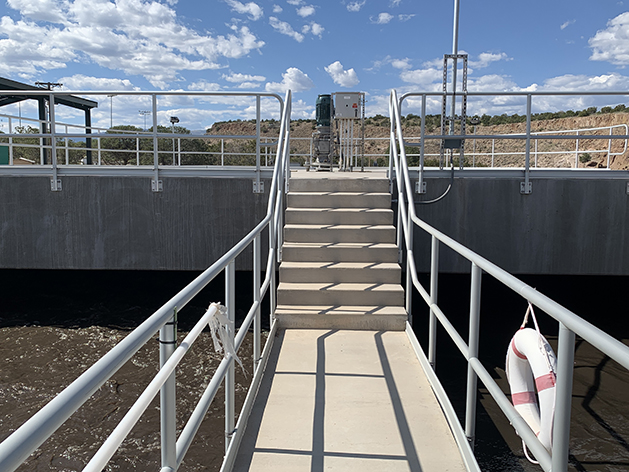 The oxidation ditch at the Water Resource Reclamation Facility. Courtesy/LAC
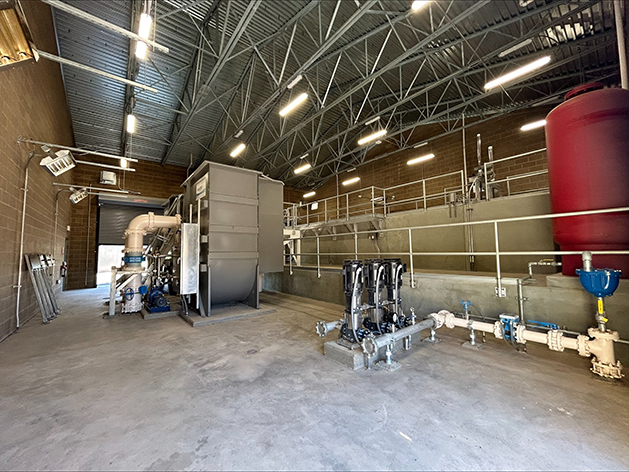 The inside of the tertiary treatment building with filtering tanks and a water pressure tank at the Water Resource Reclamation Facility. Courtesy/LAC
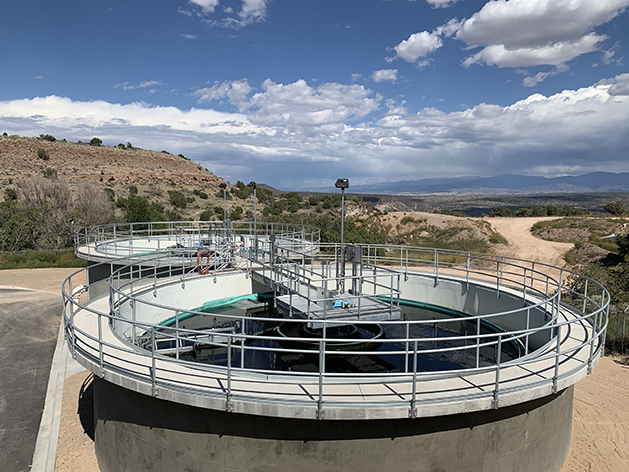 The view of secondary clarifiers at the Water Resource Reclamation Facility. Courtesy/LAC
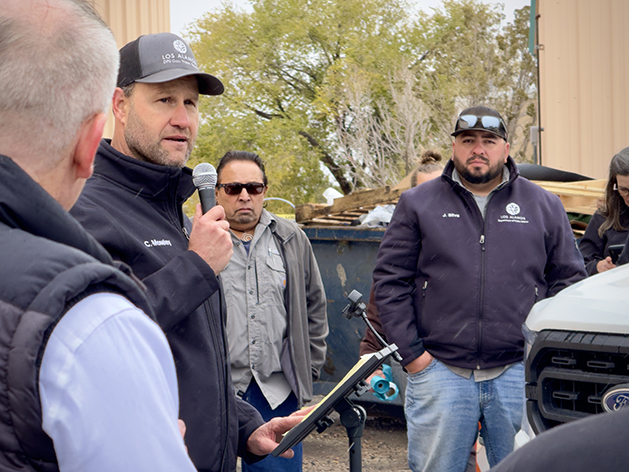 DPU Deputy Manager Clay Moseley speaks at the ribbon cutting event for the Water Resource Reclamation Facility. Courtesy/LAC
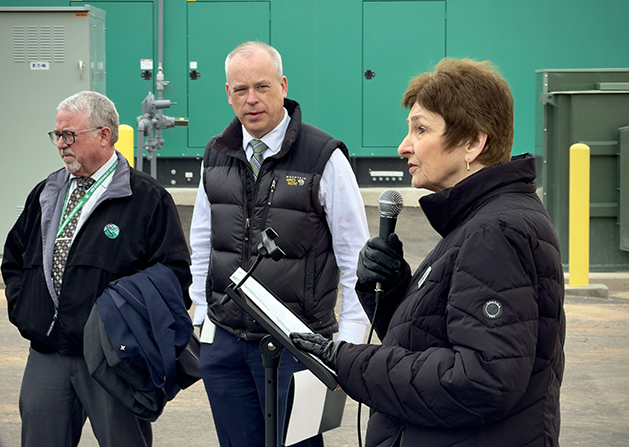 Los Alamos County Council Chair Denise Derkacs speaks at the ribbon cutting event for the Water Resource Reclamation Facility. Courtesy/LAC