
 By RICHARD SKOLNIK
Los Alamos
Editor’s Note: This is the ninth in a series of COVID-19 Updates by Richard Skolnik that appear bi-weekly in the Los Alamos Daily Post. These are meant to keep the community informed on the status of the pandemic, critical new findings on the pandemic, and what this information suggests for our community’s response to COVID-19. These updates complement the data that Eli Ben-Naim prepares for the Post. Unless otherwise noted, data is from the New York Times and the New Mexico Department of Health.
Pandemic Data and Trends – For the Week Ending January 3, 2022
In the US, the daily average of new cases increased by 239% over the last two weeks. Hospitalizations increased by 41% and are at an all-time pandemic high. However, deaths declined by 3%. The daily average of new cases in the US over the last week was about 487,000, equal to 147 cases per 100,000 population. Louisiana had the highest rate of increase, at 782%. Only one state, Maine, had a decreasing rate of new cases.
Over the last two weeks, the daily average of new cases in New Mexico rose by 54%. Hospitalizations declined by 20% and deaths decreased by 29%. The daily average number of cases over the last week was 1,688, or 81 per 100,000. Almost 76% of all New Mexicans over age 18 have “completed their vaccine series.” However, only 36% of them have had a booster shot. About 57% of those 12-17 and 17% of those 5-11 have “completed their vaccine series.”
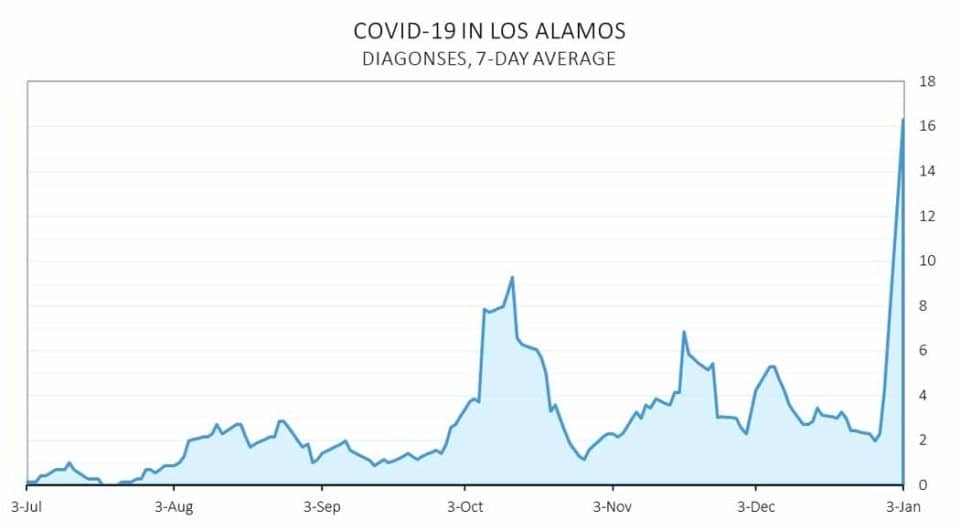
Los Alamos had a daily average over the last week of about 16 cases, equal to about 85 per 100,000 population. This was an increase of 448% over the last 14 days and is the highest number of new cases since the pandemic began. The epidemic curve for Los Alamos since July 2021 and the age distribution of new cases over the last two weeks are shown in the graphics below (Thanks to Eli Ben-Naim). About 68% of all people in Los Alamos County over 5 years of age “have completed their vaccine series.”

Important Pandemic Information
A substantial number of people are now testing themselves at home and may not be reporting positive results to public health authorities. Thus, case counts are likely to understate the true number of cases.
Pediatric cases in the US are at their highest level ever, with about 325,000 cases for the week ending December 30. This is almost double the number of cases in the week of December 9. The rate of childhood hospitalization and severe illness remains low. However, in December, the number of children hospitalized increased by 50%.
In New Mexico, from November 29 to December 27, 2021 the risk of being infected, hospitalized, and dying was 3.9 times, 8.8 times, and 8.4 times greater if you were “not fully vaccinated” than if you were “fully vaccinated.”
CDC has shortened the recommended times for isolation and quarantine. The new guidance can be found here.
The FDA amended emergency use authorization to allow booster shots with the Pfizer vaccine for those 16 and 17 years of age and at least 6 months after the completion of their vaccine series.
The Omicron variant is now circulating throughout the US. The virus is highly contagious, with some experts comparing its transmissibility to measles, which infects about 90% of the non-immune people who are exposed to it. It appears, however, that hospitalizations related to infection with the Omicron variant are not increasing at the same rates as cases. Hospitalizations continue to be driven largely by unvaccinated people. The large number of infections is causing social and economic disruptions.
What Can We Do Next?
Although vaccines will not stop all infections, they remain effective in preventing severe illness, hospitalization, and death. People who are eligible but not yet vaccinated need to be vaccinated urgently. People who are eligible but not yet boosted need to be boosted urgently. People who are eligible need to be vaccinated against influenza. The last thing we need right now is a “twindemic” of COVID-19 and the flu.
The quality of masks makes a difference to their effectiveness. Yet, this has not gotten sufficient attention and many people continue to wear masks of low quality. A recent Scientific American article discussed this matter. (link)
The challenges of reopening schools safely and keeping them open will be substantial. With this in mind, the Los Alamos Public Schools have increased the availability of testing. The closer we come to testing all of our students as school begins, the safer the reopening will be. The closer we come to quickly testing and getting results for anyone showing symptoms in the future, the safer Los Alamos will be. It will also be important for families to support the enhanced mitigation measures that the LAPS is taking to try to address the Omicron variant.
Most experts believe that the number of Omicron cases will surge quickly and then fall quickly. This could lead to a period of intense risk of exposure to the virus. It is critical that all of us do what we can during this period to avoid unnecessary risks of exposure and its consequences for viral transmission within our families and the community.
Editor’s Note: Richard Skolnik is the former regional director for health for South Asia at the World Bank. He was the director of an AIDS treatment program for Harvard and taught Global Health at the George Washington University and Yale. He is the author of Global Health 101 and the instructor for Yale/Coursera’s Essentials of Global Health. Skolnik has written this article in his personal capacity.