
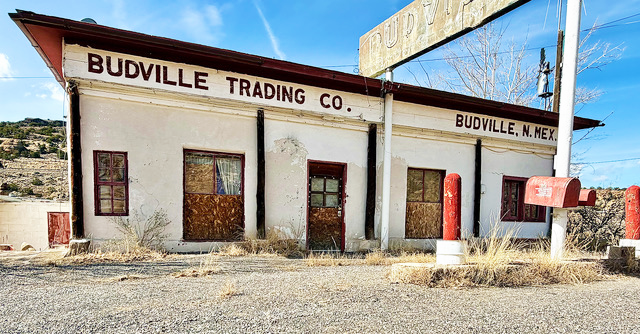
 Budville Trading Company: The exterior of the Budville Trading Company sits silent today. The old gas pumps are gone and the place remains a monument to better times. The building has obviously been maintained over the years and still attracts many Historic Route 66 travelers today. Photo by Gary Warren/ladailypost.com
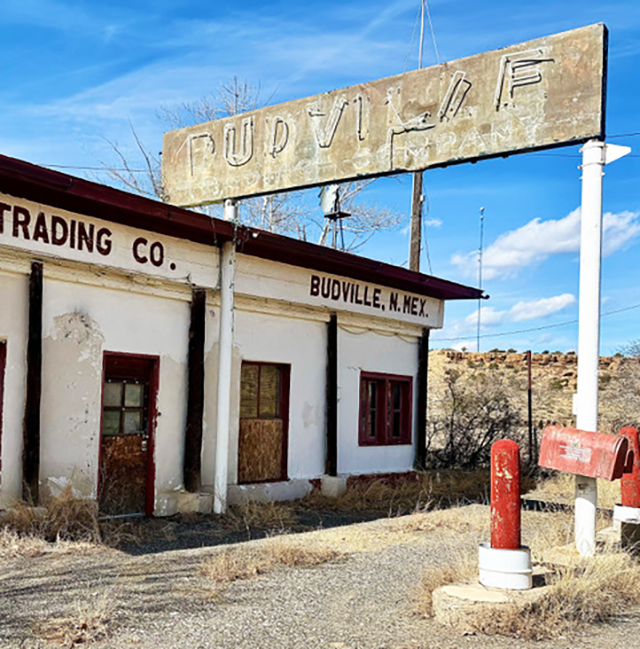 Budville, N.M.: A closer view of the entrance area and signage at the Budville Trading Company in the ghost town of Budville, N.M. Photo by Gary Warren/ladailypost.com
By GARY WARREN
Photographer
Formerly of Los Alamos
New Mexico proudly displays many features and artifacts during the long journey of Route 66 throughout the state. Figuring the mileage varies greatly as there are two routes or alignments that the famed Route 66 took through the state.
The original Route 66 alignment from 1926-1937 is 507 miles from border to border. The post 1937 alignment shortened the route significantly to 399 miles but that explanation remains for another story.
Both of the alignments led travelers through the tiny village of Budville, N.M. Budville is located on Historic Route 66 about 20 miles east of Grants and just off I-40.
The community of Budville would eventually earn the name “Bloodville” as the story of Budville unfolded.
The community of Budville was always tiny but it was a busy and thriving stop along Route 66 for many years. When Route 66 was officially commissioned in 1926, resident Roscoe Rice had the foresight to open a garage/service station to service travelers driving the highway.
Rice had a son, Howard Neal “Bud” Rice, who followed in his father’s footsteps in the 1930s. When Bud took over the operation of the garage, he expanded the service to include a wrecker service. A general store was added to the garage and service station, which also served as a Greyhound bus stop for the area. Bud created multiple businesses under the name of Budville. Bud Rice’s wife, Flossie, now worked along with Bud in the growing business ventures.
Rice’s business empire along Route 66 became quite successful over the years. By the 1950s Bud had become the justice of the peace. He would fine speeders excessive amounts and would charge excessive amounts for his wrecker service and other services. He was close friends with the governor of the state and carried deep political connections.
When the Interstate was being designed, Bud Rice was able to secure an exit on the new I-40 for Budville, which still exists today. Despite the exit being installed, I-40 still hurt the Budville community as businesses began to suffer and the village became more isolated.
Bud was liked by many but was also disliked and not trusted by others. His business practices began to lead to strife and division. The situation came to a head on Nov. 18, 1967.
Bud Rice was pumping gas for a customer who had stepped inside to purchase cigarettes. The customer got in an argument with store associate Blanche Brown. Bud stepped inside to see what was going on and the customer pulled a gun and fired five shots. Three shots hit Bud and two shots hit Blanche Brown. Both were killed. Flossie, Bud’s wife, came in from the back of the store and was forced by the gunman to hand over the cash, which amounted to about $450. She was not killed but she was tied up and her mouth taped shut.
The Rice’s housekeeper was also on the premises and came to Flossie Rice’s rescue and she immediately called police. A massive manhunt got underway. One arrest was made but evidence cleared him of the crime. No one else was found and the case sat unsolved until early 1968 when three felons plea-bargained and named Billy Ray White, a drifter with a criminal record as the killer.
In the meantime, Flossie Rice had remarried to Max Atkinson.
Billy Ray White’s trial took place in 1969 and despite the evidence against him, the jury acquitted him but that freedom did not last long. White was extradited to Louisiana where he was convicted of a similar crime and was sentenced to prison where he died in 1974. Some reports say White admitted to the Budville murders but it’s unknown whether that was the truth.
But that is not the end to the murders in “Bloodville”.
In 1973, Flossie’s second husband, Max Atkinson, was involved in a brawl at the Budville Trading Company and would be killed in the same area of the store as Bud Rice and Blanche Brown were killed just six years earlier.
Following the murder of Max Atkinson, Flossie would continue to operate the Budville Trading Company. She would run the business until I-40 finally killed all of the business in Budville. Flossie continued to live on the premises of the trading company until she died in 1994.
The story of Budville or “Bloodville” leaves many questions unanswered. Was Billy Ray White actually the killer of Bud and Blanche in 1967? Who killed Max Atkinson?
All that remains in the community today is the Budville Trading Company building and the Dixie Bar just down the road from the trading company.
The area still has a few residents but the town or community of Budville now sits silent after a storied past.
Take the Budville exit on I-40 between Laguna and Grants and drive one mile to Budville. It is desolate and Budville is a ghost town but one can only imagine the busy days of Route 66 in the area, but most of all, one can only imagine the bloody murders that gave the town the nickname of “Bloodville”.
Editor’s note: Longtime Los Alamos photographer Gary Warren and his wife Marilyn are traveling around the country, and he shares his photographs, which appear in the “Posts from the Road” series published in the Sunday edition of the Los Alamos Daily Post.
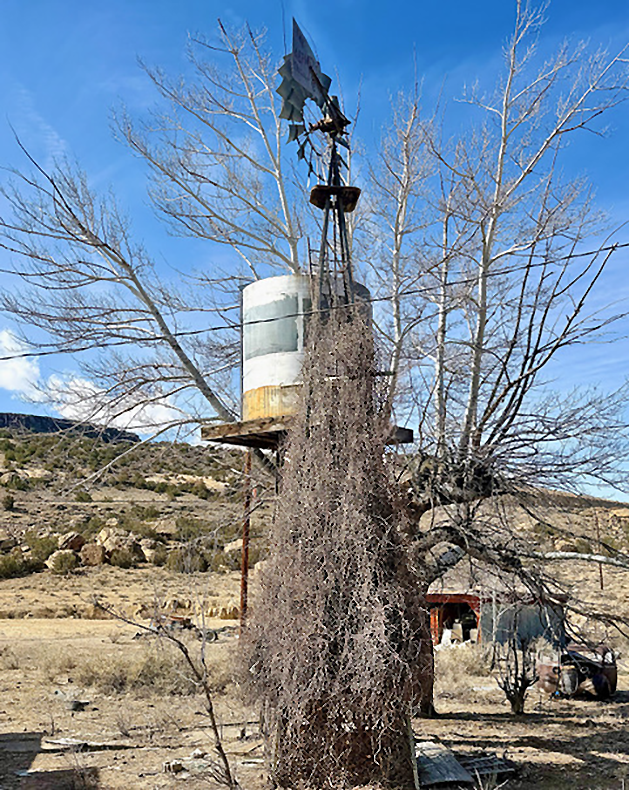 Windmill, Budville, N.M: An old windmill with overgrown vines hanging from the structure sits just a few feet from the building that once housed the Budville Trading Company. Photo by Gary Warren/ladailypost.com
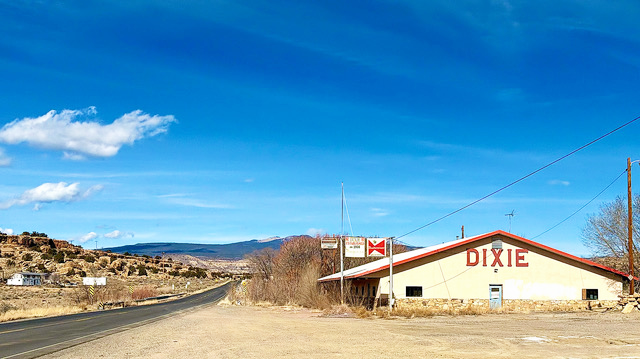 Dixie Bar: The Dixie Bar actually stayed in business until 2019 when the owners of the bar died, and the business was closed. This is a newer and larger building that replaced the original structure at some point. Photo by Gary Warren/ladailypost.com
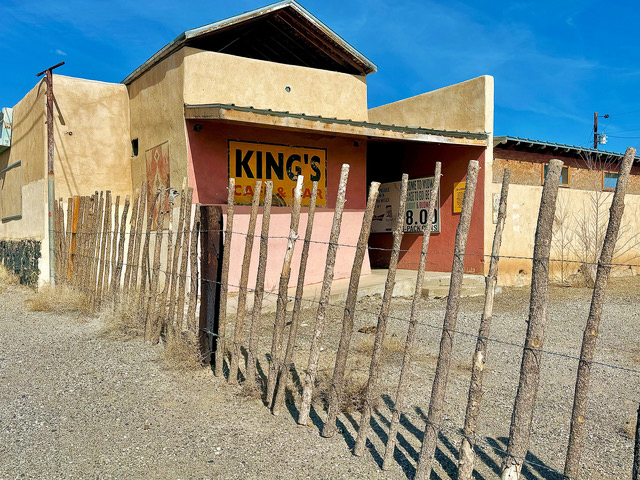 Entrance to the Dixie Bar: I found the entrance to the Dixie Bar and the fence surrounding the former parking area quite interesting. Photo by Gary Warren/ladailypost.com
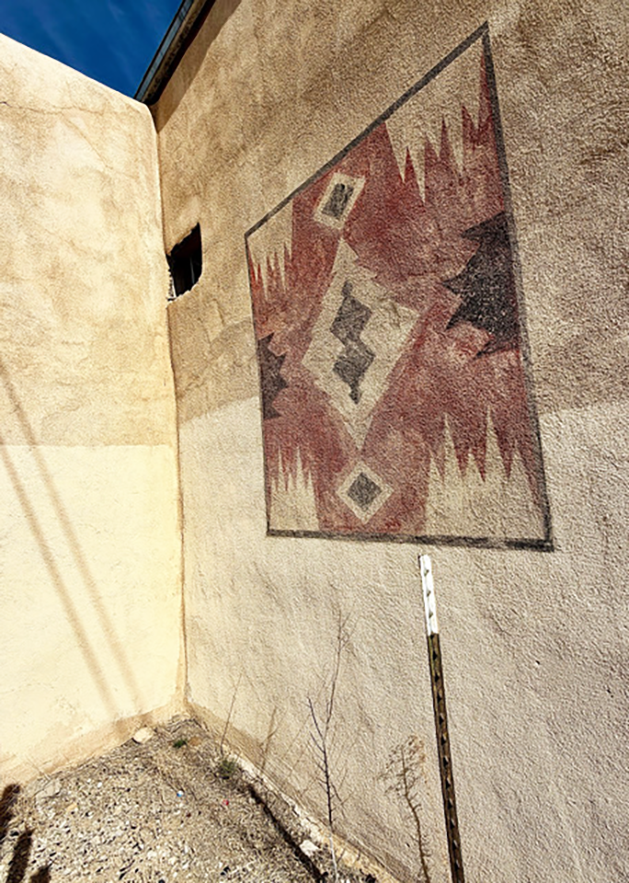 Art, Dixie Bar: This artwork still stands out on the exterior wall of the Dixie Bar in Budville, N.M. The establishment remained open long after Budville became a ghost town, but closed in 2019. Photo by Gary Warren/ladailypost.com