
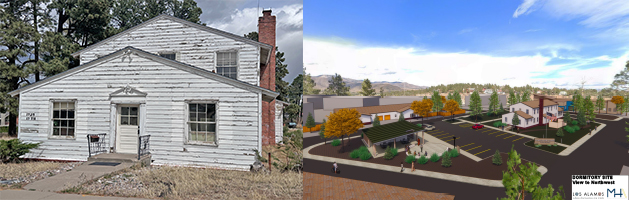
 From left, the Manhattan Project Dormitory as it currently looks versus what Los Alamos County plans to do to the building and the surrounding area. The plan includes relocating the Manhattan Project National Historical Park’s visitor center and offices to the dormitory building as well as renovating one of the dorm rooms to be a one-bedroom suite for park staff. Courtesy/LAC
By KIRSTEN LASKEY
Los Alamos Daily Post
kirsten@ladailypost.com
A 79-year-old building known as the Manhattan Project Dormitory, 1725 17th St., is unique. It is one of the few remaining buildings built during the Manhattan Project, for the Manhattan Project. This makes it not only special to Los Alamos but for New Mexico.
Los Alamos County Deputy Manager Linda Matteson said when staff members from the State Historic Preservation Office toured the building recently, the building’s special quality came to light.
“It wasn’t until the State Historic Preservation Office staff came and toured the building that I kind of realized how unusual the building was,” she said. “They were almost giddy … they just don’t see buildings built in the 1940s that still exist. The quote is ‘this building may be a rare survivor because most military installations have demolished their wood buildings from World War II.’ They just couldn’t believe that it was, first, not demolished, but really untouched …”
The dormitory building feels like a time capsule. It still has the same bathrooms and wood floors that its 1940s inhabitants used and walked on. But other rooms leap ahead a few decades and feature wall decals, rainbow colored shag carpet and other artifacts from the 1970s when the Christian Science Church owned and occupied the building.
Now, the building is entering a new era and new ownership under Los Alamos County. The County plans to renovate the building so that the present can pay tribute to the past.
When the Christian Science Church offered to sell the building to the County, Matteson said officials were interested in the prospect of owning this piece of local history.
“…obviously what interested us most was that … there are lots of buildings in town that were used during the Manhattan Project, but this is one of just a couple that were actually built for the project,” she said. “So, what’s always interested us is obviously to preserve that building, and then secondly, to figure out a reuse of this historic building that would allow us to preserve it. And so, part of the public process included kind of starting with an open, blank slate. People thought, could it be a hostel for hikers, could it go back to a dorm, could it be a museum and finally, could it be a visitor center for the Manhattan Project National Historical Park?”
In July 2022, County Council approved moving forward on a plan that would allow the Manhattan Project National Historical Park to relocate its visitor center from the Community Building and its offices inside Fuller Lodge to the Manhattan Project Dormitory. The agreement between the two parties will be the same as the existing one; the County will provide the space at no cost, but the park will be responsible for operational expenses such as phone lines.
Public Works Department Director Eric Martinez explained this agreement benefits everyone.
“The agreement essentially provides a community and public benefit,” he said.
The project entails, Matteson explained, dedicating the bottom floor of the two-story building to the park’s visitor center and office space. There will also be a conference room and a lift to the second floor.
Project Manager Sobia Sayeda added that while a one-bedroom with an ADA-compliant bathroom and kitchenette is being planned for the second floor for park staff, the remaining rooms will be left as is. However, some paint and patchwork will be done along with repairing doors and windows. A new HVAC system will be installed, too, throughout the whole building.
Outside, Martinez said a separate restroom facility will be constructed.
“The accessory restroom building provides the ability to be in compliance with ADA and have sufficient restrooms for visitors while still allowing us to renovate the building and not destroy the character of the building to fit restrooms,” he said.
Other outside improvements include landscaping, adding a pavilion, installing ADA compliant parking and sidewalks as well as a bus loading area. Overall, Sayeda said, “the building is in fairly good condition, structurally.”
As far as the timeline for the project, Sayeda said construction documents should be completed in the next couple of weeks. Then, the County will go out to bid to hire a contractor. Based on estimates, she said it will take 10-12 months to complete the project, but this will be more definitive once the contract is awarded.
The total project cost estimate is around $6.4 million.
Matteson said relocating the Manhattan Project National Historical Park visitor center and office feels like the best option.
“We think it is a great solution to occupy the building with a great re-use while also providing additional space for that visitor center and improved office facilities and improved visitor facilities for the park.”
She added council seemed to appreciate that “it checked all the boxes. We are utilizing the building in a unique re-use and a re-use that makes sense being that it was from the Manhattan Project and now it will be a Manhattan Project visitor center and then the design really does honor the integrity of the building … it really does honor the dorm and utilizes those features in the visitor center. They (council) saw it as one more way to support the National Park that they have been supporting since the establishment of that park and Valles Caldera.”
The building’s future occupants are also excited about the project, Matteson said.
While park officials have never advocated for anything or directed the County to do anything, “they have been great partners,” she said. “We have basically asked if it was a visitor center, how would you utilize it, what would make sense as far as the main room … their desire is to utilize some of their existing exhibits from the current visitor center and then they’ll just start to add exhibits as they get funding … one idea that has been tossed around is providing some exhibits of the two other parks in the area, so Valles Caldera and Bandelier …”
“They’re excited just because their current space is pretty small and they see the great opportunity for a larger space,” Matteson added. “In addition, there’s some great outdoor spaces around the building that I think they feel like they will really be able to utilize in a time of year that they could do programs outside.”
“They’re super excited to be co-located and they’re super excited at the thought of being in a building that was built for the Manhattan Project, so it just makes a lot of sense,” she said.
The Manhattan Project Dormitory is located next door to residential neighborhoods. Matteson said it was rezoned from residential to institutional.
When asked if there were any concerns about having a visitor center next door to houses, Matteson said, “We did hear a few concerns but in general we were able to remedy some of the concerns. The main one was possible noise from mechanical (units) that will now be relocated exterior to the building. We upgraded those units to be as quiet as possible.”
She also pointed out that the building is vacant and has been vandalized.
“So, our message to the residents is the security and the nature of the whole area will only be improved when we renovate it and occupy that building. And they have been very good about being on board with the project.”
Project Manager Miguel Jimenez added that the renovation plan has been reviewed and approved by the State Historic Preservation Office. He said part of the project’s scope is to have the building be registered as a historic building.
“The building is maintained as its own exhibit, essentially,” Martinez said.
Getting a new location isn’t the only milestone for the Manhattan Project National Historical Park. It will celebrate its 10th anniversary with a community event, 5:30-7 p.m., Wednesday, April 8, in the Pajarito Room at Fuller Lodge. Everyone is welcome to attend.
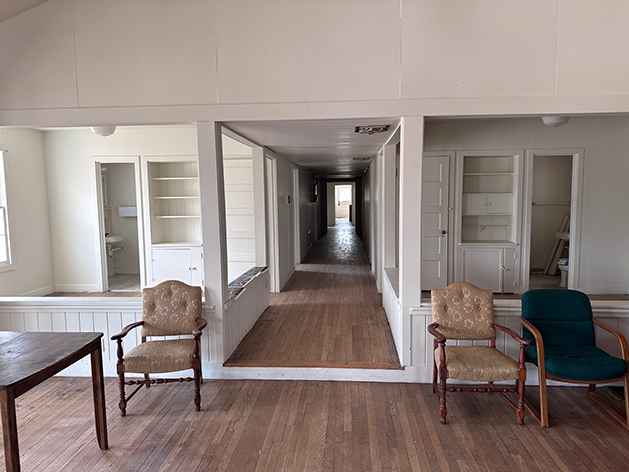 The interior of the Manhattan Project Dormitory. Its most recent owner was the Christian Science Church. Photo by Kirsten Laskey/ladailypost.com
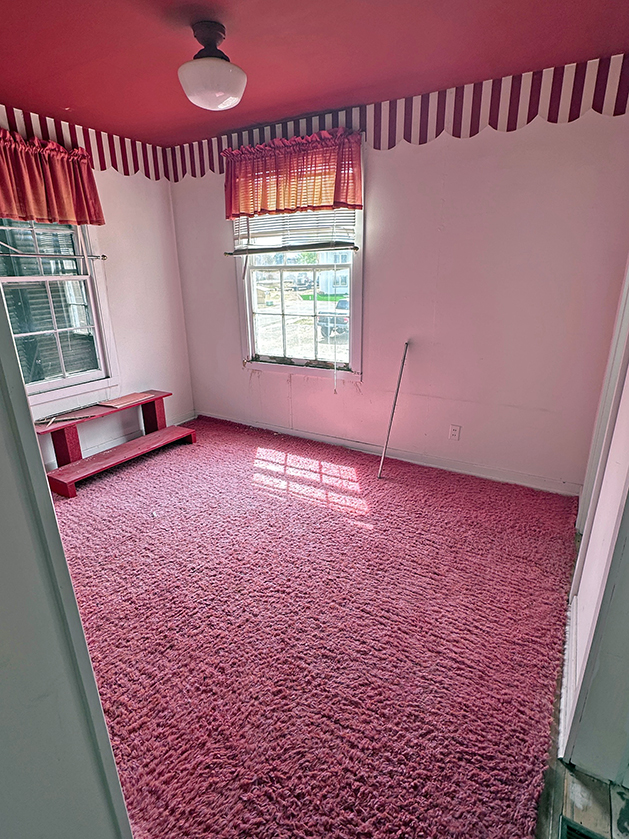 One of the dorm rooms on the second floor of the Manhattan Project Dormitory. Photo by Kirsten Laskey/ladailypost.com
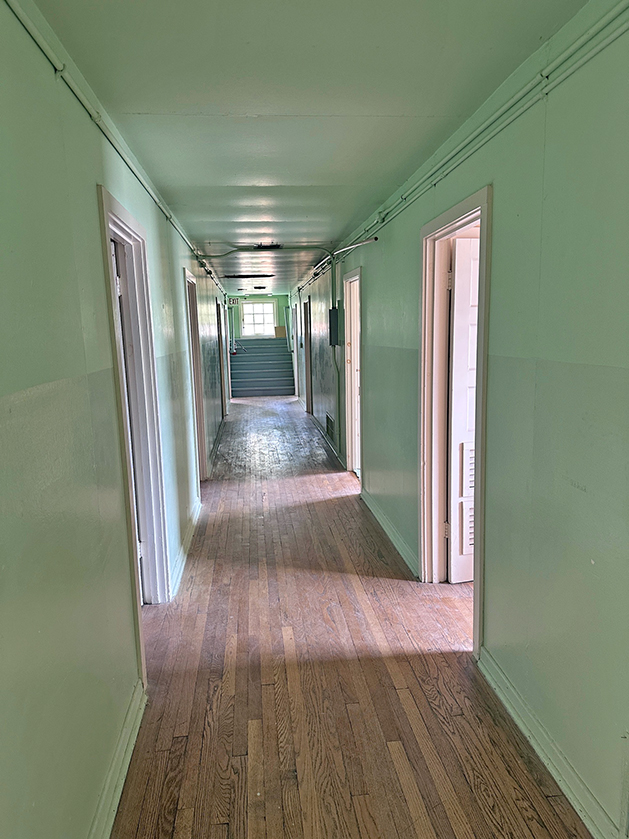 The hallway on the second floor of the Manhattan Project Dormitory. Photo by Kirsten Laskey/ladailypost.com