
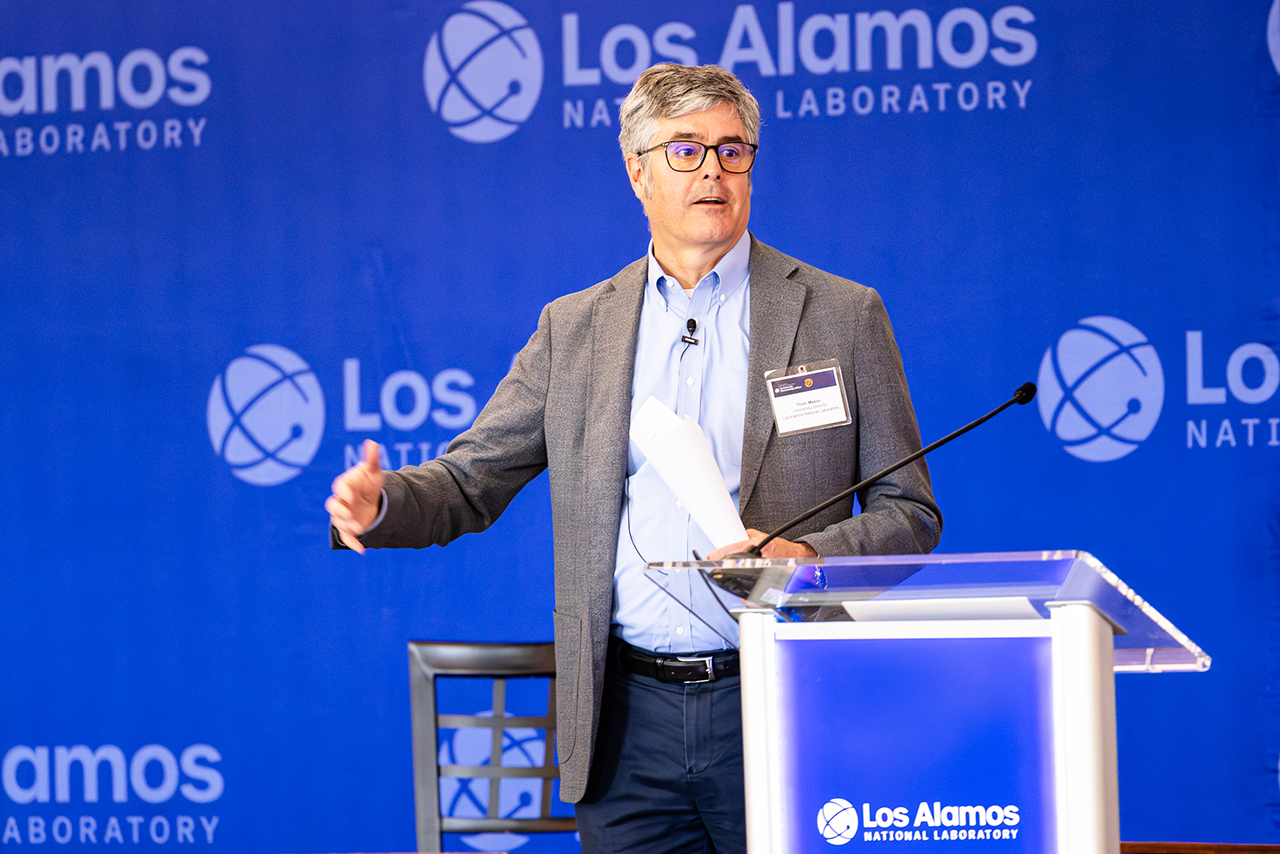
 Los Alamos National Laboratory Director Thom Mason delivering the opening conversation at the REDI Summit, held March 5 at the Cities of Gold Hotel Event Center in Pojoaque. Courtesy/LANL
By MARK MACINNES
Los Alamos Daily Post
Thom Mason, Director of Los Alamos National Laboratory (LANL), delivered the opening conversation at the REDI Summit, held March 5 at the Cities of Gold Hotel Event Center in Pojoaque. The Regional Economic Development Initiative (REDI) brought together leaders from Northern New Mexico—including representatives from businesses and public institutions—to encourage networking, collaboration, and new initiatives. The summit attracted more than 120 participants from across the region.
Dr. Mason began with a brief reflection on the current political environment, noting that despite ongoing disputes, LANL and Northern New Mexico enjoy strong bipartisan support for national security efforts. Over the past six years, the laboratory’s overall funding has doubled, now approximately $5.7 billion. LANL’s workforce, including temporary contractors, has expanded to about 18,000 employees, comparable to the size of the entire New Mexico State Government workforce. Gross receipts taxes LANL paid to New Mexico totaled $142 million last year.
Mason emphasized the laboratory’s significant role as an economic driver in the region. LANL’s expenditure includes $752 million in purchases from NM businesses and $2 billion in total payroll. He observed, “The principal way we support rural communities is through the fact that we hire people and contract with small businesses.”
National priorities and the modernization of nuclear capabilities are fueling this economic support. Specifically, the production of plutonium “pits,” which are essential components of nuclear weapons, has lagged behind the demand for replacement materials. While a new production facility at Savannah River National Laboratory is not expected to begin operations until the next decade, LANL is addressing the gap by shifting to continuous, 24/7 production, even as it refurbishes its current facility. LANL is now actively producing pits for the stockpile modernization mission. As Mason stated, “We’re the only show in town” for this critical national security mission.
To meet staffing needs—estimated at 1000 to 1400 new hires annually- LANL hires 40% of its new employees locally. The laboratory also supports educational pipelines at several New Mexico colleges through targeted training programs in radiological technology, CAD design, machining, and other specialized fields. The LANL Plutonium Workforce Development Initiative spans multiple universities and offers scholarships, internships, and training opportunities to prepare students for these roles. Entrepreneurs can work with or at the lab at no cost for business incubation, paid for by the New Mexico GRT.
Mason also highlighted several scientific initiatives at Los Alamos. The laboratory is expanding the use of high-performance computing and artificial intelligence to accelerate scientific discovery, training neural networks “not to chat in English but to chat in chemistry or physics…” and assisting researchers in generating hypotheses, running simulations, and even automating experiments.
Regional Economic Realities
While funding and the laboratory’s mission appear secure, the Los Alamos and nearby communities face ongoing challenges related to resilience, adequate housing, education, water, power, and their relative isolation. Dr. Mason mentioned the Amodt Water Settlement, which permits the construction of much-needed water infrastructure for the region. Audience questions at the summit centered on the need for improved housing, support for small businesses, and educational programs to support workers on the high Pajarito mountain mesas. These topics were discussed in the REDI Summit, with presentations from RDC leadership, NM United Way (Santa Fe), and various small business owners and home builders. Their perspectives helped ground LANL’s ambitions in the region’s practical economic realities.
Editor’s note: Los Alamos Daily Post reporter Mark MacInnes is a retiree from LANL. He acknowledges the contribution of ChatGPT (5.4 / auto) in the formatting of this article. The talk was transcribed by Otter.ai from the voice recording. The factual statements here were verified against the original recording and web research. Non-transcribed information is from his own reporting.