
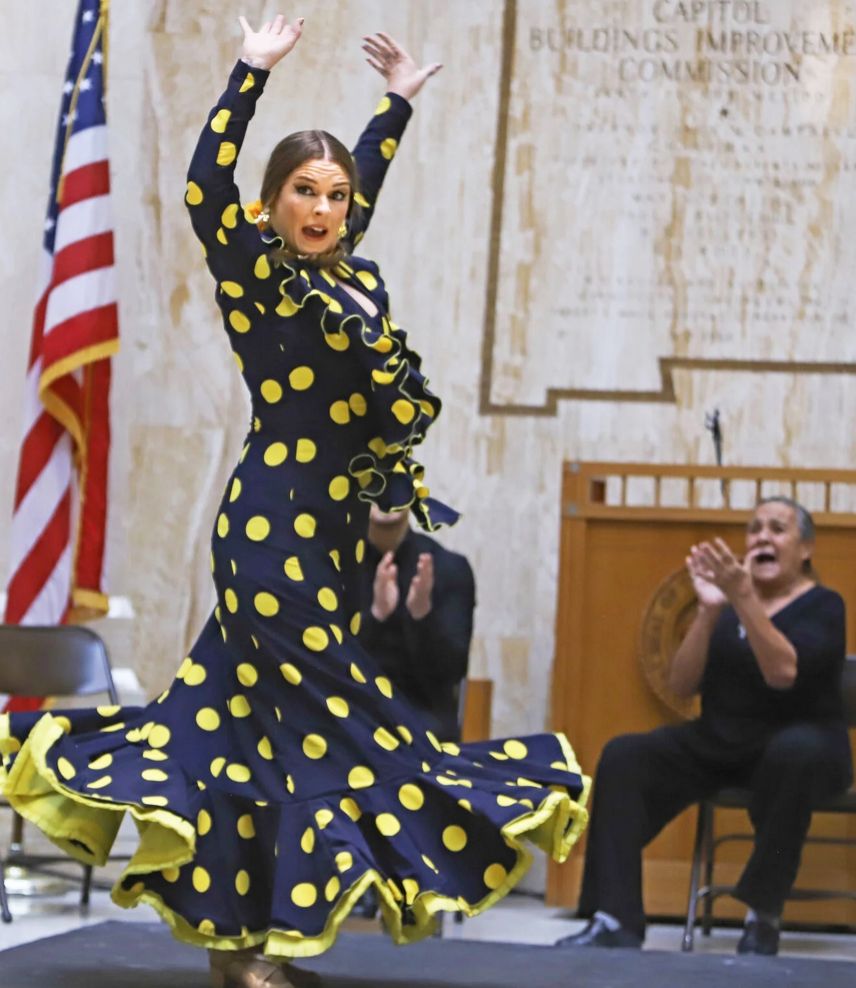
 Flamenco dancer Kayla Lyall performs for an audience in the rotunda of the Roundhouse Monday, Jan. 26, 2026. Photo by Matt Dahlseid/The New Mexican
The Santa Fe New Mexican
Medical school funding: The University of New Mexico School of Medicine is one step closer to a new home.
Lawmakers in the Senate Health and Public Affairs Committee offered initial approval Monday to Senate Bill 6, which would provide nearly $547 million in state funding for the construction of a new medical school building at UNM’s Albuquerque campus.
The new building — which will be located on the corner of Lomas and University boulevards — would replace the medical school’s primary building, Reginald Heber Fitz Hall, which was built in 1967.
The improvement would enable UNM to double its medical school enrollment — expanding class sizes from about 100 to 200 — while opening up more space to train physical therapists, occupational therapists, physician assistants and other health professionals, Dr. Mike Richards, executive vice president of UNM Health Sciences Center and CEO of UNM Health System, told lawmakers.
“This is what we think of as a 10-generation project: This medical school will be here for the next 10 generations. … We believe that this will be a good investment for the state of New Mexico,” Richards said.
Big money for behavioral health: A proposal to set aside $650 million for future behavioral health initiatives advanced through the Senate Health and Public Affairs Committee Monday.
The additional funding comes a year after the Legislature in 2025 passed a series of landmark behavioral health reform bills, aimed at regionalizing the state’s approach to mental health and substance abuse treatment services. One of those measures, Senate Bill 1, established a trust fund to spin off money annually for behavioral health care.
Proponents argued setting aside funding now is a prudent choice, since behavioral health programs are often subject to budget cuts when money gets tight.
“The Legislature and the state have a lot of money, but that’s not always going to be the case. And the wonderful thing about this kind of investment is that it will create a pathway for funding behavioral health services even into the future,” said Jim Jackson, an advocate speaking on behalf of Disability Rights New Mexico.
The state’s budget remains far from final, meaning funding for the behavioral health trust fund is still subject to change.
Health care compacts keep moving: For the House Judiciary Committee, Monday was a “day of compacts,” Rep. Christine Chandler, D-Los Alamos said.
The committee advanced seven health care worker compacts, or agreements between states that ease the process for out-of-state health care workers to get licensed in New Mexico. The seven bills passed will apply to social workers, emergency medical personnel, dentists, dental hygienists, physical and occupational therapists, audiologists and speech-language pathologists and physician assistants.
The committee is expected to take up two more compacts — pertaining to counselors and psychologists — in the coming days.
The committee approved substitutes for six of the compacts. Rep. Liz Thomson, D-Albuquerque, who sponsored five of the six proposed as committee substitutes, said they’d largely been changed to conform to the example set by the compact for out-of-state doctors and become “more palatable” for the Senate — members of which have expressed worries about the feasibility of implementing the compacts.
“It has been New Mexi-fied,” Thomson said of the physician assistants compact.
Read it and don’t weep: For its first vote of this year’s session, the Senate Education Committee gave a unanimous “do-pass” vote Friday on Senate Bill 37, the High Quality Literacy Instruction Act.
Introduced by Senate President Pro Tempore Mimi Stewart, D-Albuquerque, the bill is another step toward fully integrating structured literacy instruction into New Mexican classrooms. The approach, which has been embraced by Gov. Michelle Lujan Grisham’s administration, focuses on sounding out the parts of words, or phonemes, rather than other approaches to teach reading.
The new bill, which proposes no funding appropriation, would mandate literacy instructional materials and teacher preparation programs align with structured literacy, including for bilingual students, to address what Stewart said have been “implementation gaps all over the state” of teachers not adhering to the approach first widely adopted when Stewart’s Senate Bill 398 was signed into law in 2019.
Committee members and those in the audience largely agreed the structured literacy approach should be advanced, save for some concerns about whether there are enough literacy coaches or if they would have to be pulled from classroom teaching positions. The coaches would be required to be deployed to schools in the bottom quartile of reading scores under the bill’s provisions.
Sen. Martin Hickey, D-Albuquerque, expressed his support for the bill’s inclusion of mandatory literacy testing for K-3 students, along with required intervention plans and parental notification for students who fall behind.
Before he was diagnosed with dyslexia between first and second grade, “I thought I was just dumb,” said Hickey, an Albuquerque Democrat and now-retired physician, “and I feel so badly for other kids who are caught in this.”
Broadband bucks: The New Mexico Office of Broadband Access and Expansion is seeking state money to make internet access affordable to low-income households.
Senate Bill 152, sponsored by Sen. Michael Padilla and developed by the state broadband office in consultation with the New Mexico Public Regulation Commission, would provide $10 million to help low-income families afford broadband service.
“This money would be used to provide broadband discounts to thousands of low-income families,” Office of Broadband Access and Expansion Director Jeff Lopez said in a news release. “Connecting New Mexicans is our main mission, but too many New Mexicans cannot afford high-speed internet, and we want to change that.”
Quote of the day: When the first students started attending the University of New Mexico School of Medicine in the 1960s, “In what former building did the Department of Anatomy conduct their dissections for learning about the human body?” Sen. Martin Hickey, D-Albuquerque, asked members of the Senate Health and Public Affairs Committee.
“I wasn’t born,” Sen. George Muñoz, D-Gallup, answered.
The correct answer: Inside a former 7UP bottling plant.