
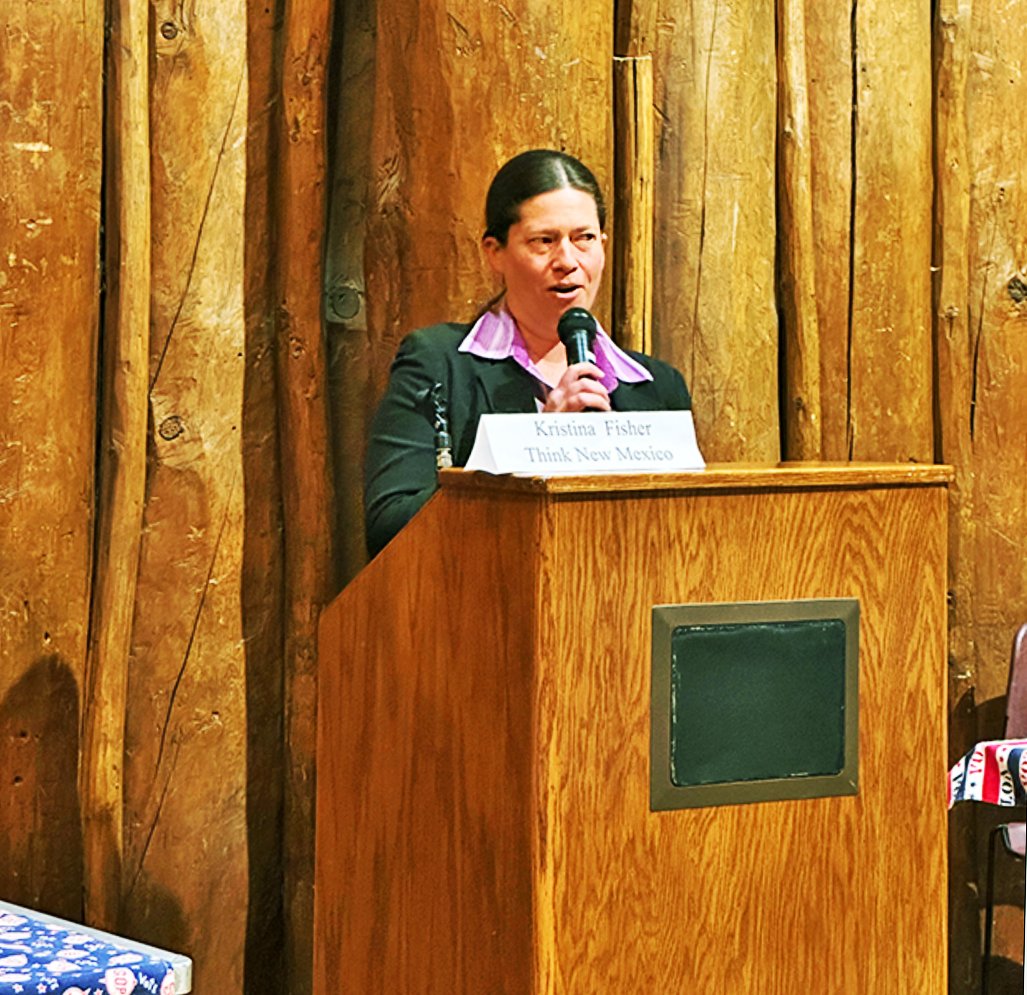
 Associate Director Kristina Fisher of Think New Mexico speaks to the importance of healthcare reform during the legislative preview held Thursday evening at Fuller Lodge. Photo by Kirsten Laskey/ladailypost.com
By KIRSTEN LASKEY
Los Alamos Daily Post
kirsten@ladailypost.com
A lengthy to-do list for improving healthcare in New Mexico emerged during the legislative preview hosted by the League of Women Voters of Los Alamos (LWVLA) and American Association of University Women (AAUW) held Thursday evening in Fuller Lodge.
That list includes increasing the standard of proof in malpractice lawsuits, eliminating Gross Receipts Tax (GRT) on medical expenses, and attracting healthcare professionals to the state.
Associate Director Kristina Fisher of Think New Mexico discussed how her nonprofit organization plans to tackle these tasks during the upcoming legislative session, which begins Jan. 20. Fisher explained that there are five reforms Think New Mexico plans to address during the upcoming 30-day legislative session.
The first addresses medical malpractice lawsuits. Fisher said New Mexico has the highest payouts per capita for medical malpractice lawsuits.
“That’s why insurance costs more here … if the insurance companies are paying out more, you can bet they are going to charge more,” she said.
In looking at New Mexico’s malpractice law compared to other states, Fisher said punitive damages are one of the big outliers. There are no limits, so from the plaintiff’s perspective, they figured they would roll the dice and maybe get a huge verdict, Fisher said.
She added that New Mexico has one of the lowest standards of proof.
“New Mexico is one of only 13 states that require just preponderance of the evidence, so that is sort of 50 percent plus one proof level,” Fisher said. “Somebody described it as you have a five pound weight on either side of a scale and a feather falls on one side and that’s the winning side and so there is a very low standard of proof …”
So, two key pieces are raising the standard of proof and putting a cap on damages, which “will take a lot of pressure off doctors,” she said.
Other reforms include placing restrictions on “venue shopping” or moving cases from a less favorable location to a favorable one and “stacking” or filing multiple lawsuits on a single injury.
Another key issue for the upcoming legislative session is eliminating GRT on healthcare expenses. Fisher explained that for healthcare professionals, trying to figure out what can be taxed and not taxed is complicated. She said there is a five-year pause on taxing co-pays and deductibles, but not for co-insurance. Fisher explained that trying to parse out what is and isn’t taxable can be a nightmare.
During the 2025 legislative session, the House and Senate did pass an omnibus bill that repealed the co-insurance tax, but neither chamber could determine how to pay for it. As a result, it was decided to put it off for a year, but Gov. Michelle Lujan Grisham didn’t like that and vetoed it, Fisher said.
Despite that, the issue hasn’t disappeared.
“There’s a lot of conversation about getting that done this session, so I think there’s a good chance …,” she said.
Another issue is Medicaid reimbursement. Fisher described New Mexico as a positive outlier in its reimbursements. It expanded its reimbursement to as high as 150 percent, but then the federal government passed its budget, which caps reimbursement at 100 percent, she said, as a result the state should find more state resources to invest in Medicaid to fill the gap, “because (Medicaid) is a large portion of our population and it is going to put a lot of fiscal pressure on doctors (who will) not be getting adequate reimbursement on those patients.”
Think New Mexico is working with legislators to create a Medicaid permanent trust fund using oil and gas revenues, Fisher said.
Attracting more healthcare professionals to New Mexico is another important goal. Fisher said Think New Mexico really advocates for more medical licensing compacts, which allows health practitioners to move from state to state included in the compact, without having to apply for a new license. Right now, New Mexico has a compact for nurses.
It is important to form more, Fisher said, because “we are really hurting ourselves by not being in a compact.”
She explained that it makes the state look unfriendly to healthcare professionals and can hinder things like telehealth.
In concluding her presentation, Fisher added that New Mexico needs to make itself competitive in medical student loan repayments. The state only pays up to $75,000 in loans and needs to increase that to be on the same level as other states. She recognized Rep. Christine Chandler, Sen. Leo Jaramillo and Sen. Roberto Gonazles for their efforts to support and push for these reforms.
While there is a lengthy to-do list, Fisher said she feels confident about the upcoming session.
“All of you and your advocacy have been hugely important and powerful and we are making real progress, and I expect to see many of these bills carried by these legislators get done this session… we’ll certainly be there to help,” she said.
Think New Mexico is a nonprofit founded in 1999 to develop and advocate public policy proposals that benefit New Mexicans, Fisher said. Its recent focus is on healthcare. Visit thinknewmexico.org.