
 This image of Pine Lakes Lodge is an example of modeling, texturing, AO/detail maps and collision (Xbox 360, 2007). Environment art by Holly Sheppard

Holly Sheppard, senior world builder at 31st Union. Courtesy photo
By MARLENE WILDEN
Los Alamos Daily Post
marlene@ladailypost.com
When 21-year-old Holly Sheppard began 3D modeling a simple office chair, she didn’t know she was helping lay the groundwork for a new kind of world building, one that could someday help train international nuclear inspectors.
Sheppard, now a senior world builder at 31st Union, was a University of Advancing Technology student working a paid summer internship at LANL.
That chair and the office it belonged to were among the first digital assets created for Los Alamos National Laboratory’s VISIT Project, a proof of concept under the N-4 Safeguards and Security Systems Group, which later folded into the Nuclear Engineering and Nonproliferation Division.
The experiment sought to determine whether physical spaces could be modeled, mapped and rendered for security and safety instruction.
For Sheppard, it was a dream assignment. She had just learned terrain sculpting and suddenly found herself recreating one of the most secretive scientific campuses in the world.
At the time, the project’s goals were exploratory. Could digital twins be built with enough accuracy to substitute for on-site access, especially in locations where clearance or safety restrictions made entry difficult?
Today, the answer is yes. Diplomatic bodies such as the International Atomic Energy Agency (IAEA) use them to prepare teams for field inspections in secure or hazardous facilities.
In 2004, however, Sheppard and her fellow interns were only beginning to test the possibilities.
“We were figuring it out as we went,” she said. “It was so early that our manager didn’t even speak the same technical language as us. We were just trying to prove it could be done.”
Those early experiments—assembling office furniture, lighting corridors and testing first-person walkthroughs—laid the foundation for future developments.
Training for a New Kind of Inspection

Jessica Bufford, nuclear policy expert. Courtesy photo
According to Jessica Bufford, a former IAEA officer whose career has focused on facilitating the secure and safeguarded use of nuclear technology, graphic artistry is vital for the precision of national security.
“Virtual environments like the one Sheppard helped prototype lower the mental load,” Bufford said. “When you’re entering a new facility, especially one you’ve never seen before, you’re constantly scanning for what’s normal and what’s not. A virtual walkthrough lets inspectors build familiarity in advance so they can focus on what matters once they’re on site.”
Bufford said immersive simulations also help safety engineers rehearse their work.
“It’s not just about training IAEA staff,” she said. “These environments help governments understand what effective access controls or secure facility layouts look like. They make the abstract tangible.”
Though she describes the IAEA as “conservative and slow to change,” Bufford said digital tools are transformative.
“We used to rely on static blueprints and lecture-based instruction,” she said. “Now, when someone can walk through a simulated research reactor built in popular game engines such as Unreal or Unity, the learning sticks. It sharpens the policy conversation, too, because people can see the consequences of design and procedural choices before they happen.”
She added that collaborations between scientists and digital artists have unexpected benefits.
“When you bring in creative support, you’re forced to explain technical measures in plain language,” Bufford said. “That process, translating the science into visuals, helps us see blind spots we might have missed otherwise.”
Digital Tools for a Nuclear Future
Bufford said the timing for this kind of innovation couldn’t be more critical. Around the world, governments are reexamining nuclear energy as part of the clean energy transition, with new reactor designs and technologies emerging faster than international regulations can adapt.
“The IAEA’s workload has increased dramatically, but the agency’s budget hasn’t kept pace. That means we need smarter, more cost-effective ways to prepare regulators and inspectors—and immersive learning environments are one of the best resources we have,” Bufford said.
These same modeling tools help anticipate risks. This is especially true for micro-reactors, sometimes called “paper reactors,” a term that signifies early conceptual designs.
“Simulated environments allow us to test those designs before they’re ever built,” Bufford said. “We can model where access points could pose challenges and how safety systems interact. That helps determine operational hurdles an inspection could face long before fuel arrives.”
That early engagement is vital as more private companies seek to export advanced reactor technologies.
“Developers sometimes think, ‘We’ll build it first and figure out the safeguards later,’ but that’s the wrong approach. Modeling lets us integrate safety and verification from day one,” Bufford said.
She emphasized that while artificial intelligence and remote sensing are supplementing the IAEA’s monitoring work, the human element remains essential.
“AI can flag patterns,” she said, “but only a trained inspector can interpret the political and technical nuance behind what they see. Digital environments strengthen that human expertise—they don’t replace it.”
Building Skills That Matter
For students who love video games, Sheppard, a seasoned environment artist, offers practical advice. She stresses that game design is a viable career path and involves much more than the finished product players see.
Project teams involve hundreds of people across art, coding, storyboard and sound, which provides many avenues to explore. “I’m an artist first and foremost, and a designer,” she said.
What stood out to Sheppard about the VISIT project wasn’t the modeling but the problem-solving, collaboration and self-discovery it inspired.
“I realized I enjoy building the world the characters live in. It’s way cooler; there’s a lot more to do there. It feels more epic than one single person or monster,” she said.
As the work Sheppard started two decades ago currently informs global practice, Bufford reflects on the unexpected ways ingenuity can shape international efforts.
Bufford said, “Mastering these tools positions the next generation to contribute in ways that weren’t possible a mere five years ago.”
“Don’t think about where you can make the most money—think where you can make the most impact,” she said.
From Classroom to the World
Back in Los Alamos, those same skills are being cultivated in classrooms where students learn the fundamentals.
At the high school, computer science teacher Allan Didier leads the game design pathway, guiding students through courses in programming, 3D modeling and animation. A biomedical engineer by training, he sees game design as a practical entry point to understanding the digital systems that underpin modern life.
Each semester, Didier teaches about 120 students. Many enroll out of curiosity, he said, while about 10 percent arrive focused on gaming careers.
“A lot of students take my class as a one-off because they know technology is essential,” Didier said. “They’ll tell me, ‘I’m going into science, but I know I’m going to have to compute.’”
By senior year, nearly a quarter of his students have taken multiple classes and are considering the field more seriously.
He tells them that everyday tools, like modern vehicles, mirror the logic of virtual environments.
“So many cars are computerized now—your steering wheel, your gas, your brake,” Didier said. “When you’re pushing down on a pedal, a computer decides how much to apply to the brakes. There’s no direct control anymore. It’s a computer game.”
Didier believes a solid grasp of the technology’s workings is essential.
“Understanding how these systems function opens doors in any field, but you also need to recognize the ethical choices and boundaries they demand,” Didier said.
Sheppard’s journey shows students what is possible: Local creativity can ripple outward and even shape global security.
“There’s so much to game design,” Didier said. “I’m the smorgasbord kind of teacher. My job is to help students find where that path begins. In education, we’re supposed to focus on pathways, and I’ve got them.”
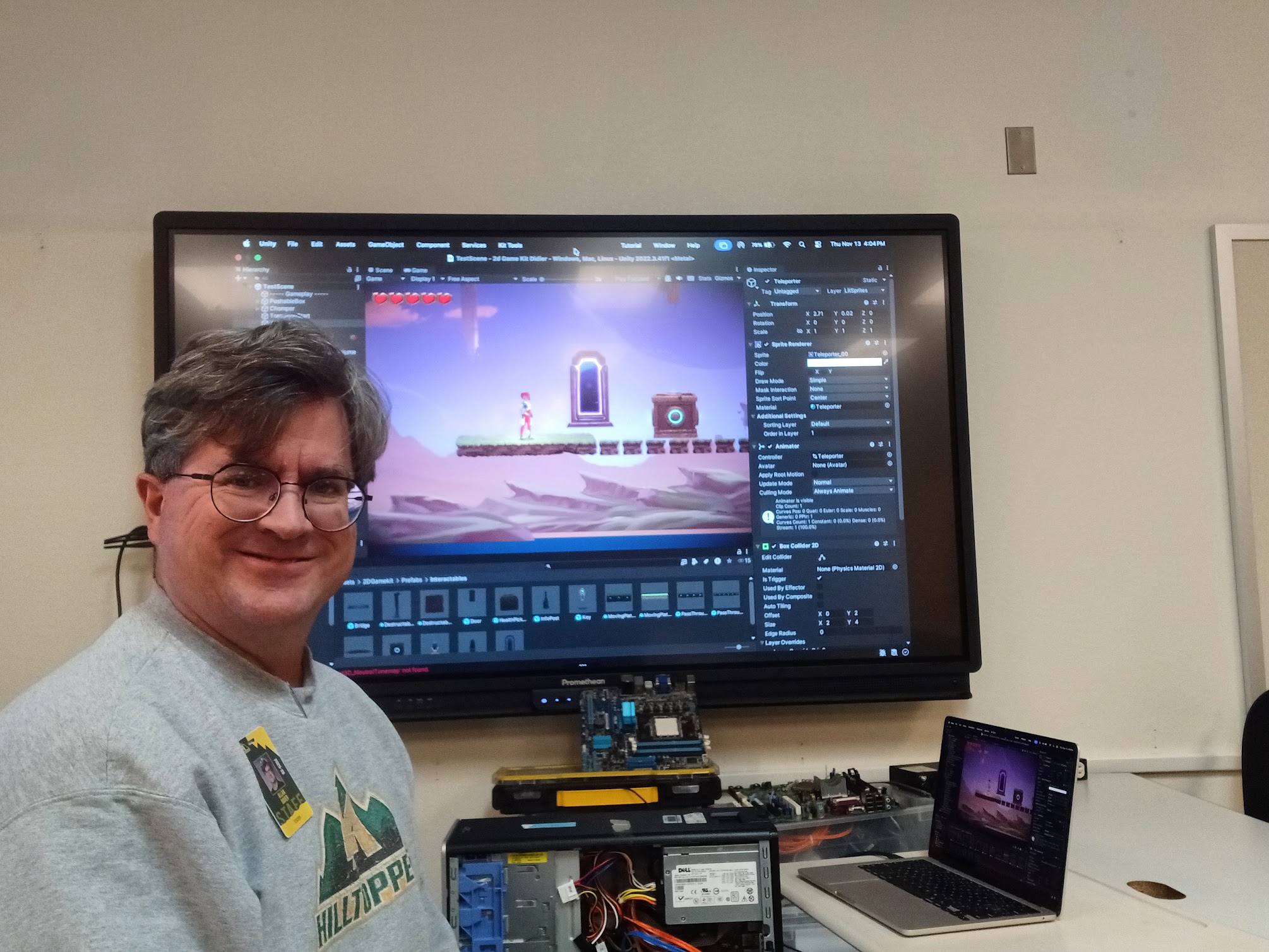 Allan Didier, LAHS computer science teacher. Courtesy photo