
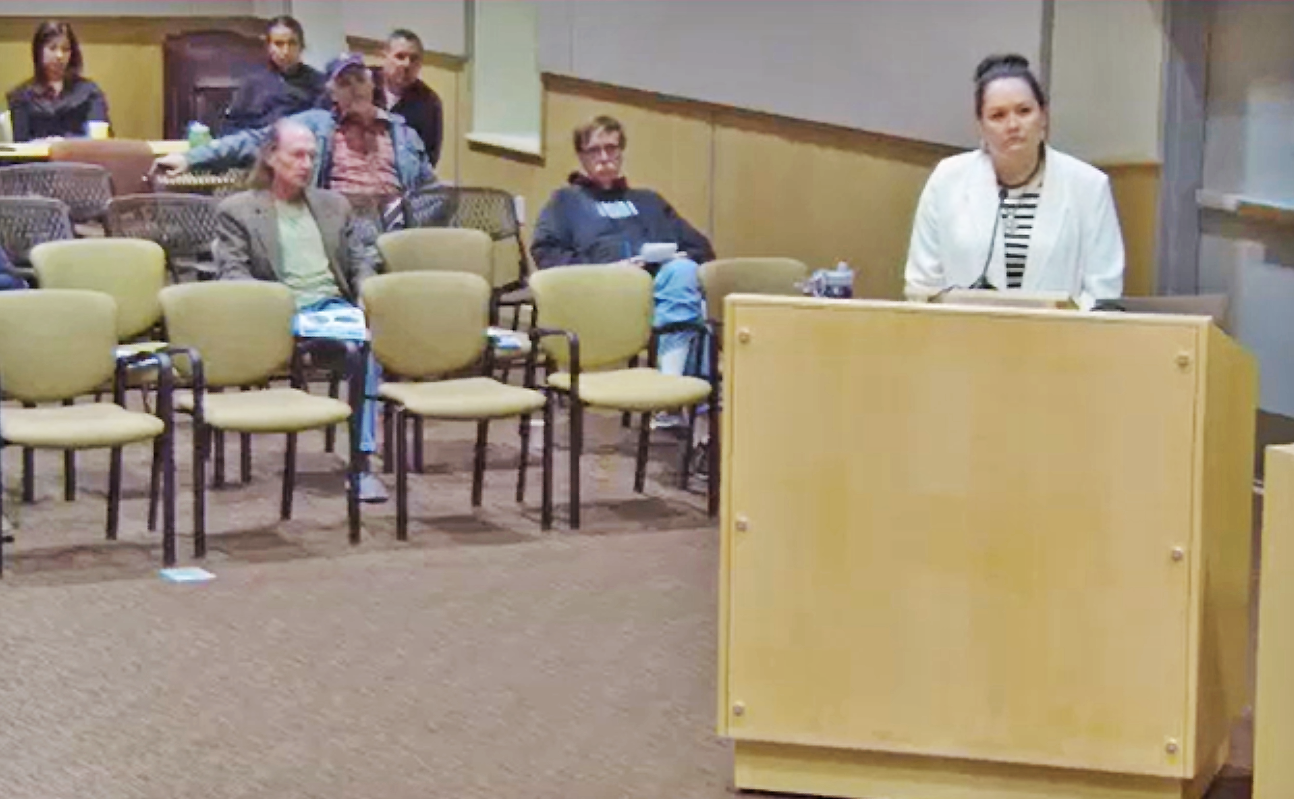
 Los Alamos County Administrative Services Director Helen Perraglio discusses increasing the County’s Gross Receipt Tax during Tuesday’s Council meeting. Courtesy/LAC
By KIRSTEN LASKEY
Los Alamos Daily Post
kirsten@ladailypost.com
It was time for a reality check, Los Alamos County Council learned during its regular meeting Tuesday night. Either the County’s Gross Receipt Tax (GRT) increases or significant reductions to the budget will be needed.
Ultimately, council approved 6-1 with Councilor David Reagor opposed to pass two ordinances to increase the Los Alamos’ GRT a total of 0.625 percent.
The increase is in response to a reduction in GRT the County is receiving due to Los Alamos National Laboratory, the highest contributor to the County’s GRT, taking advantage of the state’s GRT exemption for manufacturing.
Without the increase, Administrative Services Director Helen Perraglio said, the County would have an unsustainable deficit and cuts to operations, services and programs would be necessary for Council to prioritize and make decisions on.
“I just want to give us a reality check on our fiscal position and the fact that GRT makes up 72 percent of our general fund revenue and property taxes make up about 8 percent,” she said. “… we presented at the Sept. 30 meeting [in] that we realized our GRT revenue projections were much lower than we thought they would be and $13 million is where they came in below the adopted budget. Further declines are expected in FY 26 so the adopted budget that you adopted for FY 26, [or] $87 million (in GRT revenue) is projecting about $80 million (in GRT revenue). So, that’s another $7 million decline in FY 26. Without action, we will see unsustainable deficits of roughly $16 million to $20 million beginning in FY 27 and in that long range 10-year financial projection.”
Perraglio added that initially a minimum of a half cent increase was discussed to have sustainability and has been planned for during recent budget hearings. It is no longer proposed because it wouldn’t bridge the gap or meet the basic sustainability over 10 years.
So, higher increments were discussed “that provided council flexibility to consider growth, affordable housing options and more growth in capital investments,” she said.
Perraglio reminded council that without the increment, immediate budget cuts would be required, essential services would be jeopardized along with capital projects. During the Sept. 30 meeting, Council directed staff to come back with 5/8 percent increment, which would go into effect July 1, 2026. A quick decision is needed because developing the next fiscal year budget starts in November. Perraglio added that proper notification also needs to be given to the state Taxation and Revenue Department.
Even with the increase, she said that the County’s GRT is below its neighbors including Taos, Espanola and Santa Fe.
“It does maintain a competitive advantage for residents and businesses when compared to our neighbors,” Perraglio said.
The higher GRT also contributes to the County’s regional partnerships that are part of the County’s strategic priorities and its budget.
“Adopting that increment ensures that ability to provide that regional partnership support,” she said. “You adopted a budget that has $2.5 million in recurring support for regional neighbors, without that increment that would be in jeopardy.”
A lot of things would be in jeopardy, Perraglio said.
“GRT funds all of our general fund operations,” she said, including public safety, community services, administrative services, all programs and elected offices. Additionally, it funds grants to public schools and the University of New Mexico-Los Alamos, affordable housing, economic development, contracts with social services and nonprofits and healthcare assistances. GRT also subsidizes public transit, funds roads and capital projects.
“GRT is the backbone of what funds everything we do essentially,” Perraglio said.
She further noted that the County has planned investments of up to $75 million and this increment in the GRT will help with debt service and long-range financial planning. This includes the $40 million debt for the broadband project and $35 million for other projects. Without the increment, critical infrastructure projects would need to be cancelled, stalled or re-prioritized. Public safety would be impacted, too. Other decisions would need to be made such as what free services would need to generate revenue.
Perraglio did touch on the Laboratory’s concerns about the increase. In a column published in the Los Alamos Daily Post Oct. 23, Director Thom Mason wrote that the laboratory’s budget is stabilizing, and the additional cost was unanticipated. The projected increase to the laboratory is $13.5 million a year or $135 million over 10 years. He added that the increase would negatively impact the laboratory’s future hiring and programmatic activity.
“We’ve heard LANL’s concerns and we value their role in our economy and our partnership and the economic impact – we are economic partners in this … this shortfall is a structural decline in gross receipts and that is primarily from LANL itself,” Perraglio said.
She added that the County plans its budget carefully and transparently and noted that LANL employees benefit from County’s services and infrastructure. Perraglio further noted that LANL has been aware of this issue for the past three years.
The Los Alamos Daily Post reached out to laboratory public affairs for comment on the council’s approval of the GRT increase but the laboratory declined to comment, referring instead to Mason’s letter.
Mason was not alone in his concerns. Reagor cast the opposing vote, saying he felt the tax increase from the laboratory had been a windfall and shouldn’t have been used in the operating budget but rather for one-time uses. He added that he didn’t believe in the dire predictions for the County’s financial future if the increase wasn’t approved. Reagor also pointed out that the future isn’t known; more cuts to the laboratory’s budget could be made.
While the laboratory will experience the biggest impact of the new GRT, it is not the sole recipient.
Councilor Ryn Herrmann asked, “This just doesn’t impact the lab, it impacts all of the small businesses in town, and it is a tough sell … how do you see that impacting small businesses?”
Perraglio said technically, small businesses are responsible for the tax but usually it is passed on to the consumer. She provided an example: if a $1,000 purchase is made today, the tax would be $70.63. The new rate would make the tax $76.88.
“It is an impact, there’s no question about that, there is an impact,” Perraglio said. “It may also impact the pricing … so really the impact … is on the consumer.”
However, she noted this impact is spread out to all consumers.
The public weighed in on the issue.
Resident Rick Nebel expressed his opposition to the proposed increase.
“GRT is a regressive tax … it is inequitable and I think you people on council, particularly you Liberal Democrats, need to explain to your constituents why it is that you are trying to raise a regressive tax … not only it is a regressive tax, but it is a stupid tax,” he said.
Nebel explained how this might affect local businesses. A business might get a proposal for work and would need to calculate the tax for that work. Other companies in other states do not need to do that.
“What we are doing with this tax is we are shooting ourselves in the foot,” he said.
Not everyone thought that way. Speaking as a private citizen, MainStreet Los Alamos and Creative District Executive Director Jacquelyn Connolly said she has attended many council meetings and it has become clear that, “It is not only imperative that we pass and approve this GRT increase but that it is long overdue. We already have the lowest tax rate in the state, this increase will still keep us very competitive with our neighbors and I believe the leakage we experience from retail goods and dining out is due to lack of availability and concentration and increasing the GRT will have little to no impact on current expenditures because the regional locations that they are going to be moving to would still be higher than us. We can also not risk losing the resources that are needed to keep our community members who don’t have affordable housing, affordable options for childcare and community services, let alone broadband and investment into our local entrepreneurial ecosystem….”
Several councilors agreed.
Councilor Beverly Neal-Clinton seconded the motion to approve the GRT increase.
In supporting the motion, she said she was thinking about “What’s free in Los Alamos – we have free transportation … we have free museums, nature centers, parks, trails, community programs … we have a lot. We also help our neighbors who in turn help us … when I look at the numbers, our finance folks work extremely hard … and that we are able to project our budget 10 years in advance and we are not in debt … I would like to think that would be applauded and saluted and not looked down upon …”