
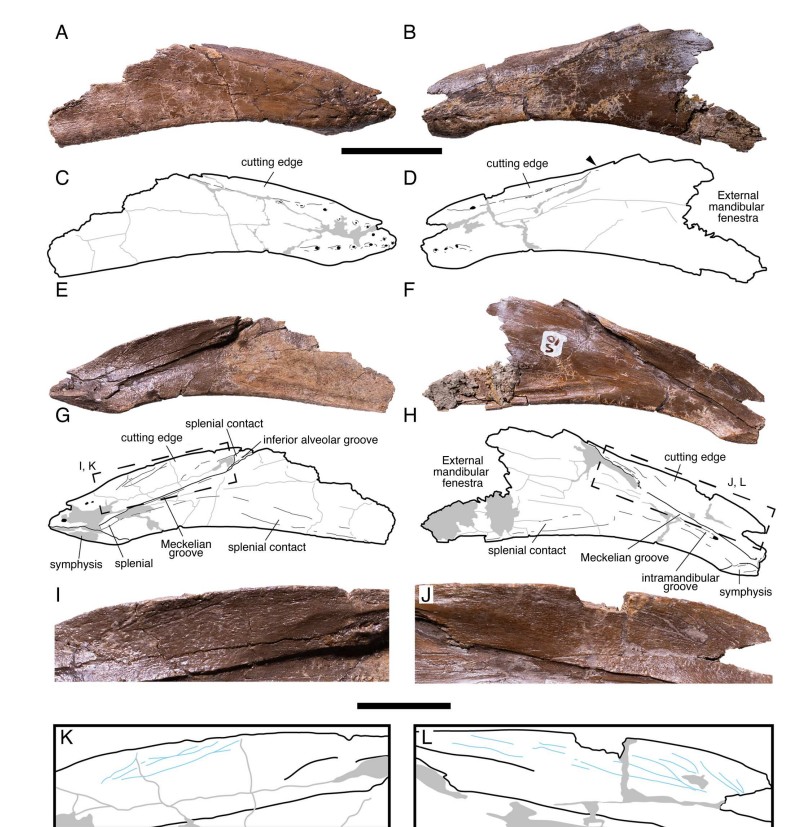
 Left and right dentaries of the Montana ornithomimosaur. This figure appeared in the Journal of Vertebrate Paleontology in Sept. 2025. Courtesy/NMMNHS
NMMNHS News:
ALBUQUERQUE — A team of researchers that included the Executive Director of the New Mexico Museum of Natural History & Science recently identified jawbones from a species of ostrich-like dinosaur in Montana.
This discovery, published in the Journal of Vertebrate Paleontology earlier this month, expands the known range of this family of theropod dinosaurs, and helps researchers better understand how these dinosaurs spread across North America, including potentially to what’s now New Mexico. New Mexico Museum of Natural History & Science Executive Director Dr. Anthony Fiorillo was a co-author on the paper, alongside authors Tsogtbaatar Chinzorig, Ryuji Takasaki, Kentaro Chiba, Yoshitsugu Kobayashi, Mototaka Saneyoshi and Shinobu Ishigaki.
“Discoveries like this not only help us understand how these dinosaurs lived and dispersed across what’s now North America, but they also remind us how much we still have to learn about these ancient animals,” Dr. Fiorillo said. “Even in some of the most well-studied rocks in North America, there are still new discoveries to be made.”
The paper describes a potential deinocheirid ornithomimosaur – a group of large-bodied and stocky, omnivorous or herbivorous theropod dinosaurs known for their resemblance to modern ostriches – from a pair of jawbones found in the Judith River Formation. This formation is one of the most well-researched rock units in North America, producing the first dinosaur discoveries dating back to the mid-19th century.
The bones described in the study are the left and right jawbones from a single dinosaur, each of which is just under seven inches long. The size of these jawbones suggests that the dinosaur’s skull would have been just under a foot in length. While the newly discovered bones are fragmentary, making it difficult to identify the dinosaur as a new species, they show distinct morphological features and may eventually prove to belong to a new species of ornithomimosaur.
The fossil record for this group of ostrich-like dinosaurs is well-documented from the Upper Cretaceous deposits of Asia and North America, with fossils spanning the Gobi Desert of Mongolia and northern China to what’s now Mexico. However, the genus of large-bodied, stocky ornithomimosaurs known as deinocheirids is much rarer, particularly in North America. These new fossils significantly expand the biogeographic range of this group, indicating a hidden dinosaur diversity yet to be uncovered and helping researchers better understand how these unusual dinosaurs spread across North America to Mexico. Dr. Fiorillo noted that there may indeed be fossils of deinocheirids in New Mexico, just waiting to be uncovered.
About the New Mexico Museum of Natural History and Science
The New Mexico Museum of Natural History and Science is a division of the Department of Cultural Affairs, under the leadership of the Board of Trustees of the New Mexico Museum of Natural History & Science. Programs and exhibits are generously supported by the New Mexico Museum of Natural History Foundation, through the generous support of donors. Established in 1986, the mission of the New Mexico Museum of Natural History & Science is to preserve and interpret the distinctive natural and scientific heritage of our state through extraordinary collections, research, exhibits, and programs designed to ignite a passion for lifelong learning. The NMMNHS offers exhibitions, programs, and workshops in Geoscience, including Paleontology and Mineralogy, Bioscience, and Space Science. It is the Southwest’s largest repository for fossils and includes a Planetarium and a large format 3D DynaTheater. The Museum is closed temporarily for renovations.